
Voltmeter for monitoring shore power - advice please

tudorsailor

Well-Known Member
Joined
12 Jun 2005
Messages
2,756
Location
London
zebahdy.blogspot.co.uk
On talking to another owner, I learned that it is good to know the voltage of the shore power supply, since a low voltage can damage the battery charger. However my boat is only fitted with an ammeter for shore power and not a voltmeter
Can someone advise whether I should just get another analogue meter for volts, or can I get a digital display of both volts and amps that might fit in the space where the current ammeter it located? My present display is 72mm x 72mm
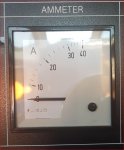
Ammeter.JPG

Thanks

TudorSailor
 
I really don't think that the shorepower voltage is anything most people ever give a thought to. Surely there are more important things to worry about? In any case, most chargers will happily work on a wide range of voltages. The Sterling Pro Ultra, one of the most common chargers, works on 80-270V. The Victron Blue Smart charger I fitted recently works on 180-265V.
 
It looks like the metering is on the battery 12V not the mains 240v as its not normal to measure incoming current and I would not expect up to 40A incoming mains as that's enough to drive electric showers, cookers and the like and wont be carried by 13A mains lead to shore. .

A low battery voltage can make the charger work harder, but that's what is for. If the battery is so defective due to internal shorting out of cells then the charger might well overheat, but it should have a cut-out for that. Measuring battery voltage is however useful but simple low/medium/high display will suffice for most purposes. Normally only time 12v system current is measured is as input from solar or wind turbine charging. Otherwise its not very useful piece of info

I suspect that either the OP has misheard or the "Other Owner" was talking out of their bottom
 
It looks like the metering is on the battery 12V not the mains 240v as its not normal to measure incoming current and I would not expect up to 40A incoming mains as that's enough to drive electric showers, cookers and the like and wont be carried by 13A mains lead to shore. .

Not necessarily, back in 1990 we were supplying Sealine with panels that had a digital AC voltmeter and two 32 amp bar-graphs for current, input 1 and input 2, may be DC, but do not assume it is.

Brian
 
It looks like the metering is on the battery 12V not the mains 240v as its not normal to measure incoming current and I would not expect up to 40A incoming mains as that's enough to drive electric showers, cookers and the like and wont be carried by 13A mains lead to shore. .

No, it's an AC ammeter; it has an alternating current symbol on it.
 
Partley to produce a standard panel that covered the boats going to the USA, though they could have a heavy AC load, from memory they had 12 AC circuit breakers.
Brian


fair enough but the OP is never going to get a combined AC 240 system ammeter and 12v DC system voltmeter and it would not be useful anyway.

The battery charger may not work if its a simple one and incoming "240V" is too low but no harm will be done to it and battery so no point in monitory incoming mains in this domestic situation.
Battery voltage monitor of 12V is however useful as general health check when battery not on-charge
 
I've got one of those plug-in energy monitors, as well as watts etc, it will read the AC voltage.
I suppose it would give some indication of how dodgy the marina was, and assure me that I wasn't abusing appliances with too high or low a voltage. And warn that it was connected!
If you have a generator, a voltmeter will warn of doom before things go bang, if you're lucky?
 
fair enough but the OP is never going to get a combined AC 240 system ammeter and 12v DC system voltmeter and it would not be useful anyway.

The battery charger may not work if its a simple one and incoming "240V" is too low but no harm will be done to it and battery so no point in monitory incoming mains in this domestic situation.
Battery voltage monitor of 12V is however useful as general health check when battery not on-charge

Back in the 80's & 90's when I building mains chargers shore voltage was a problem, we were making transformer based units then and voltage drop in mains reduced output voltage. But with the introduction of switch mode technology, mains volt drop was a problem as they could be designed to run on a large voltage spread. I suspect the chap from referring to the transformer based chargers.

Brian
 
Thanks everyone
Firstly I was not asking about getting an AC ammeter and a DC voltmeter. I wondered about AC ammeter and AC voltmeter

The guy with whom I was discussing this has the same model yacht as I have but built a few years later. He and another owner that I know have a AC voltmeter that was factory fitted as standard

I have a MAstervolt 24/75 charger. The specs state that it works with input voltage of 230v -10% to +15%. It does not say what happens if the incoming AC voltage is less that 207v AC. I will ask Mastervolt!

Thanks for all the input

TudorSailor
 
I dont know if the OPs charger is old style, but did earlier state that volt drop only such an issue for simpler ie older chargers. Wont damage batteries or charger, just wont charge

Depends on type to a degree, a lot regulated at 13.6 volt, reduction in input voltage lowers the output curve. This may give a low voltage which if run for long periods will kill the battery, or reduce output amps which can greatly extend the charge time. On the other hand I built multistage chargers, upto 14.4 volt at a constant current, so were less affected. back in the 80's I've seen 180 volt at the end of a pontoon, marina wiring was not what you see to-day.

Brian
 
As the battery charging state is the only matter of actual concern there seems no point in monitoring ac input. I fully agree that defective charging will leave battery vulnerable to flattening, though usually dimming of lights and non-operation of certain electronics or eberspakers will give strong hint

Battery should be about 12.5 not under charge and up to 14v under charge from engine or battery charger. If it drops below 12v not under charge its going flat. If it drops below say 13v under charge then charger not working correctly/supplied with reduced voltage ac shore supply, or if charging from engine its at very low revs.

On big power installations (650V and 10 miles long in my world) we monitor ac volts and amps to enable us to detect and locate faults miles down the line, but that's less useful here as its a two point link maybe only 50m long. If its not charging then either charger is dead or shore supply disconnected or deficient. I have never met deficient supply in UK marina, but then I am in happy position of rarely using them as motoring a few miles to get open sea charges it all up nicely. Maybe deficient shore supplies are more common abroad. I have however heard of corroded plugs on shore cable that give high resistance thus limiting current such that nothing works under load
 
My boat has a mains voltmeter as part of its original Jeanneau electrical instrumentation. In Turkey I often see it registering only about 200 volts, and sometimes down to about 180, but everything seems to work OK despite low voltage supply, so maybe its not something to be concerned about.
 
If you read the OP, the actual concern was of damage to the battery charger.

Low voltage wont damage the charger, anymore than running out of fuel would damage an engine. How could it?

It simply wont work below a certain threshold and modern switching one have lower threshold than older types. I thought that had already be addressed
 
Top