
Vire 7 - gap one side of driveshaft coupling

Trevelyan

Well-Known Member
Joined
26 Nov 2010
Messages
180
Visit site
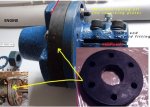
I look my engine out today for the first time(see other thread!), and at the time noted that there was about a 5-10mm gap to one side of the drive coupling (all of the way around, it wasn't just out of square), see picture below (click to enlarge) - there was a gap between the engine side and the rubber.
coupling.jpg

Having now seen pictures elsewhere etc, this now strikes me as wrong (longitudinal movement of propshaft?)
Why on earth would that be?? Has someone done this rather than get the alignment right? Perhaps through lack of a deep-drive socket to do the nuts up? What should I do now?! GULP

Any pointers please! Cheers,

Trev
 
Last edited:
You should have metal inserts in the holes of the rubber coupling which allow the M10 nuts & wahers to be tight with a little squash of the rubber - 3 to the engine ,, 3 to the shaft coupling.I would not worry too much about the reversing loads,the original system was a thin dustbin lid which prevented the rubber distorting in reverse.Not easy to check alignment ,the technical way is a dial gauge across the 2 couplings but doubt if you have room.Not clear from your description where the gap is.
Hope this helps Jim
 
Hi Jim,
The rubber coupling doesn't have any metal inserts.
The three bolts to the shaft coupling were done up tight (i.e. rubber pressed up to it)
The three bolts to the engine coupling were VERY loose - there was about a 5-10mm gap between the engine coupling and the rubber.

Surely this can't be right - I am thinking that when put into gear the propshaft would 'slam' forwards against engine coupling (or is the thrust being taken elsewhere)?

Cheers,
Trev
 
Trev - the rubber should be hard up to the engine & shaft couplings.The original bushes are thin wall brass & the length is slightly less than the rubber thickness so that you compress it then bring up tight on the bush.Have just looked at the parts list which shows the bushes but they have different bores , 3 are 8mm & 3 are 10mm I am pretty sure the holes in the rubber are all the same size .You need new nylocks & washers & a model engineering friend with a lathe.
Do you have a 7 or a 12 ?? not important as the couplings are the same.

Cheers Jim
 
Agree with BJ:- Rubber coupling should be bushed and all 6 nuts tightened fully. The Vire man does say however that early couplings were 6 x 8mm studs.
If your coupling has been run for long with no bushings and loose nuts it could be rather worn and distorted by now.
Check that taking up the existing gap on the coupling doesn't pull the prop too near to the shaft bearing, say 10mm of shaft should be visible.
If this gap has closed up, the shaft could be slid back a small amount by loosening the clamp on the drive flange but I suspect this won't be needed as prop thrust will have closed the gap anyway. Thrust would normally be taken through the coupling.
Later thought, loose nuts could have been a rather desperate attempt to compensate for bad alignment, perhaps best to check on reassembly.
Enjoy!!
 
Last edited:
Thanks both. I think mine has 6 x 8mm studs. There were absolutely no bushings on the rubber disc, I will check for distortion tomorrow. I think I will be ok shaft-length wise, as I have noted before it sticks out plenty (and doesn't have an anode fitted... there is another story!). Yes I do wonder if not doing the nuts up on the engine coupling (and perhaps even leaving the bushings out) was an attempt to correct for bad alignment.

I am looking at the parts drawing here: http://gofree.indigo.ie/~vire7/fig18.htm and cannot see bushings (if you click on the picture it gives you a table), do you think they were supplied as part of the rubber disc?

Cheers,
Trev
 
Can't remember the bushings on my Vire, ages ago, but the eBay listing, with the illustration that you use, mentions them. Suggest that you try Nicktheengineer to see if he sells them separately.
 
Trev - 8mm bush is part no is 68555 , not much use as the rubber discs & presumably the bushes are not easily available, if the rubber is not totaly shot i would not worry too much ,its a pretty agricultural system,so have some bushes made,fit new nylocks with washers underneath & do your best with the alignment.
Incidently when you did the pump did you check that the weep hole between the water & oil seals was clear ?,its in the gearbox casing under the shaft position ,its the way you tell that the water seal is leaking without filling the gearbox with water!

Cheers Jim
 
Trev - the bush in your listing is fig 3 ,an old version with all 8mm studs,my later version has the 3 10mm studs/bushes for the other coupling.

Jim
 
Thanks Jim, just back from a day working on the boat. I'm slightly embarrassed to say that after cleaning down the studs today (they were VERY rusty and gungy), I found that there are already some home made looking bushings in situ - until I cleaned the rust off, I'd thought that this was just the non-threaded shaft of the bolt. The bushings don't fit the holes in the rubber disc snugly - there is probably 3-4mm "slop". Are the proper bushings tight tight, or is clear space around the bushing normal? I started to get worried about this, and then got distracted by the fact that the threads on the studs of the engine coupling (the one which wasn't done up previously) are really poor. I spent about an hour cleaning the threads and working the nuts forward a turn, back a half turn etc. in order to be able to do the nuts up further. Two of the three studs are ok. On the other one the thread is quite poor near the head of the stud, so to avoid having to use that I'm thinking about putting the washers on, then putting a spacer in (e.g. a nut with the thread drilled out) before putting the nut on and doing up. I had bought new nylocks, however I could not get these started on the threads - very bizzare, I was having a 'is this metric' double take, as they would go on for about a turn but no further. My plan at the moment to avoid further damage (=expense) is to re-use the old nuts, as these seem to be playing ball (and it is all very heavily engineered for a was-once-7hp-probably-now-4hp engine).

PS Thanks I found the little hole, which was gunged up. Is it VERY narrow? Access was difficult because of the drive coupling, I managed to get the shank of a 1mm drill up it (by hand!) to clean it out, but couldn't get anything bigger.

PPS I also emptied the gearbox oil as a precaution (I like to think it will make the engine lighter). I couldn't see any obvious water 'bubbles', although it was a bit of a cream colour (nothing worse than what I've seen on outboard engines etc).

For parts I have found these people - http://www.mmc.dk/kataloger/ . On that page there is a link to a pdf copy of the manual, which at the end of it has exploded drawings, if you click on part numbers within that pdf it then takes you to the very web-page where they have that part listed. I have found the translate function of Google Chrome (just about) works.

That said, I don't fancy £50 for a new rubber disc, and I have been ploughing around for two years on it (half-assembled as it now turns out) no problems, so will try putting it together first to see how it goes.

Trev
 
Trev - bushes should be a gentle push fit into the rubber - i am sure your rubber disc is fit for further work - how about replacing the studs with new stainless studding ,A2 will be fine available from screwfix/toolstation use high strength locktite. For the bushes if you cant find the tame model engineering friend can you find some bits of metal pipe with the right ID/OD cut off with the hacksaw, will be better than what you appear to have.Good news that the discs are available even at £50,I thought they were not available
anymore.For info my Vire is a 12 & have had it for about 10 yrs.

Cheers Jim
 
If the holes in the rubber coupling are too big for the spacers try finding some rubber hose that the spacers are a push fit and open the holes in the rubber disk to allow the rubber hose to be a push fit in the coupling.
 
I managed to find some tube (cut a section of a box spanner) to use as a sleeve/spacer. I used this in ONE of the holes through which the engine flange bolts pass, the other two showed some wear but were ok.

When I assembled/reinstalled the engine, I then turned the drive shaft. I then eyeballed the rubber/sealing flange on the prop shaft (i.e. the stuff mounted on the end of the stern tube), and found that when the assembled coupling was turned through a full rotation, the rubber/sealing flange was showing movement - tracing out an ellipse. I am thinking that either:
-the driveshaft coupling flange is not centered to the engine coupling flange (badness with the rubber)
-the prop-shaft is bent
-something else

Any pointers please! I have a new driveshaft rubber coupling on order (£ ouch), which I will replace - but any pointers on how to investigate/diagnose would be great.

A couple of weeks until the "big" tide to launch on and counting - gulp!

Cheers,

Trev
 
Assuming that I am understanding correctly...

One way of finding out is to remove the rubber and to draw the shaft coupling up to the one on the engine, bolting them temporarily together. If they are aligned they should come together very easily once you ensure that the shaft is centred in its tube. Any gap between the two faces should be more or less constant all round. You should then be able to rotate them by hand with no binding anywhere. Observe whether or not the gap changes. If the gap does not change, the shaft is not bent.
 
Trev - the technical way to check for bent shaft is a dial gauge but if you hold a piece of stiff wire or bit of wood at right angles to the shaft so it doesnt move just clear of the shaft then rotate the shaft,if the gap is constant using mk1 eyeball it is not bent, ditto to the outside of prop couplin flange flange but the surface needs to be clean & smooth.

Jim
 
Interesting ideas, now thinking...
First: I could try putting block of wood to outside of prop coupling flange, rotate the whole coupling slowly through 360 and see if the gap is constant (is prop coupling square to engine). If that is out, then hopefully the new rubber coupling will sort it (otherwise - gulp? bent studs?)

Second: Assume the above turns out to be ok, then do the block of wood trick on the prop-shaft trick? So if it turns out to be this, what do I do... gulp gulp!

Trev
 
Top