
VHF Still not well

johnphilip

Well-Known Member
Joined
15 Nov 2005
Messages
1,322
Visit site
I had fitted a new masthead VHF aerial over the winter, but found I was receiving transmissions rather broken up that adjacent boats could hear clearly. A couple of months ago the set itself stopped working and I replaced it with new. All seemed to work at close range but now I realise that our range both transmitting and receiving is poor, can hardly hear the coastguard.
Investigating while sat here in Dover I find if I disconnect the junction at the foot of the mast, reception is still possible. If I push the inner connections together the reception is not surprisingly better but when I complete the connection with the outer (sheath) the reception is worse.
This suggests to me a fault in the new aerial or its masthead connection.
Is it OK to transmit with only the inner core connected or is there a possibility of damage to the set when doing this without the complete circuit?
 
Further check has found almost zero resistance between the inner and outer of the cable from the aerial as it emerges from the mast. Do I cut off the plug in the hope the short is there, no quick access to a soldering iron though.
 
Further check has found almost zero resistance between the inner and outer of the cable from the aerial as it emerges from the mast. Do I cut off the plug in the hope the short is there, no quick access to a soldering iron though.

I think you will find near zero DC resistance is normal as it is connected to a coil in the aerial base. You cannot therefore tell with a resistance meter if there is a short circuit or not.
 
I think you will find near zero DC resistance is normal as it is connected to a coil in the aerial base. You cannot therefore tell with a resistance meter if there is a short circuit or not.

It depends completely on the particular aerial. Some do show a dead short as normal, but given the other symptoms I suspect the OP has a real short in the cable.

I believe one aerial manufacturer provides a specific documented resistance between core and sheath, thus allowing both shorts and breaks to be easily detected - very sensible. But it's not common.

Pete
 
I suspect the OP has a real short in the cable.

Pete
Yes you are probably right.

I have found that I get pretty good reception with just a short length of single core wire plugged into the socket on the back of the radio.
 
Sounds like a good case for an emergency antenna mounted on the stern rail. That should fix radio problems until you can check/replace the antenna feed cable or deck joint.
good luck olewill
 
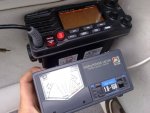
What also may be helpful is to test with a SWR meter.

1-150520111043.jpg

You may be familiar with one? If not its a device that can be used to show antenna/cable mismatch. In real terms what this really means is a poor antenna or cable will cause a reflection of the transmitter power. Your set may transmit 25w, but if you have a bad installation somewhere (highly likely with horrid PL259 type plugs) some of this power is reflected back into the transceiver. In some cases this can damage the transmitter stages since this reflected power results in heat generated within the amplifier stage. (I used to make for a while protection systems that shut down transmitters with bad load mismatches) anyway, lack of reception will usually show up as lack of transmission, so being able to see if you antenna system is matched by TX'ing will often solve RX too. Hence SWR meters are quite useful in fault finding. The results are shown in the pic example above by the crossing point of both needles, one is forward power, the other is reflected. If the ratio is below 1.5:1 and ideally 1.2:1 your antenna system is good.

Additionally something called a 'dummy load' or more formally coaxial resistor can be useful for testing cable runs. It places an 'ideal' antenna load at the end of the cable thus allowing you to see that the cable and connections are functioning correctly up to the point of the antenna.

SWR meter: http://www.ebay.co.uk/itm/181462818321
Dummy load: http://www.ebay.co.uk/itm/221388916840

Both of the above will work if you want to get more serious with fault finding.
 
I had fitted a new masthead VHF aerial over the winter, but found I was receiving transmissions rather broken up that adjacent boats could hear clearly. A couple of months ago the set itself stopped working and I replaced it with new. All seemed to work at close range but now I realise that our range both transmitting and receiving is poor, can hardly hear the coastguard.
Investigating while sat here in Dover I find if I disconnect the junction at the foot of the mast, reception is still possible. If I push the inner connections together the reception is not surprisingly better but when I complete the connection with the outer (sheath) the reception is worse.
This suggests to me a fault in the new aerial or its masthead connection.
Is it OK to transmit with only the inner core connected or is there a possibility of damage to the set when doing this without the complete circuit?
I had almost exactly the same issue after replacing our antenna, which snapped off in the Christmas Eve storm. Very short range (across the boatyard) TXs were possible but nothing much more. I bought a VSWR meter from JG Technology, which helped to diagnose a fault. In the end, I hired a radio techie who brought along his mega SWR and dummy load, along with 2 suitcases of bits, and we found that, although the deck join had been resold erred, the entire plug was duff.

In the end, we replaced the coax running up the mast and re-made the connection to the base of the antenna. This is a push-fit connector and it just hadn't been pushed in enough. I ended up with a SWR reading of 1.2:1 and was picking up a French sailor talking to CROSS Corsen, whilst I was in Start Bay, just a couple of weekends ago!

I would suggest getting in a proper radio techie. He will solve your problem and will be more than worth his fee for the peace of mind that a working VHF will give you.
 
Investigating while sat here in Dover I find if I disconnect the junction at the foot of the mast, reception is still possible. If I push the inner connections together the reception is not surprisingly better but when I complete the connection with the outer (sheath) the reception is worse.
Yes, this is typical of a bad antenna connection, or a bad antenna. I strongly suggest you don't transmit until the problem is fixed. To get any further you need to disconnect at the antenna. Then you can check there is no circuit between braid and centre conductor on the cable. If that looks ok you might need a new antenna. Most vhf antennas look like a dead short to a multimeter, by the way.
 
I would suggest getting in a proper radio techie. He will solve your problem and will be more than worth his fee for the peace of mind that a working VHF will give you.

Can't disagree with that, to most who don't really understand RF, its appears a bit of a black art to them, and the normal fault finding methods simply don't apply, or may put kit at risk.
 
Sounds like a good case for an emergency antenna mounted on the stern rail. That should fix radio problems until you can check/replace the antenna feed cable or deck joint.
good luck olewill

+1

I did that for the best part of a season - wasn't inconvenienced by a significant reduction in range although there obviously would be such an effect.

In my case, the problem was a dodgy deck plug, and since then I've always run the aerial lead right the way through to the VHF with no joints. I don't actually solder on the plug that goes into the VHF - that makes life simpler when the mast is to be unstepped and the lead has to be pulled out again through the deck gland.
 
Top