VHF aerial for home reception only

Touchwood

Well-Known Member
Joined
2 Sep 2010
Messages
863
Location
Redcar
Visit site
I recently purchased a VHF radio for the boat. I will be keeping the radio at home when not in use, and it would be nice to be able to "eavesdrop" on the radio traffic for the ships using Teesport.

The instructions with the radio warn of damage if used with an "incorrect" aerial. What do I need to use (for reception only, no transmission) to avoid such damage? It's not worth the expense and hassle of a "proper" VHF aerial.

Thanks in anticipation of the usual help and assistance from all you wonderful folk out there.
 
The only risk of "damage" is when transmitting with a very poor VSWR.

so for receive only there is no risk of damage by connecting any aerial.

Obviously for best results you want a proper marine band aerial so it's matched. Failing that, and probably a lot cheaper a 2 metre amateur band aerial won't be far off, certainly good enough for receiving.

Obviously you want a vertically polarised whip type aerial.
 
Just a short length of wire in the centre connection of the aerial socket will do.
Thats what I did.
I did calculate what was 1/4 wavelength or something IIRC.

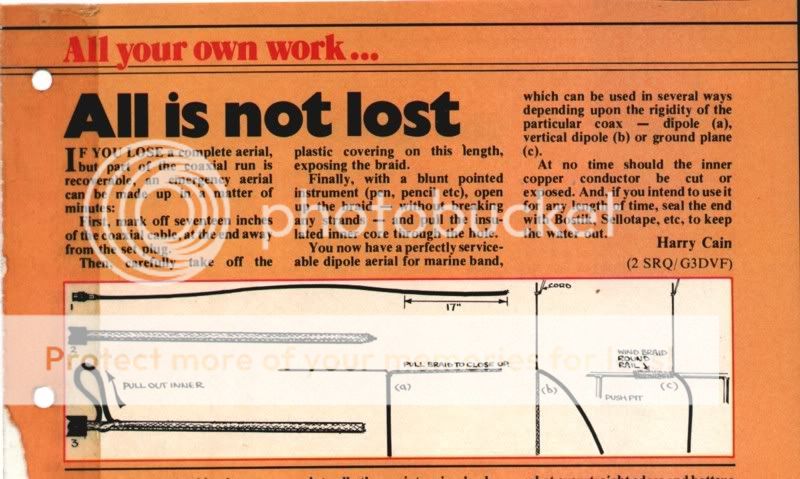
You could faff about and make one of these:

975885de.jpg


You could buy an emergency aerial. You never know it might be useful one day!

I bought a power input plug from some where. Maplin, maybe

My radio is designed to use either a telephone style handset or a fist mike.
I wired a dummy microphone plug to activate the loudspeaker and then played with it without the mike plugged in. No risk of accidentally pressing the PTT switch then.

The novelty wore off after a couple of winters!

.
 
I recently purchased a VHF radio for the boat. I will be keeping the radio at home when not in use, and it would be nice to be able to "eavesdrop" on the radio traffic for the ships using Teesport.

If you want a cheap DIY antenna, follow this You Tube video. It's a bit hill-billy American but the finished article is a serviceable dipole.

Alternatively, just tape some separated coax vertically - 19.25" upwards for the copper and exactly the same downwards for the braid.

Edit: 18" is suggested later in this thread as a suitable length, however, for receive only, the resonant length is less critical.
 
Last edited:
Just a short length of wire in the centre connection of the aerial socket will do.
Thats what I did.
I did calculate what was 1/4 wavelength or something IIRC.

You could faff about and make one of these:

975885de.jpg


You could buy an emergency aerial. You never know it might be useful one day!

I bought a power input plug from some where. Maplin, maybe

My radio is designed to use either a telephone style handset or a fist mike.
I wired a dummy microphone plug to activate the loudspeaker and then played with it without the mike plugged in. No risk of accidentally pressing the PTT switch then.

The novelty wore off after a couple of winters!

.
You know some stuff you!
Stu
 
I'm curious why VicS's article suggests a length of 17" while the YouTube video states 19.25". :confused:

I reckon both a wrong! The wavelength in the middle of the marine (2 metre) band is 1.914 metres (300/156.725) so a quarter wavelength is approx. 18.8", or am I missing something?
 
Yes. The supports for the wires have a capacitance with the wires even when non metallic and this has the effect of shortening the resonant length from the theoretical. Even then I reckon the you tube one is wrong. Maybe American inches.

If you wanted to be really picky you would make the aerial over long and then trim back to resonance in the location it is to be used in. Pointless when receiving only.
 
Last edited:
Yes. The supports for the wires have a capacitance with the wires even when non metallic and this has the effect of shortening the resonant length from the theoretical.

I've done a bit more research. Wikipedia suggests a 'fudge factor' of 0.95 for the quarter wavelength dipole so the calculated length would be approx. 18". This is to allow for ground plane and stray capacitance effects, as you suggest.
 
I've done a bit more research. Wikipedia suggests a 'fudge factor' of 0.95 for the quarter wavelength dipole so the calculated length would be approx. 18". This is to allow for ground plane and stray capacitance effects, as you suggest.

I assume for an emergency aerial it's ch16 you're going to be interested in. If that's near one end of the band rather than the middle (is it?) is that enough to cover the missing inch?

Pete
 
I assume for an emergency aerial it's ch16 you're going to be interested in. If that's near one end of the band rather than the middle (is it?) is that enough to cover the missing inch?

Pete

Channel 16 is 156.8 MHz, so it's close to the mid point of the marine band. The difference wouldn't account for the extra (or missing) inch.

Antenna design does appear to be an imprecise science, though, with trial and error 'tuning' being necessary for optimum performance. :)
 
Another question to the knowledgeable folks here - does the length of the braid part of the aerial matter? The instructions in that orange sheet say to pull it tight, which will make it longer than it originally was, longer than the core side of the dipole.

Also, if you're doing aerial type B, do you need to keep the intact part of the cable away from the braid? I doubt my cable is stiff enough to do an "A", and I don't have a pushpit or any similar metal structure to do a "C", so I'd probably be making a "B", taped to a boathook or whatever. Could the cable be taped down the boathook too?

Pete
 
OP just stick a bit of wire in it. Wire coat hanger if you're being esoteric. If you are really a 'listener' you can put a long wire up as high as possible, but VHF is prettywell line of sight so maybe that's not worthwhile.
I've got several in the shed attached to various "twigs" and can't really tell the difference between them on receive.
As for the transmit side, a good emergency ae. can be made in the "J" configuration using a single folded piece of wire and some duct tape.
 
You are missing the velocity factor - RF current in a wire is a bit slower than a wave in free air so the extra bit of wire is needed for the aerial to resonate.

For a receive aerial it will make no difference.

On a transmit aerial in practice you would cut it a cock-hair longer and then trim it to resonance using a SWR meter - if you could be bothered - if its resonant on 16 it won't be anywhere near on 80 or even on 6.
 
Thanks....

...to you all, as usual a comprehensive selection of ideas which give me the answer I needed.

I'm going with the coax dipole - 18" (or thereabouts)

Also I'm going to disconnect the microphone - good idea that!
 
On a transmit aerial in practice you would cut it a cock-hair longer and then trim it to resonance using a SWR meter

I'm mentally filing the idea away in case I ever need to use it. I'm unlikely to have an SWR meter about my person in that case - even a ruler might be pushing it :)

Pete
 
At the risk of sounding unpopular:
1) You are not allowed to listen in for fun - this is illegal and you would have been told on your course.
2) Although useful to know how to bodge an aerial I would suggest you don't unless it is an emergency. Especially if you'll be on channel 16 since this could interfere with someone using it in an emergency.

That said, some of this info is very useful so thanks all
Cheers
Dave
 
Another design of emergency aerial that is reasonably easy to manufacture at home is a balanced folded dipole, known as a "slim jim". I have knocked up a few from various materials and found them easy to make. Google "slim jim antenna" and you can get the idea.

Rob.
 
At the risk of sounding unpopular:
1) You are not allowed to listen in for fun - this is illegal and you would have been told on your course.

You are not allowed to use the full facilities of the wireless ie transmit, unless you on on the registered craft. If you are home AND only using the receive function then that's fine, as long as you do not take any action on any information received. My memory is getting hazy now but this used to be conditions of the wireless telegraphy acts when you had to pay for a radio licence, meaning you could listen to what you want.
 
"1) You are not allowed to listen in for fun - this is illegal and you would have been told on your course."

I do not believe this to be the case.

It was some years ago when the BT coastal stations were passing public telephone traffic.

This would amount to Phone "tapping" and as such was technically illegal, although to the best of my knowledge no-one was ever prosecuted for it.

Its no different now to listening on the HF channels used by shipping.
 
http://www.ofcom.org.uk/static/archive/ra/publication/ra_info/ra169.htm
Its no different now to listening on the HF channels used by shipping.

Technically illegal too, although noone actually cares.

You're not allowed to listen to any radio traffic unless you are an intended recipient or the signal is being broadcast for general reception. Strictly speaking, this includes following someone from 16 onto 08 to see what they're nattering about. Obviously it's not actually enforced.

(My non-expert understanding. We have a couple of experts around, perhaps they could clarify?)

Pete

EDIT: Here's an information sheet from Ofcom. It's aimed at scanner users, but the law it quotes is general. The question of licensing adds a slight wrinkle, assuming you have your SRC ticket and a ship station license, but note that those only license you to use the equipment on the water. So maybe you have more rights than the scanner geeks to listen in while anchored of an evening, but not when you're at home.

Still, it's all academic as nobody cares and it doesn't do any harm. I quite often turn on my handheld at home and listen to VTS chattering away.
 
Last edited:
Top