Valve stem oil seals

pcatterall

Well-Known Member
Joined
2 Aug 2004
Messages
5,507
Location
Home East Lancashire boat Spain
Visit site
The valves on my 2 recently dismantled Perkins 4108s had little O ring seals in a groove on the 4 inlet valves. ( no seals or grooves on the exhaust valve stems)
Parts4engines supplied a kit containing the 4 O rings but also 8 little cup shaped seals described as valve stem oil seas.
I can't immediately see just where to fit them on the stem( but perhaps more investigation will reveal this)
I cannot see them on the diagram in the manual, nor are they mentioned in the text.
Can anyone shed light on this please. It would be interesting to learn more about oil 'movement' between the engine and head generally. I see that other Perkins
engines do not use these cup type oil seals but just the O rings on the inlets.

Would welcome info on where if anywhere I should fit these cups, I don't want to get it wrong and have bits of disintegrating rubber flying around the head.

The O rings were also interesting in that they must have to stand a lot of wear and heat.
 
You may find some models had o rings, while others had normal valve stem seals!?

The latter are more commonly used in engines of that era!
 
The valves on my 2 recently dismantled Perkins 4108s had little O ring seals in a groove on the 4 inlet valves. ( no seals or grooves on the exhaust valve stems)
Parts4engines supplied a kit containing the 4 O rings but also 8 little cup shaped seals described as valve stem oil seas.
I can't immediately see just where to fit them on the stem( but perhaps more investigation will reveal this)

I cannot see them on the diagram in the manual, nor are they mentioned in the text.
Can anyone shed light on this please. It would be interesting to learn more about oil 'movement' between the engine and head generally. I see that other Perkins
engines do not use these cup type oil seals but just the O rings on the inlets.

Would welcome info on where if anywhere I should fit these cups, I don't want to get it wrong and have bits of disintegrating rubber flying around the head.

The O rings were also interesting in that they must have to stand a lot of wear and heat.

Kits often contain the parts for more than one engine year, version or model. Fit what you need for your engine and ignore the rest.

I'm surprised you have not come across the cup shaped seals on other engines but when they are used they fit on the protruding tops of the valve guides.
 
When I reconned the top half of our Perkins Prima/MD22 engine a few years ago the valve stems had o-ring seals and the engine had been quite smoky, especially on start up. The replacement gasket set had the cup seals with small circular springs that went over the protruding part of the valve guide as described above. The engine now has virtually no smoke and since the recon is no longer an embarassment on start up.
 
thanks all!! Yes I can see that the cups will fit over the top of the sleeve heads so I will fit them!
regarding smoky engines there had not been any seals on the exhaust valve stems only the O rings on the 4 inlets.
Are these seals supposed to stop oil running down from the head when the inlet opens then burnt and exhausted as smoke?
 
thanks all!! Yes I can see that the cups will fit over the top of the sleeve heads so I will fit them!
regarding smoky engines there had not been any seals on the exhaust valve stems only the O rings on the 4 inlets.
Are these seals supposed to stop oil running down from the head when the inlet opens then burnt and exhausted as smoke?

The hot exhaust valves will need lube & will burn any excess off
 
thanks all!! Yes I can see that the cups will fit over the top of the sleeve heads so I will fit them!
regarding smoky engines there had not been any seals on the exhaust valve stems only the O rings on the 4 inlets.
Are these seals supposed to stop oil running down from the head when the inlet opens then burnt and exhausted as smoke?

That's right. The seals are indeed to stop excess oil running down the valve stems and either being burnt in the engine or blown out through the exhaust.

There are many different designs, O-rings, lip seals with springs, lip seal without springs etc. I would normally have expected the lip-seal type which fits over the top on the protruding end of the valve guide to locate onto a ridge or groove in the top of the valve guide. Without a positive locating mechanism I would imagine that when the seal get hot and soft the oscillating valve stem would tend to work it up away from the top of the guide. However, maybe some engines just use a push fit onto a smooth taper.

Richard
 
That's right. The seals are indeed to stop excess oil running down the valve stems and either being burnt in the engine or blown out through the exhaust.

There are many different designs, O-rings, lip seals with springs, lip seal without springs etc. I would normally have expected the lip-seal type which fits over the top on the protruding end of the valve guide to locate onto a ridge or groove in the top of the valve guide. Without a positive locating mechanism I would imagine that when the seal get hot and soft the oscillating valve stem would tend to work it up away from the top of the guide. However, maybe some engines just use a push fit onto a smooth taper.

Richard
On my Volvo 2002 they fit on the top of the valve guides as described. Had no effect on the oil smoke however after I replaced them following a rebuild. Probably needed a rebore but as starting is great and she's a sail boat I'll just see if a longer running period will bed the new rings eventualy.
 
I did a top end refurb once. The valve stem oil seals were rubber with a lip on the inside which fitted over a lipped spigot on the cylinder head.
This was on a Hillman Avenger 1500.
 
On my Volvo 2002 they fit on the top of the valve guides as described. Had no effect on the oil smoke however after I replaced them following a rebuild. Probably needed a rebore but as starting is great and she's a sail boat I'll just see if a longer running period will bed the new rings eventualy.

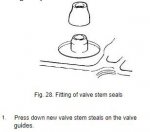
I think that was the manual I snipped my little picture from!
 
That's right. The seals are indeed to stop excess oil running down the valve stems and either being burnt in the engine or blown out through the exhaust.

There are many different designs, O-rings, lip seals with springs, lip seal without springs etc. I would normally have expected the lip-seal type which fits over the top on the protruding end of the valve guide to locate onto a ridge or groove in the top of the valve guide. Without a positive locating mechanism I would imagine that when the seal get hot and soft the oscillating valve stem would tend to work it up away from the top of the guide. However, maybe some engines just use a push fit onto a smooth taper.

Richard

The BMC A series had seal rings put onb the valves but no method of holding them in a wiping position so I presume they went up and down with the valves. My MD22 has seals on a cup which the springs sit on so that they hold them in place, the valves go up and down inside them.
 
There are stem seals known as umbrellas, and they just shed oil running down the upper stem so that only that which finds its way under the umbrella gets onto the lower stem, and on down into the guide. Just another way of making a controlled leak really.
 
There are stem seals known as umbrellas, and they just shed oil running down the upper stem so that only that which finds its way under the umbrella gets onto the lower stem, and on down into the guide. Just another way of making a controlled leak really.

Yes, that would explain it. Stu's BMC Series A was a very old design, 1950's if I recall correctly, so perhaps umbrella seals were a feature of older engines.

Richard
 
If the seal goes up and down with the valve stem, I can see how it is doing anything useful? Do you have a theory? :confused:

Richard

How would you explain this one? ( no prizes for identifying the car though) Click, click and click again to get the image fullsize

Part #5 is the oil seal

DSCF1715.jpg
 
Ang on ang on !! You have got me thinking again ( never a good thing!)
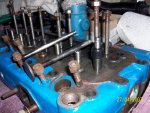
The cup seals supplied 2007-04-27 08.01.23.jpg are not a tight fit onto the valve guide nor is there a locating groove on the guide.
my photo shows a closed inlet valve with the cup fitted into the groove on the stem where there had previously been an O ring.
I assume that the O ring would have just sat on the top of the guide to prevent oil running down the stem, I GUESS that using the cap instead
means that the 'umbrella effect' quoted previously prevents oil entering ( to an extent) should the valve stop open?

Note that there is no groove on the exhaust valve stem though possibly a cap would just locate itself, sitting at the top of the guide when that valve is closed?

I guess that some oil 'mist' getting to the valve stem is desirable?

I can go back to parts4 engines but cannot expect them to have an answer to questions of such detail on all their stock.

Over to the experts again!!
 
Top