Useful Tips

LadyInBed

Well-Known Member
Joined
2 Sep 2001
Messages
15,222
Location
Me - Zumerzet Boat - Wareham
montymariner.co.uk
Maybe it's time for another useful tips thread!
Here's a couple

New battery - if it's not sealed, use a clean plastic straw and dip the cells.
Look for where the straw just breaks the surface tension of the electrolite and measure the straw length to the top of the case. Write the measurement, date battery was bought and cost on masking tape stuck to the top of the battery. Then when you come to check the levels you will easily know if any are down.

Rope length - Get to know a meter length (thumb and finger to tip of nose). Coil the rope in meter length coils, then count the coils to know how long any rope is.
 
Maybe it's time for another useful tips thread!
Here's a couple

New battery - if it's not sealed, use a clean plastic straw and dip the cells.
Look for where the straw just breaks the surface tension of the electrolite and measure the straw length to the top of the case. Write the measurement, date battery was bought and cost on masking tape stuck to the top of the battery. Then when you come to check the levels you will easily know if any are down.

Rope length - Get to know a meter length (thumb and finger to tip of nose). Coil the rope in meter length coils, then count the coils to know how long any rope is.
Not to challenge, but arent most batteries now sealed for obvious spillage reasons on a boat and with a colour indicator..
My ropes are different , colour or thickness, depending on use....so I know a long grab line form a heavy mooring line Different approach I guess.
 
Not to challenge, but arent most batteries now sealed for obvious spillage reasons on a boat and with a colour indicator..
The ones I buy aren't, I like to check the cells with a hydrometer.
My ropes are different , colour or thickness, depending on use....so I know a long grab line form a heavy mooring line Different approach I guess.
Someone on a different thread wanted a new main sheet, so took an old one and measured it with a tape measure.
I carry many lines of various lengths but similar thicknesses for various jobs. It's nice to know if I am picking up a 20, 25 or 30 mtr line / cord / mains cable.
Like any post here - Take it or leave it!
 
To the OP, well done for starting what promises to be a useful thread in the true spirit of Practical boat owner. Hopefully this will develop into a useful practical thread once others start contributing. My batteries aren't sealed either so I may well use your suggestion.
 
well here goes, hope I dont get shot down too!

If you have a shaft drive, stick a jubilee clip on your propshaft an inch or so before your stern gland. that way, if the shaft should somehow come out of the half coupling in reverse this could be your last line of defence against loosing the shaft, having a hole in your boat and possibly jamming the rudder. never used in anger but I have known somebody loose a shaft, so it might just save the day - all be it while mangling your stern gland.

I recently had a cordless drill for which the battery and charger melted. bought a new cordless as it was cheaper than a battery and charger, was going to chuck the old one then I hit upon the idea of (it was a 14.4v drill) soldering a few metres of flex to the battery terminals and fitted the other end with a lighter plug. now I have a 12v drill on board that will reach anywhere and has all the ampere hours of my domestic battery bank at its disposal. my new cordless has not been used since!! for those out there interested, try searching ebay for an old cordless drill with no battery or charger - bargains to be had aplenty you could probably get a much better drill than I used for peanuts.

for fibreglassing/epoxy repairs - in our awful climate, things have a much better chance of setting properly with a little help. I cant afford an industrial one but some years ago I picked up an old pifco theraputic 150watt infra red heat lamp for a few quid. For small area repairs this is great at both drying the area prior to working it and indeed gently heating the job to assist curing. they seem to crop up at car boot sales, I think they were all the rage in the past but arent wanted now.

donning body armour and running for cover now......
 
Maybe it's time for another useful tips thread!
.......Get to know a meter length (thumb and finger to tip of nose).

Sheesh! You must have long arms.... I get 80cm. However, each loop made by my two-arm stretch is about 1.5 metres. It's a good idea nevertheless.

Here's another way - tuck your ( left ) elbow into your waist, and drop a loop of rope from your ( left ) hand to your foot and back to your hand. That loop is, for me, 2 metres...... Coil up your warps and halyards that natural way, and simple 'rithmetic gives you the useable length.


'Nother idea.... the look of chromed leather sheaths on runner blocks fitted to classics such as the beautiful Fifes is most attractive. What's more, those sheaths protect varnished wood and old pates alike, but the cost is prohibitive for many of us. Take one or more punctured white vinyl fenders, cut the ends off, slice down from top to bottom and turn inside out. That clean, tough vinyl material is just about as good as split chromed leather and can be cut to shape and sewn with strimmer line in exactly the same way - but very much cheaper. There are many other places around a boat where a shaped slice of knackered fender, sewn or tacked on, can do good service in protecting edges and varnished work from knocks, dings and chafe.
 
Last edited:
If you have a shaft drive, stick a jubilee clip on your propshaft an inch or so before your stern gland. that way, if the shaft should somehow come out of the half coupling in reverse this could be your last line of defence against loosing the shaft, having a hole in your boat and possibly jamming the rudder. never used in anger but I have known somebody loose a shaft, so it might just save the day - all be it while mangling your stern gland.

I use a spare shaft anode for the same purpose (ie. fitted on the inside).
 
When out day sailing I get rather hungry, to combat this before i go I place a slice of cheese and sometimes when funds allow a slice of ham between two slices of bread. I call this "mbays cheese and bread snack" and makes a handy no nonsense midday meal which takes no cooking and is easy to eat whilst at the helm.
 
Last edited:
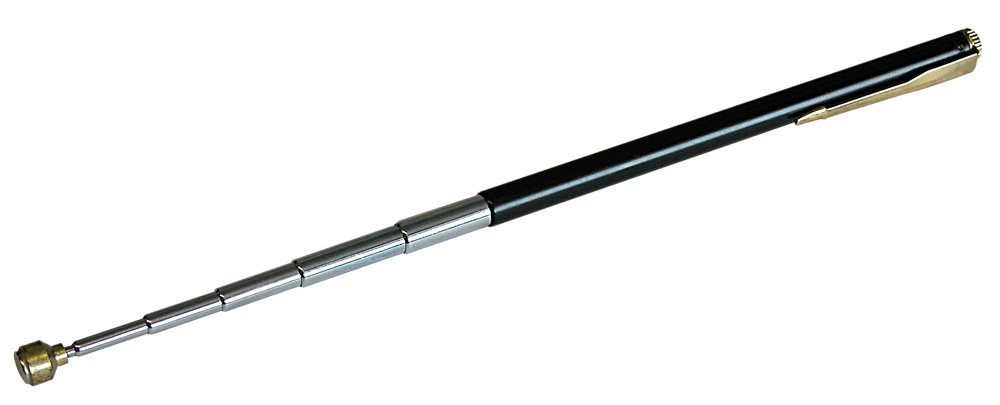
Never be too far from one of these:

magnet_pen.gif


Pete
 
Cut the ends off cable ties using nail clippers; it leaves a nice rounded end with no sharp corners to subsequently rip your skin
 
For working on the hull, antifouling or sorting out the waterline on a deep keeler, use a lightweight plastic storage box to stand on. Choose one strong enough for the job though.

They can be quickly moved, with your boot if need be.
 
If you have wooden spars that occasionally suffer dinks to the varnish, an empty copydex bottle (the type with the brush in the lid) can be filled with varnish for quick touch-ups. Because the brush sits in the varnish all the time, it doesn't need cleaning, just take out, use, put back in. A couple of 1/3-sheet pieces of sandpaper for preparing the site can be wrapped around the bottle and held on with rubber bands.

The varnish does tend to dry out slowly, and is best replaced each year while you're doing the main varnishwork.

Pete
 
Here's an unproven one, but it seems sensible to me. To avoid losing a signal halyard up the mast, thread a 2oz spherical fishing weight onto it just above the upper inglefield clip (or loop or toggle or whatever you use). This should be enough to counteract the weight of the line on the other side of the block (which normally whips it all the way up as soon as it's allowed to escape part-way) and let you jiggle it back down again, but isn't enough to make a serious wrecking ball. The bottom end of the halyard can be put through the middle of the mast cleat with something on the end to stop it pulling back through (another good thing about using inglefield clips).

Pete
 
Eber fuel screen cleaning. spray oven cleaner leave for 10 mins flush, repeat again until clean, works on the cobustion chanber as well.
 
Top