Use a ball valve on the exhaust outlet?

Joined
20 Jun 2019
Messages
1,385
Location
Odessa
Visit site
Can the nylon type material in a ball-valve type seacock stand continuous 80 degrees C exhaust gases, and warm water ?
I think it might be useful to close the exhaust skin fitting sometimes, and it woukd help with fitting the hose tail.
2" BSP thread with 51mm internal diameter hoses. The skin fitting has a male thread, and the hose tail has a male thread, and the valve has two females to conveniently join them together.
( You can get skin fittings in this size incorporating a hose tail, but thry're too short to go through the hull planks and internal pad)
So I have two good reasons to use a ball valve, if the valve can handle it.
Yes I must not carelessly start the engine with the valve shut :encouragement:
 
From the data sheet for Tru-Design ball valves:

operating temperature range
o -40° to 80°C (-40° to 176°F)

Their skin fittings go to 110°C. They're resistant to many chemicals, including diesel fuel. No special mention of exhausts. They're definitely not designed for it, there's not a lot of safety margin, and if you ever have a cooling water interruption the plastic fitting will melt quickly, same as the plastic mufflers do. Exhaust hose is rated to 100°C and 115°C for short-term, so I would want anything else to have at least that much.

Still a really bad idea to have a seacock on the exhaust though for obvious reasons. Also, wet exhaust skin fittings typically have a drip lip or tube to reduce hull staining, which standard skin fittings (plastic or otherwise) lack.

In what situation is a closable exhaust useful, building a submarine?
 
Not generally required, but I could introduce people to two individuals who've lost engines due to water up the exhaust in following seas while sailing.
Personally, I'd rather have a non-return flap or put a bung in the transom fitting in such seas, but I appreciate that is not right for every boat.
If you have some vintage yacht with a narrow arse-end, it may be worth considering.
 
From the data sheet for Tru-Design ball valves:


Their skin fittings go to 110°C. They're resistant to many chemicals, including diesel fuel. No special mention of exhausts. They're definitely not designed for it, there's not a lot of safety margin, and if you ever have a cooling water interruption the plastic fitting will melt quickly, same as the plastic mufflers do. Exhaust hose is rated to 100°C and 115°C for short-term, so I would want anything else to have at least that much.

Still a really bad idea to have a seacock on the exhaust though for obvious reasons. Also, wet exhaust skin fittings typically have a drip lip or tube to reduce hull staining, which standard skin fittings (plastic or otherwise) lack.

In what situation is a closable exhaust useful, building a submarine?

Thanks for looking it up, 80 degrees C is fine.

Yes a closeable exhaust is useful to keep water out..just like a submarine :encouragement:

What are the obvious reasons it's a really bad idea? (Assuming I can remember to turn the seacock when needed, and it doesn't melt the nylon. Although if the nylon melted, it wouldn't block the exhaust.)

I'm ok with a bit of hull staining, any protrusion would receive or inflict damage when springing off.

I may indeed have forgotten something obvious, don't know what though.
 
Had one on a previous boat. I owned boat for 16 years and only ever closed it when laid up over winter incase wildlife used exhaust as a home. So it didn't come to any harm after 20 years or so. But if you have a decent gooseneck fitted in the exhaust you should be ok. Only problem I could see happening is the one time you close the valve will the time you forget to open it, then start the engine. You can buy a valve that contains a ball and a spring for the exhaust that prevents water from flowing back towards engine, but the increase back pressure slightly and may be more trouble than they are worth when they age.
 
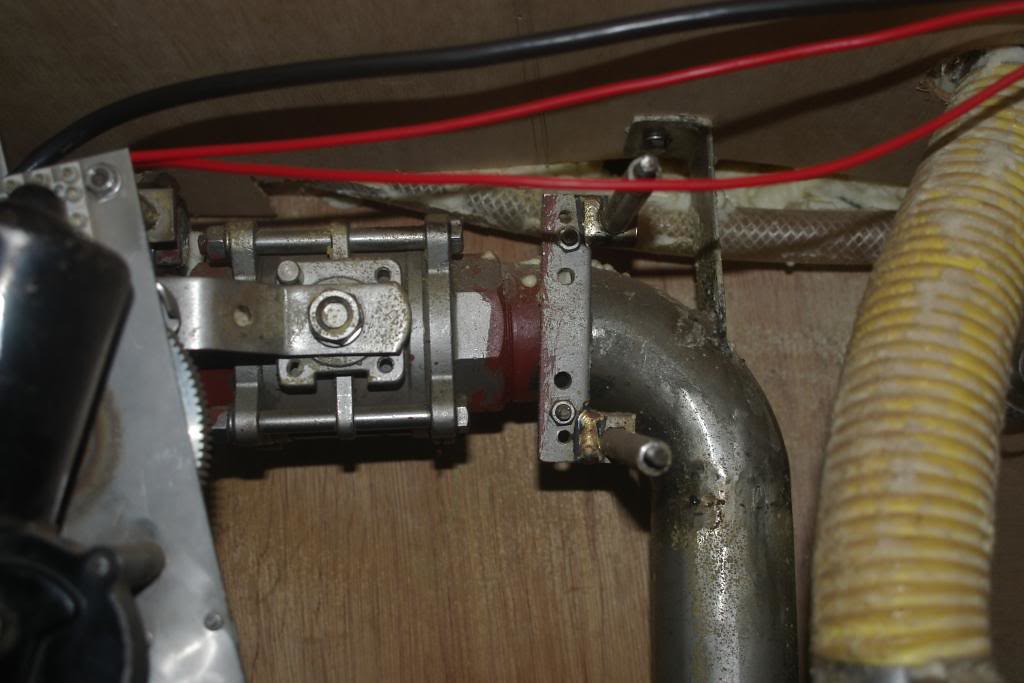
This is a stainless steel ball valve in my engine exhaust that exits on the port side. I fitted it to allow me to beach my boat on its side.

The seals are PTFE which has a higher temperature rating than nylon.

36086458405_ae4ee219ed_b.jpg
 
Assuming a water cooled exhaust, why would you be concerned about the temp at the transom fitting? The hose to get there is subjected to the same temps, so after the water injection at the exhaust elbow point, it does not matter.
 
Assuming a water cooled exhaust, why would you be concerned about the temp at the transom fitting? The hose to get there is subjected to the same temps, so after the water injection at the exhaust elbow point, it does not matter.

Yes watercooled through a Vetus trap/silencer.
I was thinking of the nylon type stuff in the ball valve not liking warmth from the exhaust gases. I don't now think it would be a problem heat-wise.
But the valve was really just a way to join two male 2" BSP threads together, with the added benefit of being able to close the exhaust.
Finally I have found a suitable female to female bronze fitting, (just by using the right search terms on ASAP..) so I'm not using a valve in the end anyway.. but thanks for all the suggestions!
 

Attachments

  • IMG_2186.jpg
    IMG_2186.jpg
    196.6 KB · Views: 0
  • IMG_2184.jpg
    IMG_2184.jpg
    204 KB · Views: 0
  • IMG_2185.jpg
    IMG_2185.jpg
    199.4 KB · Views: 0
Last edited:
From the data sheet for Tru-Design ball valves:

Tru-Design are one of the glass-filled nylon (or other plastic) types, aren’t they? The OP didn’t mention using anything other than standard brass or bronze. He’s just concerned about the small amount of plastic (ptfe?) seating material around the ball.

Pete
 
Tru-Design are one of the glass-filled nylon (or other plastic) types, aren’t they? The OP didn’t mention using anything other than standard brass or bronze. He’s just concerned about the small amount of plastic (ptfe?) seating material around the ball.

Pete
Yes that's right, the ptfe type stuff has also gone hard, or swollen, in my 3" cockpit drain ball valves, they have only ever touched cold water so the material doesn't last for ever.
I'm going to remove them and try flushing with warm water, in case it's salt building up, or mini barnacles..but am not optimistic..
 
Apart from fitting a valve in the exhaust not being a good idea, don’t use anything with PTFE if there is the slightest possibility of its rated temperature being exceeded, eg cooling water fails.
PTFE whilst being rated for a temperature higher than most plastics it is a thermo setting plastic, ie it will not melt, it burns.
At about 350 deg it gives off carcinogenic fumes, highly toxic.
It gives flu like symptoms and is nicknamed PTFE Flu.
Not very common unless you work in the manufacturing of the stuff. However I have seen a plumber get it from using PTFE tape, having a very small amount on his finger then rolling a cigarette, thus burning it and inhaling the fumes
 
On most boats, the exhaust near the engine would be long gone well before a teflon part in a seacock got anywhere near 350degC.
 
On most boats, the exhaust near the engine would be long gone well before a teflon part in a seacock got anywhere near 350degC.

I agree I would be more concerned with the exhaust hose melting and letting exhaust gasses into the boat with all the CO.
 
I agree I would be more concerned with the exhaust hose melting and letting exhaust gasses into the boat with all the CO.

Unless you run a petrol engine, there wouldn't usually be a CO issue with diesel exhaust fumes entering the boat. Your biggest problem would be the water entering the vessel.
 
Unless you run a petrol engine, there wouldn't usually be a CO issue with diesel exhaust fumes entering the boat. Your biggest problem would be the water entering the vessel.

Yes water but the gases whatever they are would be very nasty and may kill you quicker than the cancer you could get from the burning PTFE.

Google gave me this

https://www.google.co.za/search?sou.....0i131j0j0i10j0i22i30j0i22i10i30.27ajdRcPUiA


"Common pollutants include unburned hydrocarbons (HC), carbon monoxide (CO), nitrogen oxides (NOx) or particulate matter (PM). Total concentration of pollutants in diesel exhaust gases typically amounts to some tenths of one percent"

Also depending on the sulphur content you can ge SO2 which converts to acid rain (Sulphuric acid)

Ask VicS
 
Yes water but the gases whatever they are would be very nasty and may kill you quicker than the cancer you could get from the burning PTFE.

Google gave me this

https://www.google.co.za/search?sou.....0i131j0j0i10j0i22i30j0i22i10i30.27ajdRcPUiA


"Common pollutants include unburned hydrocarbons (HC), carbon monoxide (CO), nitrogen oxides (NOx) or particulate matter (PM). Total concentration of pollutants in diesel exhaust gases typically amounts to some tenths of one percent"

Also depending on the sulphur content you can ge SO2 which converts to acid rain (Sulphuric acid)

Ask VicS

Of course diesel engine give off pollutants, no one- is disputing that, but you said "I would be more concerned with the exhaust hose melting and letting exhaust gasses into the boat with all the CO."

A diesel engine doesn't usually give off large quantities of CO and it doesn't sneak up on you like Co from petrol engines. If the exhaust failed in the manner being discussed here, you'd be choking on the fumes before there was a remote possibility of Co poisoning. Not to mention the noise of the exhaust or the water pouring into the engine compartment.

Don't think there'll be a lot of acid rain in the engine compartment :D:D:D
 
Last edited:
Top