Up the mast

McFrancis

New Member
Joined
22 Jan 2025
Messages
7
Visit site
Newbie here.

What are the preferred methods of getting up.the mast for maintenance? As I need to change the masthead light, which was damaged is storm Amy.

Also is climbing the mast whilst the boat is out the water in a cradle considered to be a safe option or is climbing purely a water based activity?
 
Some yards won't let you climb the mast when the boat is on the hard. Whether you consider it safe probably depends on the size of the boat, and the person climbing, and how securely the boat is supported.

The standard way to get up the mast is to take two halyards (one as a backup) and attach them to a bosun's chair, then get somebody on deck to grind a winch until you are at the top. Ideally a second person takes in the slack on the backup as you go. If you only have one helper, just take in the slack every so often.
You can use a climbing harness instead, I find that for reaching right the masthead this works better, but it's not always as comfy for long periods.

There are various other ways of doing things. If you have a halyard that doesn't run down inside the mast, you can make your assistant's life much easier by hauling on that- that's what I generally do. Or if you're really lucky you can use an electric winch handle (or a right angle cordless drill with the correct bit). And then there are mast ladders, special ascender climbing gizmos, etc etc.

Couple of extra tips- remind your assistant not to remain loitering at the mast base while you're up there, you might drop something on them. If you have bluetooth headsets onboard, that will save a lot of raised voices. If you think you'll need to take anything up or down, tie a light messenger line to yourself and use that to haul a bag (preferably one that can be securely closed). And on smaller boats, be aware that anybody walking around on deck will create a surprising amount of movement, so ask them to remain near the centreline and not jump around too much :)
 
I have mast steps, which are great. When going up, I much prefer being ashore and in a secure cradle, but as long as it's calm, it's OK at anchor. With the steps, I normally use a bosun's chair, with my wife taking up slack on a halyard as I go up, and making fast once I'm where I want to be. A bit of thought, care and preparation pays dividends.
 
I have mast steps, which are great. When going up, I much prefer being ashore and in a secure cradle, but as long as it's calm, it's OK at anchor. With the steps, I normally use a bosun's chair, with my wife taking up slack on a halyard as I go up, and making fast once I'm where I want to be. A bit of thought, care and preparation pays dividends.

I go up my mast in exactly the same way as NormanS with wife help in the same way

My steps are folding steps so unfold then going up and fold them back upcoming down
 
I have steps up my mast which I use to go up, I go up twice a year, lay up and recommissioning. The boat is in a cradle in the boat yard. As a back up I wear a climbing harness and I use a Petzl Shunt on a tied off halyard as being most singlehanded I don't have the luxury of a person to take in a rope. I always have a sling so I can loop this over say the top of a mast and clip to my harness so I can have both hands free for the work.
 
Yes - I think climbing the mast is limited to afloat activities. Since you have suffered wind damage aloft, it might be a good plan to have the mast down so you can check out everything else up there. As an old school, ex wooden boat person, I still take my mast down every year so that I can put an all over cover on.
 
I have steps up my mast which I use to go up, I go up twice a year, lay up and recommissioning. The boat is in a cradle in the boat yard. As a back up I wear a climbing harness and I use a Petzl Shunt on a tied off halyard as being most singlehanded I don't have the luxury of a person to take in a rope. I always have a sling so I can loop this over say the top of a mast and clip to my harness so I can have both hands free for the work.
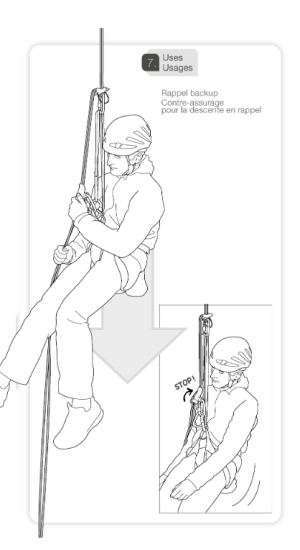
I suggest a Camp Goblin for fall protection. There have been a number of serious accidents using the Shunt for this purpose, including fatalities, which you can Google. The Shunt is for rappel back-up, not fall arrest. I have one and it is is NOT for this.

[Google "shunt top rope solo," which is what you are doing.]
 
I have mast steps, which are great. When going up, I much prefer being ashore and in a secure cradle, but as long as it's calm, it's OK at anchor. With the steps, I normally use a bosun's chair, with my wife taking up slack on a halyard as I go up, and making fast once I'm where I want to be. A bit of thought, care and preparation pays dividends.
Curiously, most US marinas will not allow climbing the mast with the boat ashore, stands or cradles. I'm not sure I understand the reasoning, since any number of blokes are allowed to thunder around on deck.
 
Newbie here.

What are the preferred methods of getting up.the mast for maintenance? As I need to change the masthead light, which was damaged is storm Amy.

Also is climbing the mast whilst the boat is out the water in a cradle considered to be a safe option or is climbing purely a water based activity?

These are good but expensive now, perhaps about £800:

https://kinlevenmarine.com/shop/yacht-mast-ladder/

I see there are alternative all fabric ones on Ebay which are very much cheaper. Either way you stand a chance of moving them from boat to boat so they can be a good long term investment.

.
 
These are good but expensive now, perhaps about £800:

Yacht Mast Ladder - Kinleven Marine

I see there are alternative all fabric ones on Ebay which are very much cheaper. Either way you stand a chance of moving them from boat to boat so they can be a good long term investment.

.
These are highly regarded in the US. Many surveyors and riggers use them.

Mastmate ladder

The loops may seem less convenient, but they are reinforced for support and grab the foot very securely. There are no wrongs for the hands, but in fact, climbing is more secure if the hands go around the mast than on some flexible wrung. Considerably cheaper and more durable because of the simple design. Works best with deck shoes (smooth in and out of the loops) and gloves (better grip on the rigging and mast). Very fast.

Notice the fall arrest grab on a halyard near my knee. This glides up and down on its own as you climb or descend, but grabs if you fall suddenly. Camp Goblin. The haul line is to pull my tools up.

9.%20The%20Goblin%20trails%20at%20knee%20level.jpg
 
Newbie here.

What are the preferred methods of getting up.the mast for maintenance? As I need to change the masthead light, which was damaged is storm Amy.

Also is climbing the mast whilst the boat is out the water in a cradle considered to be a safe option or is climbing purely a water based activity?
Perceptions of what is safe can vary. This caught my eye a few years ago. I believe the owner got his head for heights while working on the construction of Canary Wharf.
 

Attachments

  • TBC high life.JPG
    TBC high life.JPG
    1.1 MB · Views: 55
Perceptions of what is safe can vary. This caught my eye a few years ago. I believe the owner got his head for heights while working on the construction of Canary Wharf.
That looks like an extremely complicated and questionable solution to an easily solved problem.
 
There are various methods. The identification of potential failures and your backups are what’s important. For example if you are using an external halyard, you are relying on how securely the block is attached. I wouldn’t - especially if you are not 100% sure that the shackle hasn’t come loose. They do that with vibration (unless cable tied) and sounds like the storm has given your mast some shaking.

If you can wait and get help, even just to take up the slack of your safety line, I would wait.

The help I can get is usually limited. My first mate does take up my safety line but wouldn’t winch me up. Therefore I use two prussik knots on a fixed halyard. One attaches the climbing harness and the other I use to push myself up with my foot. This is also much faster than being winched up. I am afraid of heights and appreciate that the hole thing is done much more quickly.

In my way I am relying on the strength of the prussik, the security of the halyard in the clutches on the coachroof. I made the prussik out of a rope that doesn’t give me worries. I am less trusting to the clutches so
I also tie the halyard on a winch.

The perception of the safety of going aloft when the boat is ashore seems to be cultural. I don’t know a yard that would allow that. Also it sounds like replacing a light is a job that can wait for the launch. You won’t need it when the boat is ashore.

If you have never been up a mast and never seen it done, it might be a good idea to ask someone local who knows to come and help you - or paying the hourly fee to two riggers.

Finally, for long jobs I use a climbing harness AND a bosun’s chair on different halyards. I feel safer in a harness when I am climbing but you can be eased into the bosun’s chair when you are dealing with whatever problem you have up there.
 
We have a multitude of kits for going up the mast. Climbing harness, bosun chair, ascender and ascending step. The ascending step is like a step with a rope jammer built in. Its handy when you are at the top of the mast as you can get a little higher if you want to work on the top of the mast. It uses a second halyard that can also be the halyard the ascender runs on. The ascended fixes to my harness as a back up to the main rope.
My wife usually hoists me up the main mast using the electric windlass rope drum. Safer than an electric winch with a self tailer as you can slip the rope on the drum easily. We run the main halyard via a block at the bottom of the mast to the deck mounted horizontal windlass.
 
I've frequently gone up the mast of yachts when ashore in cradles, some quite small (24' LOA or so, but I only weigh 70Kg). Just don't draw attention to yourself and choose a day without very strong winds. You've got to consider the heeling moment it can create: as long as it's less than that induced by you standing on the side deck it won't cause a capsize.

You can judge this by drawing an imaginary line from the mast-head to you in your bosun's chair and on, down to the ground: does it pass outside the gunwale? If so there may be a problem, but it it's well inside then there's no issue. Obviously, if dead centre, ie the imaginary line goes through the mast foot, there is zero heeling moment. You can use trigonometry if you prefer; it'll give the same result. The key thing is to keep jolly close to the mast, not swinging around.

Alternatively, consider the effective moment from a side wind of say 20ms-1 (ie gusting to about 40 knots which we'll exceed 20 or more times a winter in the UK, so I jolly well hope it can take that).

The mast is 16m high say, and 6" wide, so its x section is 0.15m2 per meter length, so 40 knots creates a force of about 37Kg / metre length, equating to an effective moment of 1/2 w x L2, or 4800 Kg-metres.
You weigh 100Kg say, and are 2m from the centre (ie the beam = 4m): that's only 200Kg-metres of moment, much less. Don't worry, climb away (provided the wind is calm that day).
 
Last edited:
I’ve been up my mast a few times on a single static line, bought for the sole purpose of ascending the mast, run up and over the sheaves in place of one of the halyards then made off at deck level.

On the hanging end I use a bosuns chair, ascender, gri gri and pulley. If you want to be safer then use another ascender on a second halyard.

No need for absent minded helpers with questionable winch skills.
 
I recall aged around 7-8 that my father used to go up the mast on our Macwester 27 - by putting a fairly sturdy wellington boot on one foot, tying a halyard around it and with another halyard around his waist as a 'safety line - would climb the mast assisted by my mother. It was a joint effort; she'd winch and also take up the slack on the safety line and he would help by shimmying up the mast and trying to take some of the effort off her. A third halyard could be used for hauling up tools in a bucket (my brother's job, then as I got older my job) and then eventually as we got older my brother and I would do the winching and safety line.

We didn't have a bosun's chair.
 
I suggest a Camp Goblin for fall protection. There have been a number of serious accidents using the Shunt for this purpose, including fatalities, which you can Google. The Shunt is for rappel back-up, not fall arrest. I have one and it is is NOT for this.

[Google "shunt top rope solo," which is what you are doing.]
Thanks thinwater for bringing this to my attention. Shows how you need to keep reviewing and updating methods and gear as things progress.

However I do feel that the way I use a shunt is not really akin to a tope rope solo and not for fall arrest. The halyard I use is tied off a the base and kept quite tight and the shunt attached at waist level so very little or no slack in the system and climbing using mast steps very little risk of a fall or inverting. So its main use is mainly for reassurance. Anyway maybe time to review my methods and use another device.
 
Thanks thinwater for bringing this to my attention. Shows how you need to keep reviewing and updating methods and gear as things progress.

However I do feel that the way I use a shunt is not really akin to a tope rope solo and not for fall arrest. The halyard I use is tied off a the base and kept quite tight and the shunt attached at waist level so very little or no slack in the system and climbing using mast steps very little risk of a fall or inverting. So its main use is mainly for reassurance. Anyway maybe time to review my methods and use another device.
In fact, climbing the mast is exactly like top rope solo, and I do both. Your shunt, as you use it, is exactly for fall arrest. In both you are climbing on holds, and if you slip, a fall arrest device on a parralel rope without slack catches you. No difference. I could also argue that when I use a Goblin for fall arrest when top roping it is just for assurance. Most of the climbs I do, there is no more chance of me falling than of you falling off a potentially swaying mast. Really. I've been climbing for over 40 years, most recently 3 days ago ... on top rope solo.

The function of the shunt is to hold the hand tension (not load) side of the rappel rope, much like a self tailer jaw holds ONLY the tailing load, not the load of the sheet. Not that the shunt is rigged below the rappel device, not above. it is not intneded to hold the full weight of the climber, and certainly not a falling climber.

BTW, the impact force of even the smallest slip on a non-stretch halyard is greater than a climber experiences with a much longer fall on a stretchy climbing rope. Really.

Just trying to keep you safe. Ditch the Shunt for fall arrest. I ditched mine.

1760373534703.png
 
Top