Underwater filler for wood

Seagreen

Well-Known Member
Joined
30 Jul 2005
Messages
2,299
Location
Tied up away from the storm. Oh yes.
Visit site
What does the Panel recommend for filling in age related holes in wood?

My keel had a little bit of fairing compound in, which has to be replaced. In parts, this was quite deep - about 2cm holes - which are too awkward for graving pieces. I've one deep hole which will be graved in, but the rest are too shallow.

So, the compound has to be waterproof, sticky, set hard yet a bit flexible, and be cheap. This is mainly to be used as a fairing compound, but has some deep indentations to fill. The wood is very old and a bit fragile, so some chemical stability would useful as well.

D'oh! Just remembered Roach asking this a few months ago. I'll chase up the thread, but in the meantime, all suggestions and experience, especially from the marine archaeology mob welcomed.
 
Tar and lime. I use the tinned stuff you buy from hardware stores, thicker the better. The lime is either brickies lime or garden lime, they are the same. Pour some tar into a shallow container and add lime till its a putty like mixture. Smear into the gaps. The lime keeps gribble etc away.

If there was no movement and only a small area try Selly's Knead it.
 
You'll never dry it out enough for 'poxy.
Tar and line has worked for centuries.
There's Curraghs here that are built of canvas, or these days old coal or other sacks, and the only waterproofing is tar.

860.jpg


So I'd go for the tar and lime every time.

And it's a sight cheaper than poxy. /forums/images/graemlins/ooo.gif
 
[ QUOTE ]
What does the Panel recommend for filling in age related holes in wood? D'oh! Just remembered Roach asking this a few months ago

[/ QUOTE ]

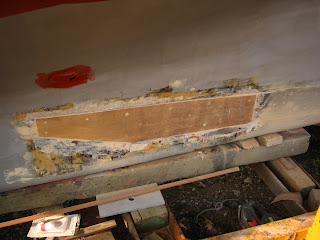
I had a veriety of holes to fill. The first were a number of deep 10mm drill holes, which I took the forum advice and filled with dowels. I squidged the epoxy in using a srynge. The tops of the dowels were left shallow in order to make level using WEST and Mircolight fairing compound. After making the area flush, I chamfered in the new 1inch iroko deadwood plank. Again, this was epoxied in using WEST and MicroFibres to thicken the mix and again, was finished off with Microlight fairing compound. Wood was ALL well under 7% humidity (hard this summer but I had her in a tent) - I used a heat gun around the areas to be filled beforehand juts to make sure the mosture level was as low as I could get it. Now that boat is out I can see no problems with the repair.

img_2239+(2).jpg


PS. This is the biggest under-water repair I have done so far and a well known East Coast boatbuilder acted very kindly as my "Advice Hot-Line" reassuring me to go with WEST epoxy - you just need to ensure that moisture levels are very low indeed.
 
Black pudding, from John at tradboats. Or tar and lime But if you want it to set up, waterproof epoxy filler, no use saying you cant get it dry enough, dry it! with a heat gun if ness.
 
Hi Roach, et al.

I think I'll go for a variety of treatments. The graving piece will be epoxied, but the rest of the fairing in will probably be done in a more traditional manner, at least thats my opinion so far. Dryness of the hull will be no problem as she's been out and cradled for a year, so 'Poxy'll glue well, and has done so in other areas. I'm under the impression that car body filler was originally used in fairing the keel at the forefoot, so when I've finished painting the insides and have a fine cold weekend, I'll get at it.

However, SWMBO has got me booked to lay a 36 m2 lounge floor and to rebuild two fireplaces before Xmas. The job may have to wait.. /forums/images/graemlins/shocked.gif
 
Do not use car body filler, absolutely crap at bonding! and its not waterproof, just being talcum powder in polyester, rubbish!
 
Top