trim a plymoth pilot 18

outlander58

New Member
Joined
19 Dec 2010
Messages
5
Location
Poole, Dorset, UK.
Visit site
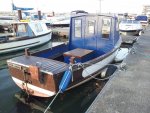
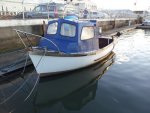
Hi everyone, This is Julie-Anne, I have only had her a couple months and I believe she is very high in the stern. The wheelhouse was added by a previous owner, and was built onto an open boat, so I would imagine added a large amount of weight forward, also I am 6ft and can comfortably stand in the wheelhouse.
So what I am asking is, what is the best way to trim her level in the water, and secondly would the addition of that wheelhouse onto a previously open boat severely affect her stability.
all feedback really appreciated.
Thanks Rob.
two.jpgthree.jpgone.jpg
 
Yes the added pilothouse affects her stability. Whether the effect is severe is unknown.

First thing in changing trim is remove all portable bits in the boat....every single thing....then see how she trims. Take the bow rail off, doesn't seem to do much. Then consider moving or removing anything heavy that's forward of midships. Things like heavy seats, the cabin door, battery, fuel tank, anchor, etc. If you can't do without it then move it aft. Lastly add lead ballast in the bottom of the boat right against the transom.
 
As Tadr said weight above will affect stability I doubt it is critical. Caught out flooding is going to be more of an issue than stability I would suspect.

The trim by the time you have one or 2 in the cabin may well be a bit head down. Again how critical it is is another question.

My suggestion is think heavy aft and low down, light forward (and lowish down?), re-stow the boat move what you can aft.

You would be surprised the effect of moving things just a bit aft, a sum of small parts soon mounts up.

When stowing the boat for your day out leave as much as you can aft, you would be amazed the diffidence the odd crate of beer makes.
 
Is it just me, but the photos don't look bow heavy to me! So long as the cabin isn't too heavily built, it'll prove more of a problem with windage than stability as such - it;s not unusual to see a cabin like an allotment shed on even a small fishing boat. The Pilot isn't lightly built anyway (definitely a displacement hull) so once underway, I'd expect the stern to squat a little and she'll be fine. That said, it's always worth trying a bit of trimming to improve speed and consumption.

Rob.
 
Visit your local scrap yard and see if you can get some iron weights. She won't need much right aft to trim her level. I would't worry too much about the wheelhouse as it does not look too heavily built. The safety rail forward won't weigh much either so I would leave it as a hand hold. The addition of the cabin will have vastly improved the flooding protection when heading into weather. The biggest problem I can see with the design is that because of the window placement you most likely have to either stand or sit in a high seating position to see where your going? If sitting in a high seat this might have more effect on stability as your placing your centre of weight higher up. If the windows were lower you could place your weight lower and still see out.

PS. I presume your fuel tank is aft? If it is empty you may find the vessel is trimmed properly when filled?
 
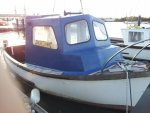
Doesn't look too low at the bows although the third pic. shows rather a lot of A/F above the water. To get an idea of the magnitude of the problem get a few friends or bystanders to cluster as far aft as possible and see how many it takes to lower the stern to a better attitude.
 
fuel tank

Visit your local scrap yard and see if you can get some iron weights. She won't need much right aft to trim her level. I would't worry too much about the wheelhouse as it does not look too heavily built. The safety rail forward won't weigh much either so I would leave it as a hand hold. The addition of the cabin will have vastly improved the flooding protection when heading into weather. The biggest problem I can see with the design is that because of the window placement you most likely have to either stand or sit in a high seating position to see where your going? If sitting in a high seat this might have more effect on stability as your placing your centre of weight higher up. If the windows were lower you could place your weight lower and still see out.

PS. I presume your fuel tank is aft? If it is empty you may find the vessel is trimmed properly when filled?

The fuel tank is up under the foredeck, maybe it would be a good idea to move it into the aft locker. that would move 20l (quite a weight) of fuel plus tank. my workplace has a pilot 24 and her fuel tank is in the stern.
Thanks cryan for pointing out the obvious, sometimes it takes someone else to do that. :D:D:D

cheers Rob
 
When moving weight the effect is double (reduce from one end + add to the other) as opposed to adding weight.

Same goes for weight being moved down: Improves stability more than just adding weight
 
I had a Pilot for over twenty years until about 1995, I recall the transom sat about less than an inch deeper than yours and it also had an open cuddy style wheelhouse, rather smaller than yours, and never had any stability problems. Most Pilots do have some form of cabin. I am also six feet tall and had to bend over to get in with the height being about 5 feet from the deck. When at rest any water in the bilge should run toward the stern.
The fuel tank was in the stern locker and the engine was a 10hp Stuart petrol engine so relatively light compared to a diesel at probably about 150lb max.
I did have lumps of iron ballast in the stern locker and sand bags in the side bilges, with probably 250lbs approx. in total, all this biassed towards the stern. This is slightly different to the stability issue but the Pilot has small bilge keels in addition to the long centre keel and these normally are wood capped, from experience, the deeper these bilge keels are the less prone the boat is rolling in a swell, also allows the boat to stand more upright when aground.
 
I am not sure if it is incorrectly balanced, or simply it appears so because of the visual line of the a/f. You could call plymouth pilots and send them picture 3- they must have a good idea of where the waterline should be.
 
Rather than scrap metal in bags for movable ballast I'd get some shingle ballast in 56lb bags,say 5 of these, and place fore and aft in the bilges until the load line is obtained - remembering that in motion the stern will dip and the bow lift,and forward vision may be impaired if overdone.
I'd certainly want to add some wooden(for lightness) handles to forward topside to allow safe access for picking up a mooring from the foredeck,and a handy(secured)Danforth anchor which folds flat on the deck.

ianat182
 
Last edited:
Top