Transom/ pintle repair

Searush

Well-Known Member
Joined
14 Oct 2006
Messages
26,779
Location
- up to my neck in it.
back2bikes.org.uk
OK so it's only a dinghy, but my 1958 GP14 had a loose lower rudder pintle & removing it revealed some water penetration around the bolt holes. The previous owner had filled the damage with silicone bathroom sealant & thro bolted the fitting with mere steel bolts & washers. I am considering drilling out the bad wood & aralditing in a bit of dowel (1/2" will do it) before drilling new clean & close fitting (4mm) holes. I have limited woodworking tools or skills & this seems an easy & satisfactory solution.

I have bought s/s countersunk set screws with penny washers that will overlap the dowel on the inside & the pintle fitting will cover most of the dowel on the outside, so in effect the dowel will just be a hidden spacer. Clearly I will use a decent marine sealant on the bolts, washers & pintle. If I could find my Aldi hole cutter set I would have cut some plugs out of marine ply to fill the holes in a more professional manner, but it is stored somewhere "safe" & I know not where. :nonchalance:

Any comments about my plan? I'm sure most of you could make a completely watertight & invisible repair, all I need is strong & waterproof - oh & suitable for an incompetent to achieve easily. :encouragement:
 
Problem is that you need to totally dry out the wood before using epoxy. That could take a couple of weeks, easily. I doubt that half and inch will remove the affected wood.
Ideally you should be cutting out a quite large patch and scarfing in new wood.
 
Water penetration isn't necessarily a bad thing as long as the wood is still sound. If the bolts have just come lose then plugging and redrilling should solve your problem.

The only suggestions I can make is that you use proper epoxy instead of araldite since it and other five minute epoxies are rather poor at bonding wood. I'd also plug the holes instead of dowling them. Probably worth buying a new plug cutter for the purpose since you will get a much better fit than if you cut them with a hole saw or use purchased dowel.

This is of course assuming that it's just damp wood and not all out rot you are dealing with.
 
A half inch auger bit should remove all the black wood. There doesn't seem to be any softness around the area. I just looked up plug cutters on e-bay & they are cheap enough to buy one so thanks for the heads up on that, Woodlouse.

No way I am going to attempt a major scarf, Phil, I have neither the skills nor the tools for that.
 
Think I would use dowelling rather than a plug as the grain will run in the direction of the bolt. Coat it all in epoxy, drill the hole for the screw, fill with epoxy and redrill. Bed the fastenings in sealant of your choice (not silicone).
 
I assume from your post that it's the pintle that attaches to the transom, rather than the more usual gudgeon, and that it does indeed bolt right through the transom. Also that the transom is solid wood.

First off, make sure you get rid of all bad wood, otherwise you'll only be doing a temporary job. And if that means a larger hole than you expect, then consider getting a boatbuilder to put in a dutchman for you as suggested (from the inside).

Otherwise, the best idea is probably to fill the entire hole with thickened epoxy. (Araldite will probably do, as long as it's not the 5-minute kind. You can thicken it with wood flour, microballoons, or another fine filler. Even though it's thickened you'll need to blank off both sides with tape while it sets.) It'll probably need two goes and some sanding afterwards, but then the transom will be back to one solid piece. Then drill through the epoxy for the new pintle, coating it with more epoxy as you insert it. That way, all exposed timber edges are protected from water ingress by epoxy.

If you decide to settle for a circular wooden insert, it would be better to go with a plug (or a series of them), all epoxied in place and to each other, rather than a length of dowel. The dowel is simpler because you can cut it to length, but the grain runs into the hole and so is more likely to encourage wicking of water back into the transom, with the attendant increased risk of inducing rot. Whether plugs or dowel, make sure you drill out the right size hole to get a good sliding fit, and epoxy the insert(s) in place.

Silicon has no place on a boat....

Mike
 
Ahh, it is actually the gudgeon rather than the pintle - sorry, my error. The transom is indeed solid wood (but could possibly be ply, it isn't easy to be sure) and the fitting was presumably screwed on originally but the screw holes in the transom have become enlarged & then been thro drilled for bolts with washers.

The boat only goes in the water for a few days during the annual family gathering at Bala and was bought about 3 years ago so has probably had this bodge for a few years. Thanks for all the guidance, guys.
 
Our gudgeons are designed to be screwed rather than bolted. (Pintles are more usually on straps, designed to be through-bolted on to the rudder.) Once you've repaired the timber you could perhaps go back to screwed fittings -- just use stainless or bronze instead of mild steel or whatever it was.

gudgeons-h&v.jpg
Mike
 
This has 3 holes, presumably for screws originally, I am concerned that using screws again may pull the plug out which is why I was planning on using set screws & penny washers which will overlap the plug. Of course, screws mean 2 less holes in the transom that could leak - provided the plugs hold.

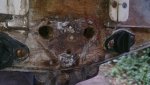
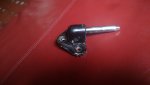
Pics show drilled out holes (it is solid wood) & gudgeon fitting

DSC_0696 (Small).jpg


DSC_0698 (Small).JPG
 
That's a pintle. However. Not much space for messing about there. I would be tempted to do as WBF suggests. Dry out the wood with a paint stripper on half power or hairdryer. Several sessions to get it pretty dry.
Fill the holes with a thickened epoxy and drill through when set for your bolts. That bottom hole probably goes into the hog so you won't get a nut on the inside, so perhaps epoxy a stud (stainless bolt, minus head) in and use a nut on the outside. Or just ignore, your bolts will be pretty secure. As long as they are a snug fit. The bottom pintle does take a bit of yucking. I tore a similar one off by lashing the tiller at the mooring and in a storm it worked the pintle off.
 
Last edited:
There is a "knee" in the centre of the transom that the bottom screw goes into, I was planning to pop some filler in it & then put a greased screw into it before it sets. I may see if I can get a suitable small coach screw/ stud in s/s so it won't matter if I can't get it out at some future time. I have a plug cutter & set-screws with penny washers on order & have filler & epoxy in already so I will keep[ you updated.
 
With the right pilot hole you can put machine screws and bolts straight into wood without a nut on the end. Personally I'd plug that hole as well and bang a screw in.

All the talk of just filling the large holes with epoxy is valid but it makes the job a lot longer. Since it will take at least two applications of epoxy you'll add an extra day to the job with out any benefit to the end result.
 
Ah. That makes it a bit of a rush-job.

How about planting a willow nearby and feeding two twigs through the holes. They should grow to a tight fit by, say, May. Cut it off each side and you have a rot-resistant, snug-fitting plug.
 
Oh my goodness! You want it done that quick? I'd definitely follow Lakey's suggestion then. :)

How to remember the difference between gudgeons and pintles -- 'pintle' is long for 'pin', and that's what it is -- a pin. Alternatively, 'pintle' sounds a bit like 'pencil' (or it starts with the much the same letters as 'penis', if that helps) either of which it's sort of a similar shape to. The gudgeon's just the, er, other bit....

Mike
 
Ah. That makes it a bit of a rush-job.

How about planting a willow nearby and feeding two twigs through the holes. They should grow to a tight fit by, say, May. Cut it off each side and you have a rot-resistant, snug-fitting plug.

That's interesting, there is already a Willow nearby that has been coppiced in the past 100 years or so. The cottage was owned by a Cartwright in the late C19th & early C20th centuries. Amazing how far sighted some people can be. I did consider making a coracle to use as a tender for SR, but they are a bit too tender for carrying hyperactive G-kids & grumpy nannies at the same time & I couldn't find a local Ox willing to give up its hide without a fight.

Oh my goodness! You want it done that quick? I'd definitely follow Lakey's suggestion then.

Yeah, that's one reason why using a profession boat repairer may not be the answer - plus the fact that I am notoriously tight with my wad. :cool:
 
Last edited:
Well the plug cutter arrived today & I tried to cut a test plug out of an odd bit of oak firewood.

It was not as easy as I expected & the drill battery has gone flat. OK so it was only a cheap e-bay cutter, but should it be allowed to spin fast with gentle pressure applied to cut lightly, or should I be leaning on the drill to apply pressure & make it cut faster?

BTW, the transom is solid wood, fairly dense grain & rather reddish in colour, what wood is it likely to be? The varnished finish is fairly dark, but that could just be its age.
 
Last edited:
Top