Transatlantic in a 63' SS Sea Ray.. Laugh Out Loud or Doable?

roguewave

New Member
Joined
26 Feb 2015
Messages
1
Visit site
I've got 30 years experience on the ocean. I understand the fuel issues (my major concern). I also need help with additional fuel storage onboard this vessel. Having never done a transatlantic crossing but absolutely wanting to, despite any immediate concerns. What would be my best options?

Is it possible to arrange for fuel depots with other vessels during the crossing?

Fun bit: I have not actually bought the yacht yet and my goal is to get it to the Med in the Costa Blanca region of Spain.

Some have said: It's cheaper and easier to just have the yacht shipped to a port near Gibralter. Which sounds grand, but I have nothing against battling the sea for a few weeks.

Humor me and throw out some worst-case, best-case scenarios. Obviously the worst case is we lose the vessel and our lives. Best case we make it and have a blast and talk about it until the day we eventually die.

The plan is to actually buy a near new but in need of refit SS and strip it of all the silly things that weight it down and then upon arrival in Spain have it sorted out while dry-docked.

The reason: I own a villa near Denia, Spain and I want to sell out of my property holdings in NJ and permanently move to Spain, with my boat :)
 
Rather you than me, especially re-fuelling in the mid-Atlantic, though U-boats did it back in WW2.

Cross the Atlantic by boat? Nice comfortable cruise liner going west->east or a large sailing yacht going east->west
Boat in the Med? Lovely, buy a European boat while lounging by the pool at your villa

But then I got over-excited just leaving the UK coast behind to go on a short Atlantic jaunt to the Isles of Scilly :)
 
Barbados to Cape Verde is a little under 2.5k miles....if you sit for long enough with a pen and calculator there's a danger you might convince yourself it's doable!

It's not the right boat, no two ways and rather than stripping kit you would be adding it...stabiliser, water maker, fuel tanks...

Buy a cat A with simple blocks and some kind of redundancy, find some like minded cruisers and boats to accompany outside of hurricane season and it could be fun...a fleet of Grand Banks or Flemmings would be ideal.
Of course If it's a must do Bucket List item to do it in a sports cruiser then go for it, but perhaps save it for last ;)
 
I've got 30 years experience on the ocean. I understand the fuel issues (my major concern). I also need help with additional fuel storage onboard this vessel. Having never done a transatlantic crossing but absolutely wanting to, despite any immediate concerns. What would be my best options?

Is it possible to arrange for fuel depots with other vessels during the crossing?

Fun bit: I have not actually bought the yacht yet and my goal is to get it to the Med in the Costa Blanca region of Spain.

Some have said: It's cheaper and easier to just have the yacht shipped to a port near Gibralter. Which sounds grand, but I have nothing against battling the sea for a few weeks.

Humor me and throw out some worst-case, best-case scenarios. Obviously the worst case is we lose the vessel and our lives. Best case we make it and have a blast and talk about it until the day we eventually die.

The plan is to actually buy a near new but in need of refit SS and strip it of all the silly things that weight it down and then upon arrival in Spain have it sorted out while dry-docked.

The reason: I own a villa near Denia, Spain and I want to sell out of my property holdings in NJ and permanently move to Spain, with my boat :)

Ofcourse shipping the yacht is smarter, but....:

Miami via Bermuda Azores to Gibraltar is roughly 3800 miles with 7 knots 3 weeks
Miami via ECUS upto Greenland via Iceland and south via WCUK and Biscay to Gibraltar is 5600 miles with 20 knots 2 weeks
Both ofcourse plus stopover for fuel food etc.
This is doable (summer months only) - doubt the Sea Ray can take fuel enough for the direct route anyway....

:)
 
What you need is something like Kadey Krogen 42 Nordhaven or similar; Richard has just crossed the Atlantic from the states In his and is down in Waterford in Ireland at the moment. He dropped up to visit me on my barge and recounted some hairy moments on the crossing.

an amazing feat in a single engined trawler, nothing special in a sailboat! :p

http://www.trawlerforum.com/forums/s36/%92s-showtime-15877.html
 
Last edited:
What you need is something like Kadey Krogen 42 Nordhaven or similar; Richard has just crossed the Atlantic from the states In his and is down in Waterford in Ireland at the moment. He dropped up to visit me on my barge and recounted some hairy moments on the crossing.

an amazing feat in a single engined trawler, nothing special in a sailboat! :p

http://www.trawlerforum.com/forums/s36/%92s-showtime-15877.html


Great link, will give me something to read later....
 
I don't see why nobody seems to be taking this question seriously because in fuel consumption terms, this is doable. Firstly, lightweight planing hulls at displacement speed are actually more economical than heavy displacement hulls at the same speed. My own 63ft planing boat (which is something of a lardarse) achieves more than 2mpg @ 7kts whereas you'll be lucky to see 1mpg @ 7kts out of a Nordhavn 63 so assuming a 10% reserve, my boat would need to carry roughly 1400g of fuel for a 2500nm crossing. According to the interweb, the Searay 63SS carries 800g of fuel so the OP would have to either build in tanks for an extra 600g of fuel or carry it on deck, which is theoretically possible.

Of course whether you'd want to do it is a different matter altogether. Being stuck at the helm of an open cockpit cruiser whilst it rolls around like a pig for 2-3 weeks wouldn't be my idea of fun and even less so, if you were unlucky enough to hit heavy weather. I suppose if it had stabs, it might make the trip more palatable
 
The question of doable has already been answered. People have crossed in a lot worse. The question really should be is it sensible. I think the consensus is no.
 
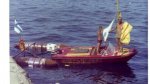
Indeed. The crossing was actually done in a boat i posted a pic above. Their planning was less than meticulous but they did manage to get fuel off passing ships and despite many incidents along the way, they made it.

The owner of the boat never returned from his attempt to circumnavigate the earth, though.

So against that story, it's ofcourse doable, but worth careful planning.
 
The question really should be is it sensible. I think the consensus is no.
What's not sensible about it? At the right time of year, the conditions will be relatively benign. Two engines is one more than most motorboats that cross the Atlantic and if the crew are reasonably competent and the boat well prepared, it's not a mad idea. The issue for me would be the discomfort of operating a planing boat at D speeds for an extended period probably without stabs but thats not really an issue of safety or sense. It's not a trip I would want to make but that shouldn't stop the OP if he really wants to do it
 
What's not sensible about it?
LOL, U must be joking, M.
I just googled for the meaning of sensible, 'cause you made me wonder if I got it wrong.
But I found that such adjective, associated to either a statement or course of action, means "chosen in accordance with wisdom or prudence; likely to be of benefit".
Therefore, IMHO there's nothing sensible in what the OP has in mind - aside from being at least aware of what the worst case is... :D
 
But I found that such adjective, associated to either a statement or course of action, means "chosen in accordance with wisdom or prudence; likely to be of benefit".
Therefore, IMHO there's nothing sensible in what the OP has in mind - aside from being at least aware of what the worst case is... :D
Nah thats the wrong definition. The correct definition is doing something crazy and if you live to tell the tale, it was a sensible thing to do! Having said that, I still don't think the OP's idea falls into that category and we shouldn't discourage him
 
Ah, but!
I have a funny feeling that with someone whose first post in a boat forum is the one which is being debated, we are more likely to encourage him (/her?) by highlighting how crazy the idea is, if you see what I mean... :D

Anyway, FWIW, not only I do hope that he/she will go for it, but also that will keep us posted about the adventure.
As much as I prefer real to virtual boating, that's the sort of cruise for which I'd rather just read about it from an armchair, with some good wine and popcorn handy! :cool:

All the above Assuming that BruceK wasn't spot on with his post #10, which might well be....
 
What's not sensible about it? At the right time of year, the conditions will be relatively benign. Two engines is one more than most motorboats that cross the Atlantic and if the crew are reasonably competent and the boat well prepared, it's not a mad idea. The issue for me would be the discomfort of operating a planing boat at D speeds for an extended period probably without stabs but thats not really an issue of safety or sense. It's not a trip I would want to make but that shouldn't stop the OP if he really wants to do it

It is a bit mad Mike, but agree with Mapis...would be fun to watch the journey unfold. The op's either going to earn life long bragging rights or a big shiney Darwin Prize...it's a win/win. :)
 
I'm going to throw my tuppence in here....

The SeaRay 63 Super Sport were delivered with;

Hard-top and without .... Would prefer the Hard-top for a serious ocean crossing like this.....
Arnesons or V drive .......Would prefer V drive for a serious crossing like this,,,

Low COG with heavy 92 Series Detroit Diesels would last the journey no worries... and would run them 2 - 3 hour each in single engine, swap over and do engine checks etc., as part of the routine.... and running them one at the time will ensure that you get loading on them which these engines prefer...

I for one would not rip out anything of furniture etc., as you'd do the crossing at displacement speed and the limited weight loss you'll achieve is negated by difficulties & cost of re-building the furniture structures etc., at the other end...

Now ... fuel volume needs to be added as low (COG again) as possible, and as only temporary, I'd consider bladder tanks (multiple of) installed with pipework installed to transfer to main tanks as appropriate.... I'd would also consider using the water tank as a fuel tank as to keep COG as low as possible and to avoid interfering with the structure and run a bladder tank as low in the hull as possible and have the watermaker feed only what is required into this as needed...

Fun to see preps evolving.... oooh yes!! :)
 
This is a weird thread albeit a bit entertaining, even though it will work if you get enough fuel and good enough weather but what happens if the weather (wind) gets really bad? Bladder tanks moving about, rubbing against the hull, piping getting stretched or whatever for a longish time....and how about those breaking waves, shit that wave just filled the boat with water and bad news drainage was not good enough so that water just filled the engine rooms and then some, killed the one engine that was just running which is sort of good news, gives you another shot at getting there on the other engine..maybe if the weather improves.

Why would you even try? If you want to cruise in the US/caribbean than I am sure you can get a searay 63 for not so much and if you want to cruise in Europe than there are probably equally good or bad boats to be had. If you enjoy the crossing there are better boats.

And if nothing else in this situation I think CE type classification is a good thing, good luck with the insurance company.
 
Last edited:
Top