Trace / Xantrex C12 Charge/Load/Lighting Controller - PV Array - High Voltage Disconnect Question

CapPugwash

Well-Known Member
Joined
16 Mar 2016
Messages
232
Location
The Firth of Clyde
Visit site
Hello folks.

Does anyone have any experience with the Trace (Xantrex) C12 PV Charger Controller? I have one installed on my boat which I am currently rewiring. I am concerned that it may not disconnect the batteries in a High Voltage situation. It does disconnect the DC Load Output, which I do not use. The manual does not mention disconnecting the batteries though.

I have searched the forum to no avail but I believe that they're quite common.

Many thanks. :)
 
Hello folks.

Does anyone have any experience with the Trace (Xantrex) C12 PV Charger Controller? I have one installed on my boat which I am currently rewiring. I am concerned that it may not disconnect the batteries in a High Voltage situation. It does disconnect the DC Load Output, which I do not use. The manual does not mention disconnecting the batteries though.

I have searched the forum to no avail but I believe that they're quite common.

Many thanks. :)

Not sure what you have in mind for a "high voltage situation"

Product Features

  • Silent, pulse width modulated microprocessor control
  • Electronic protection against short-circuit, overload, over temperature and reverse polarity conditions
  • Field-adjustable low voltage disconnect and reconnect points,
    and a low battery disconnect warning
  • Easy to read, front panel status LED
  • Automatic overload protection (in both active and passive modes)
  • PV array short circuit and reverse polarity protection
 
Not sure what you have in mind for a "high voltage situation"

Product Features

  • Silent, pulse width modulated microprocessor control
  • Electronic protection against short-circuit, overload, over temperature and reverse polarity conditions
  • Field-adjustable low voltage disconnect and reconnect points,
    and a low battery disconnect warning
  • Easy to read, front panel status LED
  • Automatic overload protection (in both active and passive modes)
  • PV array short circuit and reverse polarity protection

Hello Paul,

Thank you for your help again :)

I mean when the PV array is outputting a voltage that is too high for the electrical equipment. I'm not sue what the upper limit is for everything I have but I would like to limit it to say 16 volts.

The manual suggests that it disconnects at 15 volts, by default, for the DC Load terminals which are not connected. The "Photovoltaic Charge Control Mode" section of the manual that deals with the battery charging function only mentions Over Current and Temperature protection. The only time it mentions High Voltage protection is in the event that the batteries are disconnected, again to protect the DC Load. That occurs at 18 Volts when it disconnects the PV array.

Maybe it is just the wording and that applies regardless. In which case is 18 volts too high?
 
Hello Paul,

Thank you for your help again :)

I mean when the PV array is outputting a voltage that is too high for the electrical equipment. I'm not sue what the upper limit is for everything I have but I would like to limit it to say 16 volts.

The manual suggests that it disconnects at 15 volts, by default, for the DC Load terminals which are not connected. The "Photovoltaic Charge Control Mode" section of the manual that deals with the battery charging function only mentions Over Current and Temperature protection. The only time it mentions High Voltage protection is in the event that the batteries are disconnected, again to protect the DC Load. That occurs at 18 Volts when it disconnects the PV array.

Maybe it is just the wording and that applies regardless. In which case is 18 volts too high?

If you are not using the load terminals the controller output will be limited to whatever you have set the charging voltages to.
 
You don't need to worry CapPugwash.

The controller will limit the maximum battery voltage to the set bulk (or equalisation) voltage. As long as the voltage set points are correct, the charging will be appropriate.

The 18v limit is only a safety feature that will operate to help protect connected equipment if the batteries are disconnected, but the solar array is not.

With most controllers It is better practice to always disconnect the solar array from the controller before disconnecting the batteries from the solar controller. If this is done there is no danger of equipment being exposed to the high PV voltage no matter how it is wired and the 18v limit will never be reached.
 
So, I have finally hooked the thing back up again and have come to the conclusion it is kaput! I read 21.4 volts across both the PV terminals and the battery terminals. It seems it is just passing the current through. I fiddled with the pots but they had no effect. The load terminals were reading 0.5 volts. All measurements are ish.

I guess I am looking at replacing it :(
 
So, I have finally hooked the thing back up again and have come to the conclusion it is kaput! I read 21.4 volts across both the PV terminals and the battery terminals. It seems it is just passing the current through. I fiddled with the pots but they had no effect. The load terminals were reading 0.5 volts. All measurements are ish.

I guess I am looking at replacing it :(
I would suggest that unless you have a huge PV array and tiny battery that if you measure 21.4 volts at the battery you are either not actually connected to the battery or the battery is completely open circuit Kaput. No current is flowing in to battery. The controller is probably doing what it should ie connecting PV to battery direct until battery voltage rises too high. The battery if hit with raw PV voltage will draw charge current. This charge current will pull the PV voltage (and battery voltage ) down to that of the battery under charge. The PV panel has a limited ability to provide current typically 5 amps for 100watts in full sun. At 5 amps the best PV panel voltage will be around 17 volts. Draw more current and voltage drops.
Hence it is not essential to have a charge controller between PV panel and battery. the 21 volts no load of the panel becomes perfect for charging a 12v battery.
Only where you have a large PV array and relatively small battery in lots of sun over a few days can the PV system fully charge then over charge your battery. For safety iof the battery 10w is considered the max for typical lead acid battery say 60 amp hour for no controller. 10w will give .5 amp which can be dissipated in a deceent sized battery long term when fully charged. ol'will
 
I would suggest that unless you have a huge PV array and tiny battery that if you measure 21.4 volts at the battery you are either not actually connected to the battery or the battery is completely open circuit Kaput. No current is flowing in to battery. The controller is probably doing what it should ie connecting PV to battery direct until battery voltage rises too high. The battery if hit with raw PV voltage will draw charge current. This charge current will pull the PV voltage (and battery voltage ) down to that of the battery under charge. The PV panel has a limited ability to provide current typically 5 amps for 100watts in full sun. At 5 amps the best PV panel voltage will be around 17 volts. Draw more current and voltage drops.
Hence it is not essential to have a charge controller between PV panel and battery. the 21 volts no load of the panel becomes perfect for charging a 12v battery.
Only where you have a large PV array and relatively small battery in lots of sun over a few days can the PV system fully charge then over charge your battery. For safety iof the battery 10w is considered the max for typical lead acid battery say 60 amp hour for no controller. 10w will give .5 amp which can be dissipated in a deceent sized battery long term when fully charged. ol'will

Thanks, it is true that i had not connected the batteries yet. I wanted to check the High Voltage Disconnect was functioning. But it sounds like it won't until there are batteries. When I did connect the batteries it read 13 v (ish). So that sounds ok.

Your description could also explain the high voltages I was experiencing before. My electrics were in a bad way and there was significant voltage drop. So now I have fixed that, it sounds like I should leave the PV connected for a while and see what I get.

Thanks :)
 
FAILED TEST!!! :(

So, I was at the boat today with full sunshine so the perfect opportunity to test this. The Batteries were fully charged a few days previously.

From the manual :

Photovoltaic Charge Control Mode
3-Stage Regulation
The C12 charge controller rapidly cycles the photovoltaic array on and
off to control the charging of the battery. The battery voltage will vary
during the charging process, as follows:
1. BULK—During this stage the PV array is allowed to charge at its
full output. Once the voltage of the battery reaches the BULK
voltage setting, the controller goes to the next stage.
2. ABSORPTION—During this stage the voltage of the battery is
held at the BULK voltage setting until a timer accumulates 1 hour.
3. FLOAT—During this stage the voltage of the battery is held at
the FLOAT voltage setting. Full current from the PV array can still
be delivered to the loads during this stage.


With the POTs all at default, and the battery connected, I switched on the PV panels. The voltage began to rise from the 12.88 volts starting point. If it was working correctly I would expect the PV Controller to allow the full PV voltage through until it reaches the BULK/HVD setting, being 14.0v by default. For Stage 2, Absorption, it holds it there for an hour before moving on to stage 3, Float. Now the voltage is held at the FLOAT/HVR setting which is 13.5v by default.

However, the voltage kept climbing until I turned off the PV array at 16.7 ish volts.

There is a NiCad NiFe mode that adds 2v to the POT settings. This is set by clipping a resistor so I wondered if that was the problem. I repeated the test with the POTS set to the minimum settings. The results were the same unfortunately. I also checked the test points on the POTs to see if a POT was the issue. They were all ok.

So it seems that the controller is either not attempting to regulate or cannot regulate the voltage when it should. The manual says that it has 3 modes and can run on or more of these modes, but does not mention how to set them. The modes are :

Operating Modes
The model C12 charge/load controller can operate in one or more of
the following modes:
• Photovoltaic Charge Control Mode with 3-stage
regulation and automatic or manual battery equalization cycle.
• DC Load Control Mode includes automatic low battery
disconnect with warning by flashing the loads. In manual mode the
reset switch allows one 10-minute “grace period” of load operation.
• NITE-LITE Mode with automatic dusk detection and adjustable
time period from 10 minutes to 9.5 hours duration or dusk to dawn
operation with a 20 hour limit.


Maybe it is stuck in DC Load Control Mode?
 
Last edited:
I find it amazing that your battery got up to 16.7 volts. it should have been really boiling by that stage. What is surprising to me is that you have so much solar PV power to be able to do that. Unless you have a small battery or the battery is old and has a small capacity such that it charges /over charges quickly. yes i understand battery was fully charged (from shore power I presume) So just going over again was 16.7 volts measured at battery posts? was battery getting hot? How much solar power do you have and how much battery capacity do you have (AHs?) But yes beginning to look like a dud controller. ol'will
 
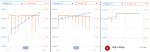
Yes, and it would have gone higher had I not disconnected the PV array input. I captured the charts below. I missed the beginning because i switched from the app to my camera. (It is frustrating how it does that!) The readings are taken by the Victron Battery Monitor I just installed and have been confirmed with a Volt Meter.

I have a 75w Siemens SP75 PV panel and 4 x EXV90 Enduroline Calcium Leisure Batteries, 80 ah (C20). 3 are in a Domestic bank and 1 is the Starter Battery. These are combined by a Cyrix CT when the voltage is high enough on either side.

The batteries are 5 or 6 years old so they may need replacing. I wanted to get everything else sorted first.

Not sure it is relevant, but I removed a dump regulator when I took down my wind generator. It had been storm damaged and makes a racket!

1646654602971.png

EDIT : Looking at those charts, the voltage and amps do drop very regularly. The Charge Controller must be doing something.
 
What has me surprised (or doubtful) is that 2 amps could raise the voltage of 320AH of battery up to 16volts. I would think even just one 80AHbattery could soak up 2 amps long term without going into over charge. Like I said before check actual voltage at the battery posts with digital volt meter. This will check accuracy of built in volt meter and continuity (low ressitance) of all wiring to battery. Summat queer goin on. ol'will
 
What has me surprised (or doubtful) is that 2 amps could raise the voltage of 320AH of battery up to 16volts. I would think even just one 80AHbattery could soak up 2 amps long term without going into over charge. Like I said before check actual voltage at the battery posts with digital volt meter. This will check accuracy of built in volt meter and continuity (low ressitance) of all wiring to battery. Summat queer goin on. ol'will

Thanks Will. The measurements above are correct, checked at the battery posts. I just replaced all the wiring so that is not the issue. Maybe the batteries are buggered, I'll do a load test on them next time I'm down.

Someone suggested this cheap controller in another thread : EP Solar Landstar 10A 12V Solar Charge Controller 120w . I think I'll fit one for the time being.
 
Last edited:
Top