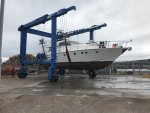
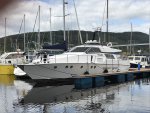
Touching (up) a mature Lady's bottom

Divemaster1

Well-Known Member
Joined
15 Jan 2002
Messages
4,456
Location
Aberdeenshire, Scotland
Visit site
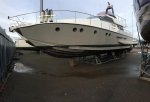
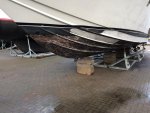
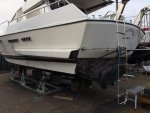
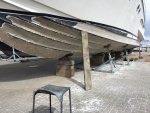
Lifting Navigator out of the water this year, I noticed something appearing to be a blister (or two) just under the waterline ... Despite getting a clean bill of health by surveyor two years ago, I had to admit to myself that this winter was going to be a bit hard work ...

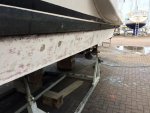
So biting the bullet and doing the whole hull.... currently scraping off anti-fouling, followed by light sanding to expose any blisters to repair ... cut them open to expose good material and conduct repair... I have also found a couple of old nicks in the chines (covered by old antifoul), which will be repaired at the same time...

This will then be followed by more sanding down of whole hull, before applying epoxy followed by new antifoul.

Hard work, but getting really intimate with every inch of the lady's bottom :) ... if that can be counted as an award.

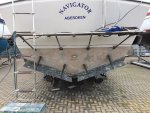
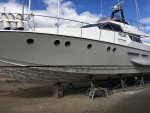
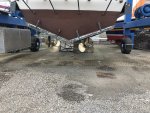
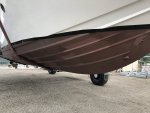
So in the midst of all this, is there any advise that the forum can give on how to best achieve the above ?? ... half the hull is scraped to what the pictures show in about 3 days, working around 5 hours each day ... which is about how much I can do before muscles give in ... so have plenty of time to take your guidance into practice ...

Thanks!
 

Attachments

  • IMG_0009_1.jpg
    IMG_0009_1.jpg
    72.6 KB · Views: 2
  • IMG_0007_1.jpg
    IMG_0007_1.jpg
    69.9 KB · Views: 2
  • IMG_0006_1.jpg
    IMG_0006_1.jpg
    73 KB · Views: 2
  • IMG_0005_1.jpg
    IMG_0005_1.jpg
    69.5 KB · Views: 2
Tough work that Alf, I'm not going to give advice on work to blisters, I think I would know what to do with them but I'm not 100% so will leave that for others who are 100% on what they are doing. However, sanding I do know a lot about.... if you have not got a decent orbital sander with dust extraction I can highly recommend a Mirka Deros , https://www.restexpress.co.uk/acatalog/mirka-deros-system-1-kit-150mm-abranet-ace-discs.html#SID=30 its an investment but (so long as you have a good vac, Mirka do one, or I use a Henry), it is 99% dust free sanding. The Abranet discs last well and are superb. I have always found wet sanding unpleasant, using this Mirka sander makes the job a load easier. Good luck with the work!

 
Last edited:
After trying all sorts I ended up using a vacuum-connected scraper, assisted by an orbital sander with Mirka Abranet discs.
Our marina has equipment incl. an industry vacuum cleaner for free use by members and this scraper collected all very neatly. Working with the hose attached however took more elbow grease.

922a3ff8cbdcbe68295bbc8fd9d86d0949dba7a3.jpg


Was a big work and I decided that is was my last of the kind. Pretty good shape now, but when eventually needed next I'm letting somebidy else do it, most likely by high pressure hot water followed by a dryice-blast.

For me the next generation antifouling is thin-film paint over a sealing primer. I did it on a previous boat years ago with VC17m and was happy for all the time I owned it.

The product on my radar at the moment is SeaTec GTi 30 from svb in Bremen at EUR 89.95 for 2½ liter (copper, red or anthrasite color).

www.svb24.com said:
Highly efficient thin-film antifouling paint with a PTFE base. Thin film anti-fouling does not act through the release of active components into the water, but by the extremely smooth surface it creates, thereby preventing organisms from easily adhering to it.

Its PTFE additive is what creates the extremely smooth surface. The anti-fouling effect is further supported by the embedded copper in the binding components. The smooth surface has very low frictional resistance in the water, resulting in higher speeds with lower fuel consumption.

Very well suited for the North Sea, Baltic Sea and inland waters. Not suitable for aluminum boats; Steel boats have to be primed with a bi-component primer (at least 350 μm). GTI 30 is ready-to-use and contains approximately 30% metallic copper powder. Quick-drying, a boat can launched 5-6 hours after application. SEATEC GTI 30 is compatible with VC-17m and can be applied directly to existing old coatings without primer / adhesive. SEATEC GTI 30 does not contain chlorofluorocarbons. Available colors: copper, red, and black. The final colouring does not develop until some time after immersion.

Coverage: approx. 11m² / litre at a dry film thickness of 10 microns, dry for about 20 minutes (20°C).
 
Last edited:
Thanks Firefly!

Got a Makita 5" random orbital sander at the moment, but if it fails I'll definitely look at your recommendation!

no probs, I would just add if your current sander has dust extraction and Velcro backing then you can still just buy the Mirka abranet sanding discs, they are mesh discs rather than the normal paper type with holes, with the mirka mesh type dust goes through the actual discs which is a key part to full dust extraction... I'm sounding like a Mirka salesman now!
 
After a lot of trial and tribulations, a GelPlane with a skilled person operating it was the answer .... All done in a days work and I'll finish the underside of the chines, the details around hull fittings etc. Then it is a waiting game drying out until filler, epoxi etc., goes on ... still a lot of work left ...
 

Attachments

  • IMG_0063_1.jpg
    IMG_0063_1.jpg
    94.8 KB · Views: 1
A gel plane is not for removing antifouling , as its name says It planes off the Gel exposing the matting, its a brutal tool especially on a hull with chines.
 
A gel plane is not for removing antifouling , as its name says It planes off the Gel exposing the matting, its a brutal tool especially on a hull with chines.

....Hence using the tool for removing the Gelcoat, exposing the laminate and de-laminated areas caused by the Osmosis ... so I can do the hull repairs needed etc. We were cautious when looking at the chines, but fortunately, both the hull and chines are laid up properly with a very even layer of gelcoat, so chines shape is retained after stripping the top part.... if there were any doubt or indication that the chine shape would be compromised, we would not have touched the chines with the GelPlane. I decided to strip the gelcoat and do a full UW hull Osmosis repair / prevention when we discovered several areas with small blisters starting to form .... We could have done spot repairs in principle, but I'd rather do a proper job once...
 
A milestone achieved over the WE ..... after two years of blood sweat and tears;

1) Gel removal, Sanding down gel of chines
2) sanding out de-laminated fibreglass
3) Plenty of time to dry out (Daughter summer wedding)
4) 2 coats of low viscosity epoxy
5) repairs of blister areas
6) fairing, sanding, fairing, sanding
7) 8 coats of epoxy
8) 3 coats of 2 component epoxy primer
9) 3 coats of antifouling + new stripe
10) cutlass bearing replacement

... that is 16 times across the whole hull with roller, brushes and pads (not counting fairing and sanding)... I feel that I know the hull pretty well by now ....

So gone from bare bottom, to fairing and complete, including through hull fittings checks etc., until finally afloat on Friday ....

IMG_0006.JPGIMG_0007.JPGIMG_0116.JPGIMG_0118.JPGIMG_0123.JPGIMG_0129.JPG

oooh, and as we obviously did not have enough to do, we have also re-upholstered the saloon and galley areas ...

Now onto the work of cleaning, recommissioning the main systems, engines etc., plus cosmetic work on topsides, replacing damaged torpedo screen etc., etc..
 
Last edited:
I missed this thread when originally posted, an amazing commitment and effort indeed, very well done! :encouragement:

sanding out de-laminated fibreglass
This part made me curious, because It's rare to hear of more than just superficial blistering, on these early GRP hulls.
Though I'm mostly thinking to builders in Tuscany, Adriatic, or along the coast from Rome to Naples.
IIRC, Centromarine was based in Apulia - a sort of oddball, in the nautical industry.
Have you got any detailed pic of this delaminated areas?
 
Was just superficial ...the deepest part sanded out was not much more than 1 - 1.5mm I guess..., but where I could see dry weave in top layer, I classed it as de-laminated area and sanded it out, before coating the whole hull with low viscosity epoxy (penetrates better than what was used as the barrier) and conducting repair followed by full fairing of the hull...
 
Two years on the hard Alf, sounds like the old lady has had a real birthday, good to see the commitment.
Any cruising plans now she is back in the water? Out to the West Coast perhaps?

Congrats to all for the big wedding, they grow up so quickly :)
 
Top