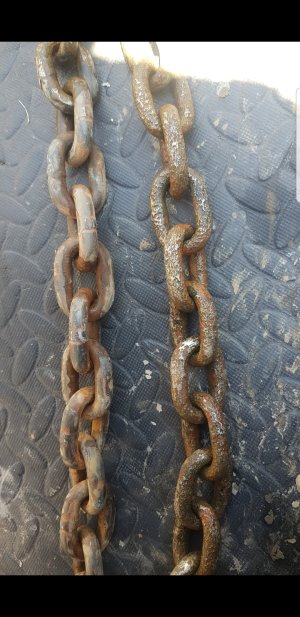
Top Riser chain, Menai straits Jimmy Green sleave.

Rhylsailer99

Well-Known Member
Joined
19 Jun 2020
Messages
782
Visit site
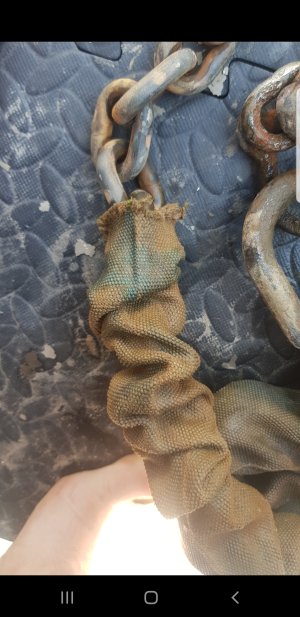
I had a sleave over my chain, and I was shocked to see the difference after 2 years of the section not in the sleave.
sleaved section still measures over 10mm, but the unsleaved chain is pitted and measures only 9.4mm.
I was told the sleave might cause the chain to rust more, but as you can see it offers better protection.
 

Attachments

  • Screenshot_20230614-160801_Gallery.jpg
    Screenshot_20230614-160801_Gallery.jpg
    1.2 MB · Views: 27
  • Screenshot_20230614-160753_Gallery.jpg
    Screenshot_20230614-160753_Gallery.jpg
    1.5 MB · Views: 25
Galvanising on a chain in a mooring system will not last long. The constant mooving under load quickly wears galvanising between links and then starts wearing the chain metal itself. Galvanising might keep the outside of the chain looking good for longer but wear will be similar to black iron.
Interesting that OP chain is ok under cover. Cover is bad in one sense that you do not inspect the chain in that area. I can only suggest there is less movement of the chain in that area So less wear. Or worn chain is the part in the water more. . ol'will
 
A friend at Abersoch used stainless steel chain for the riser. Not sure what went on down below where different metals met but the top bit looked good.

Interesting that on another thread about anchors very few people knew of anchor chains that failed But there seem to be many examples of moorings (chain, rope, joins) failing.

My experience in the past was surprisingly fast deterioration of chain coupled with wear at the link joints from constant movement.

Is the wear and galvanising loss from above or below water?
 
A friend at Abersoch used stainless steel chain for the riser. Not sure what went on down below where different metals met but the top bit looked good.

Interesting that on another thread about anchors very few people knew of anchor chains that failed But there seem to be many examples of moorings (chain, rope, joins) failing.

My experience in the past was surprisingly fast deterioration of chain coupled with wear at the link joints from constant movement.

Is the wear and galvanising loss from above or below water?
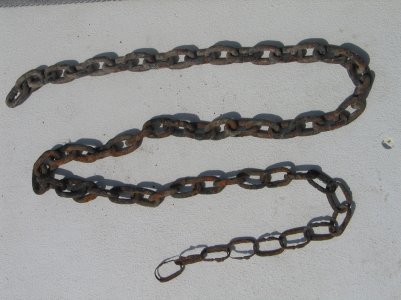
Indeed yes, moorings are a very different matter. Corrosive wear is a major problem, this occurs where a nascent bright surface is created by wear, either between links or against the seabed, it corrodes and the rust is immediately worn away. I know of a mooring in a rather exposed location in Menai Strait that had a boat on it all winter. The mooring failed in the spring and the boat was wrecked. I saw the chain but have no photos.

The photo shows a chain I saw in Mallorca, a mooring for a small motorboat. Wear occurred against the sandy seabed.
IMG_2151 small.jpg
 
A friend at Abersoch used stainless steel chain for the riser. Not sure what went on down below where different metals met but the top bit looked good.

Interesting that on another thread about anchors very few people knew of anchor chains that failed But there seem to be many examples of moorings (chain, rope, joins) failing.

My experience in the past was surprisingly fast deterioration of chain coupled with wear at the link joints from constant movement.

Is the wear and galvanising loss from above or below water?
Yes it is the interface of Stainless steel chain to black iron or GI where problems occur with wear on the black iron. Our government mooring authority mandate and provide a floating buoy with stainless steel rod through the centre incorporating a swivel. A thousand or more in place but it is the connection to the riser of black iron chain or GI with a GI shackle that gets most wear and deterioration. One friend elected to go for rope riser which actually seemed like a successful idea. However I went for all SS which has been good for many years. Then only interface with black iron is where it goes around the railway wheel then shackled back onto itself. ol'will
 
I've been using octoplait polysteel risers (on fore and aft moorings) for 25+ years. I have changed moorings in the past but never had to replace a riser. So far as I am aware my old moorings are still in use, unchanged.
Not sure about using it on a swinging mooring, there would need to be a fairly free swivel incorporated.
 
Indeed yes, moorings are a very different matter. Corrosive wear is a major problem, this occurs where a nascent bright surface is created by wear, either between links or against the seabed...

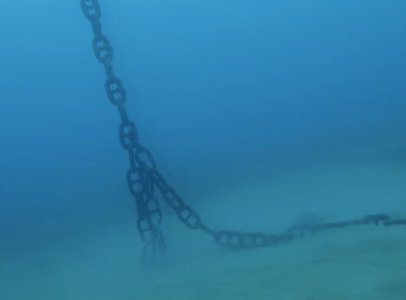
You're not kidding! Here's another photo; wear is especially bad in volcanic ash. I took the video on Good Friday (the pic is a still from the video), and on the evening of Easter Sunday the chain parted and the boat on the mooring was wrecked. I tried and failed to alert the boat's owner to the state of his riser over the w/e.

In the swell the riser was going up and down about 1m, and the wear in this section was amazing, whereas it was negligible elsewhere.
Depth ~14m, Boat 'Joyce' a 23m LOA fishing boat, location Little Bay, Montserrat. You can see where it was joined by a shackle in a futile attempt to bridge the worn section.


1686937941408.jpeg
 
Top