Tips on filming on a boat?

Karel

Well-Known Member
Joined
7 May 2006
Messages
125
Location
Behind you!
Visit site
Hi everyone!
wink2.gif


My first post here.
thumbsup.gif


I work in the film industry in the UK and subscribe to another forum where other film folk post questions, and someone has just asked this:
<ul type="square">[*]Hi, I'm planning a shoot which involves shooting (with a cast/crew of about 10 people) at sea on a small yacht. Anyone done this before, and if so, can you give me any pointers as to what problems/issues I will encounter, and any additional safety or insurance issues I should plan for?

Thanks, Paul J

[/list]
So I thought I'd ask the old sea dogs here (and include a link on the BB) to see if anyone here had any advice to give or relevant experience.

I'm also curious about any other tips / stories (or links) people may have regarding filming on a boat or at sea that go beyond what Paul is asking.

Cheers!
captain_125.gif
 
Depends what you call a small yacht. 10 people will fill up a lot of small boats.

The other thing is that you will need a far wider lens than you imagine to get any context into a shot. But the the subjects may look a bit distorted. I would suggest rafting to a larger MOBO and using that as a filming platform.
 
Make sure the cameraman takes some anti sea sick stuff. Looking through a lens while all around you keeps moving doesn't help them one bit!
 
Have done some. You'll need a shadow boat with an experienced helm and good cameraman who is horizon-aware, mobile and doesn't get sick

The shadow boat will need to get close and it calls for good seamanship by all

You don't say what conditions you expect to film
 
I have done a bit of filming drama at sea in all size of boats.. The big trick is to keep the crew to a minimum on board the 'action' vessel. Minimum crew. leave the rest on the safety boat!

Try to fix packed meals so that the unit does not have to dis-embark for breaks.

A helicopter is far and away the best way of getting sailing shots or even motoring shots and with the time it saves is often cheaper.

Make sure the actors have been familiarised with how they should appear to behave on board a boat rather than leave it till they are sick, frightened and cannot remember their lines far less which bit of string to pull... a bit of rehearsal can save a 1000 retakes!

Michael
 
Thanks for the replies. I'll pass the url to here on and maybe he can ask questions himself. I posted something myself in the BB yesterday - should've posted it here too, but was curious about what other folk would have come to mind:<ul type="square"> The first thing is: avoid doing it! By that I mean plan your shoot to need as little footage as possible while out at sea. We all moan about the weather in the UK, but it's far worse at sea. I was due to do some sailing this weekend, but there was no wind (well, just about force 2!) and then it rained. And no sun. Most people see the sea as a place of beautiful tranquility, but they only ever see it on trips to the seaside on calm sunny days. That's maybe 20 days out of the year, if that. So do all your below decks shots in some comfortable marina.

I would say use a skipper who's had experience of film crews, and get a local fixer/location manager. There are companies who specialise and the local harbour master's office should be able to help there. Good local knowledge is key. Also have a full complement of crew to handle the boat who are not part of the film crew. This is usually not too many, and they shouldn't be expensive. Boats are expensive, sailors aren't!

Consider hiring a tender just for ferrying stuff/crew to and from the boat or between boats. It will save a lot of time. It will also allow to shoot shots of the boat itself.

You MUST check all this with your insurance company. I use Navigators and General - they do a good deal. You have to tell them exactly what you are doing beforehand and *that you intend to be filming*. My policy covers me for UK coastal waters up to 30 days in a year, and I have to tell them before. Any further out and I have to make special arrangements, and that will mean everyone carrying their passports. Check that your camera gear is fully covered. Remember that insurance companies will gladly take your money, and only check that you've met all the provisions when you make a claim.

Sea sickness: you can use sea sickness pills, but they usually contain the anti-histamine Piriton which WILL induce some drowsiness (a good alternative to a sleeping pill actually!) But I find that Cetrizine works well (for me) with minimal drowsiness. Half a tablet seems to do the trick. Those prone to sea sickness should medicate before the trip - it's too late once you're out there - so it's worth taking everyone out on a training/familiarisation trip just to see who's prone to it. Not every film crew does this, and I was on a shoot where the focus-pull became violently ill (the only time I've ever seen someone turn genuinely green) and the loader had to take over his duties, on a heaving fishing boat!

On UK inland waters children are obliged to wear life jackets at all times. I'm not sure about coastal waters, but this is a good rule to follow. It certainly helps with any dealings with the coastguard! They really don't like to see children being put at risk. Non-swimmers should wear them at all times too. Old life-jackets can be smelly unpleasant things, and on a hot day your cast/crew might not be too happy with theirs and be inclined to take them off. I think it's worth buying some.

Be strict with those fooling around. Accidents do happen, and people do die. And anyone falling in the water might seem funny at the time, but it really could cost you an hour of filming in having to safely recover them (I assume you plan to shoot on a calm sea, because in poor conditions you can assume they are lost to the sea and pray the RNLI can find them) and then they could well sue you for negligence if they get hurt. And they'd be right to!

Ban alcohol consumption at sea. Even at lunch time.

Legally there should at least one qualified VHF operator on board. Check this! Many UK skippers don't bother because this means taking a one day course somewhere and this may affect your insurance if there's an incident, or if the Coatguard chooses to get bolshy. Only he/she or a delegated member of the crew should ever make a mayday broadcast. It really is a specialised skill, and an arrogant film director is not qualified! It's worth checking to see if the mayday protocol is on a printed notice next to the VHF set. It doesn't have to be, but it's a good sign if it is.

Boating people are very very helpful, salt of the earth, and you'll love them. But be prepared - they take forever to do anything. Unless you're in trouble, then you'd be amazed. Best of luck.

Are you still sure you want to film on a boat?

Forgot to add (the most important thing): at all times *the skipper is in charge*. If he says you can't do something, or that you have to go back because he's worried about the weather turning, then that's it, day over. Don't push him on it - that's how it goes.

Oh, and sometimes the coastgaurd likes to send out their helicopters on a practice rescue. If this fits with your script, or with your *familiarisation day* you could always try asking. Similarly the RNLI can be very obliging...

Excellent sea safety site here: http://www.rnliseasafety.org.uk/upload/seasafety/e-learning/nav.htm
[/list]Reading it again, I sound like a grouch!
yellowlaugh.gif
 
Why does this thread only appear in 'active topics' (and on page 2) and not where I posted it on 'Practical Boat Owner's Reader to Reader'?
confused.gif
 
Check your profile settings , if you change the right one it'll be at the top . By the way , fill in some details while you're there , not compulsory , but does sometimes help , you could have an expert next door and not know it
 
all three of your posts are in the same thread, and in the same place you posted them, so you probably need to learn how the forum sofware works. If you want to see how most recent posts on a thread appear, rather than when a thread was posted, go into your options and change your options to see threads by date updated rather than when when posted. Commonly called date slip here
 
I am probably making amateurish comments to proffessionals however.
You need to carefully plan any photographing of yachts.
Generally you need the sun behind the camera. Shots generally look better from the windward side and shots of crew you take from behind while shots of action, the bow from the front. You then have to deal with the glare in the eyes of the crew if they are looking at the camera. You certainly need a skipper on the sail boat boat who understands the needs of the photographer and then a chase boat that can go fast to reposition itself.
olewiilll
 
I figured it out Brendan & Trevera. Thanks. I'll add some profile stuff soon.

Thanks for all the tips, though it's not for me personally and the info I have is scant. I'll pass this link on and suggest Paul joins and asks what he wants to know.

I'm an old hand at filming myself - on land - but some of the stuff I read about filming at sea has surprised me: sometimes by how obvious it is once you know! Like the glare. Of course if the sun is behind you (if there is any that is) it will be reflected off the sea and cause glare . Doh!

Saw King Kong last night. Great effects, but stupid nautical stuff, like when the ship is headed for the rocks the captain orders 'stop engines!'. Well of course the boat, because it's a bit pointy at the front, would just carry on onto the rocks wouldn't it...?

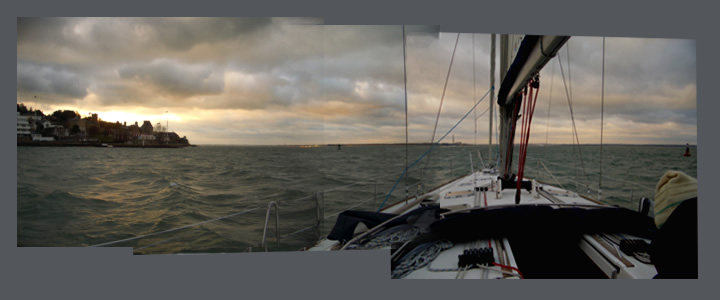
One of the things I've found with just taking stills is how difficult it is to capture what's it's really like on film. Here's one I rather like here, taken on a trip out of the Solent on a friend's boat:
view_ahead.jpg


Beautiful sunset. The problem with filming is you can't plan something like that.

For those who are interested in cinematography stuff, someone gave me this link here:
http://www.cinematography.net/Pages%20GB/%5Bcml-pro%5D%20Boat%20sequence..htm

Cheers
 
Done this for historical re-enactment stuff as tech adviser and cast extra. Cannot emphasise too highly the need to find camera crew who don't get seasick or alternatively get sleepy on Stugeron. Its also quite common for non-film types to get very frustrated when its apparently all gone just fine and yet the director still isn't happy. Don't vex the boat crew lest they become inflexible.

Its not a sound stage, nor is it simple location work, both issues that need sorting out with the film crew before the set foot on board. Likewise even Spielberg can't affact tides or weather.

And one other one. Cameras and recording gear neither float nor, unless specified so, are they very resistant to salt water. The above screwed up (despite warnngs) a potentially decent documentary on the Civil War in the Solent and IOW a few years back, ended up with about three minutes of useable footage after viewing the takes:-(
 
What on Earth are they doing? Is that meant to be sexy? Is that a guy with his back to us? They all seem to have implants. Is that Great Yarmouth in the background?

Seriously though, this is going a bit off topic...
rant.gif
 
Top