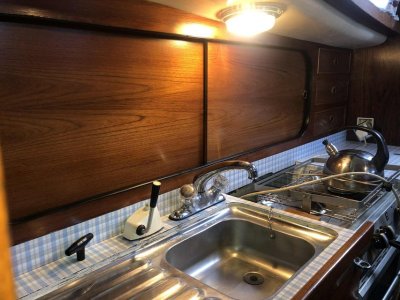
Tips for bringing back the finish on this veneer

Ceirwan

Well-Known Member
Joined
26 Jul 2007
Messages
1,148
Visit site
New to me boat.

The veneer and woodwork is generally in pretty good condition, and can be refinished as normal.

However in a few spots there is evidence of water penetration damage.
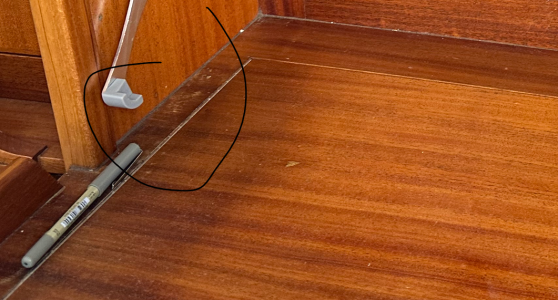
1763016586127.png

Now in the past I've ended up sanding through the veneer while trying to repair stuff like this and making it look even worse, and I'd rather avoid that this time around.
I'm thinking maybe heat gun or stripper to take off the finish, then maybe some bleach / oxalic acid solution to try and remove the stain, followed by a very light sanding & then revarnishing.

Does that sound like a sensible plan?
 
Yes. Heat gun will be a bit tricky if you only want to do the damaged bit. Also when you come to finish it you might have difficulty blending it in with the surrounding area.
 
Rather than try and blend the varnish, I'll probably unscrew the centre portion of the chart table & then strip the varnish from all the surrounding chart table surround area. Seems the easiest way to get a good uniform finish.
 
I scraped the old laquer off the galley area on my boat. I tried cabinet scrapers at first without much success. I ended up using a broad chisel, 2" if memory serves. I sharpened the chisel in the normal manner but didn't remove the burr. When I drew this across the veneer the laquer came away in blonde ribbons. When the ribbons of old laquer gave way to dust I new I'd reached the veneer. At that point I cleaned up, vacuumed the ribbons and dust, wiped down with a tacky rag and applied 3 coats of acrylic laquer.
1763035780304.jpeg
 
If the veneer has stained by water .. then that means the lacquer is not sealed ... I would try Oxalic on it without stripping the lacquer .... it may take longer and need repeated coats / rinse off ... etc .. but worth a try ....

Then its furniture lacquer to finish.
 
I scraped the old laquer off the galley area on my boat. I tried cabinet scrapers at first without much success. I ended up using a broad chisel, 2" if memory serves. I sharpened the chisel in the normal manner but didn't remove the burr. When I drew this across the veneer the laquer came away in blonde ribbons. When the ribbons of old laquer gave way to dust I new I'd reached the veneer. At that point I cleaned up, vacuumed the ribbons and dust, wiped down with a tacky rag and applied 3 coats of acrylic laquer.
View attachment 202041
Looks good, what lacquer did you use ?
 
Looks good, what lacquer did you use ?

Vintro Gloss and Satin. Mixed 50/50 to give that mid-sheen.

From their blurb: Easy to apply using a brush or roller, Extreme Lacquer is ideal for items which will get used more robustly, such as coffee tables, and it will give a fully washable, sealed surface. Extreme Lacquer should be used in areas of high moisture, such as kitchens and bathrooms, or for exterior use. Can be used on bare or painted surfaces. Vintro Extreme Lacquer is formulated to be non-yellowing.

1763051789081.png1763051799706.png
 
Vintro Gloss and Satin. Mixed 50/50 to give that mid-sheen.

From their blurb: Easy to apply using a brush or roller, Extreme Lacquer is ideal for items which will get used more robustly, such as coffee tables, and it will give a fully washable, sealed surface. Extreme Lacquer should be used in areas of high moisture, such as kitchens and bathrooms, or for exterior use. Can be used on bare or painted surfaces. Vintro Extreme Lacquer is formulated to be non-yellowing.

View attachment 202062View attachment 202063
Thanks (y)
 
New to me boat.

The veneer and woodwork is generally in pretty good condition, and can be refinished as normal.

However in a few spots there is evidence of water penetration damage.

View attachment 202037

Now in the past I've ended up sanding through the veneer while trying to repair stuff like this and making it look even worse, and I'd rather avoid that this time around.
I'm thinking maybe heat gun or stripper to take off the finish, then maybe some bleach / oxalic acid solution to try and remove the stain, followed by a very light sanding & then revarnishing.

Does that sound like a sensible plan?
Carefully scrape off the varnish, don't sand. Bleach to remove black staining then vinegar to neutralise. Stain to desired colour to match and then varnish.

Yoda
 
Carefully scrape off the varnish, don't sand. Bleach to remove black staining then vinegar to neutralise. Stain to desired colour to match and then varnish.

Yoda

Desired colour is to match the rest.
Do you think it will need staining? I was hoping that after some oxalic acid it might be enough, but I've never tried it before.
 
Desired colour is to match the rest.
Do you think it will need staining? I was hoping that after some oxalic acid it might be enough, but I've never tried it

Desired colour is to match the rest.
Do you think it will need staining? I was hoping that after some oxalic acid it might be enough, but I've never tried it before.
Probably, the bleach tends to make the wood very pale.
 
Probably, the bleach tends to make the wood very pale.

Thanks.
Looks like I'll give that a shot after stripping it back.

Kind of annoying that the off coat of varnish from a previous owner could have prevented this. But hey ho.
 
To stain, make sure you use a water based stain as this is easier to control the depth of colour and a better blended colour to the wood. Wipe on, leave for a short while, then wipe off. If not dark enough, repeat. The stain can also be watered down. However using any stain, you can over darken the wood and this means going back to bleaching the wood again.

Before you start staining do ensure all the old finish has been removed. Just wipe the cleaned wood to check if water is absorbed evenly. Frequently old finish shows as a creamy white layer.
 
Top