Tidying my 12v Nav Station wiring

davethedog

Well-Known Member
Joined
13 Feb 2016
Messages
847
Visit site
Hello all,

Oner of the projects I am looking to do in the next few weeks is to tidy up the Nav station wiring (that is hidden from view) as it is a bit like the proverbial "snakes wedding" behind the panel. It all works well and no where near as bad as some I have seen but it could be better.

So the questions I have are:
- can I run all the negatives from a single negative bus bar?
- Same for the positives that are on the same circuit, eg the AIS transponder and VHF radio are both connected to the same breaker at the switch panel.
- Best way to lengthen the wiring, as some of it is a little bit tight with not much room to move the panel.
- I am planning to use a lot of cable ties to really tidy it all up, good practice?

Anyway, await the responses and hoping this does not cause any "heated discussions"!

DTD
 
- can I run all the negatives from a single negative bus bar?
yes
- Same for the positives that are on the same circuit, eg the AIS transponder and VHF radio are both connected to the same breaker at the switch panel.
yes
- Best way to lengthen the wiring, as some of it is a little bit tight with not much room to move the panel.
new wire that is long enough
- I am planning to use a lot of cable ties to really tidy it all up, good practice?
cable ties are second only to box stitching (an art so dark MrGoogle hasnt heard of it)[/QUOTE]

Use nice, sweeping cable routes, you'd be surprised how much extra wire you can get behind a panel, and its means you can easily access the rear of the panel with everything still connected. Swan neck cable forms will help this but take it easy on the number of ties on the bends. Connect one wire at a time and comb it onto the form,using a lose(ish) tie slid along the form will keep the bundle tidy.

Best-Rack-Cabling-Management-Arrangement-Design-03.jpg
 
If you run the Pos & Neg as common wires check that the gauge of the wires are sufficient to handle the combined currents.
If you tie the wires together, put labels on the ends of the wires, especially if you have several of the same colour.
 
If the cables are not marked then I would suggest getting a marking kit and start off with labelling as much as you can, or list down any existing cable marks. If you are going to break any cable or make a disconnection then label it first including the termination or both ends of any cable broken or if not as soon as it is disconnected and before you lose track of it.

As already mentioned best to replace any wires too short, but if this is unavoidable then properly set crimps are fine, ideally the ones with heat shrink ends.

Then list down what number you either find or create and where it goes to.

When running the cables route each carefully avoiding passing in and out of other wires. If you follow this rule religiously eventually all the cables will be non crossing. Be prepared to use cable ties as temporary only. They cost pennies so don't worry that some are only used during the tidy up.

As you go along make sure none are taut, and allow for any natural movement the loom may require.

Have you considered clip top trunking - marvellous stuff ?

Also if this were me I would be using bootlace ferrules on anything 2.5mm2 or smaller and on every end.

If every wire is marked as it is disconnected the ends can be hung out of the panel then brought back in one at a time in the order that appears most natural. Don't let ~50 - 100 loose wires bother you as long as they are labelled. The problem ones are those found already loose, or that pop out of their terminations so you are not sure where they came from. Mark these with the approximate place they came from as this will save time later when tracing where these came from.

I find on most control projects with say 2 - 300 wires will have around 6 or 7 'Not sures' which I then have to spend more time identifying these, which becomes far easier once the majority are neatly tidied away.

Finally be aware of the electrical version of Sod's law - any two electrical wires or cables that ever inadvertently touch each other are required by divine law that they must form at least three twists and two full knots !
 
If the cables are not marked then I would suggest getting a marking kit and start off with labelling as much as you can, or list down any existing cable marks..... label it first...... as soon as it is disconnected and before you lose track of it.

The problem ones are those found already loose, or that pop out of their terminations so you are not sure where they came from.

Now he tells me...! :rolleyes:
 
Wago do some great stuff, some of their range will likely make the process much easier and tidier :cool:
https://www.wago.com/gb/electrical-interconnections

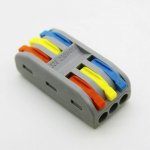
I too love Wago connectors. Great for connecting and unconnecting and reconnecting! However I always wanted inline versions of 2 and 3 core to replace choc block connectors. I have now found that another company (in China) make inline connectors for two or 3 core wires
If you search on eBay for Compact Wire Wiring Connector Conductor Terminal Block SPL-2 SPL-3_vi you will find these
Connectors.JPG

There are bigger versions too s-l1600.jpg if you search for Terminal Block Conductor Universal Compact Wire Wiring Connector 10pcs

TudorSailor
 
Last edited:
Top