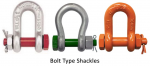
Thread lock on mooring shackles

I have read many times that 'black iron' shackles offer optimum corrosion resistance underwater. Despite several searches I have been unable to find what this material is or if anyone supplies it. The 'black' description suggests wrought but I doubt if anyone makes these today.
I doubt such things were ever made of iron in the modern era, the implication is that it's a product that's straight from the forge and still coated with millscale which is black in colour; in contemporary use it's likely just slang for uncoated steel, I've never seen a shackle supplied with millscale on, only galvanised, electrozinc plating or bare steel.

Disagree.

There's a considerable volume of eng-technical material directly related to this and closely-related topics. Google Scholar, for example, offers several dozen references; here's just one of many.... Influence of Corrosion on Fatigue of the Fastening Bolts
That cites high tensile fasteners holding up a WTG; of nugatory relevance to a mooring shackle.
 
I doubt such things were ever made of iron in the modern era, the implication is that it's a product that's straight from the forge and still coated with millscale which is black in colour; in contemporary use it's likely just slang for uncoated steel, I've never seen a shackle supplied with millscale on, only galvanised, electrozinc plating or bare steel.
Millscale would be the last coating wanted on a product intended for subsea use. It is renowned for promoting corrosion and is always blasted off before painting.
I agree that ungalvanised steel shackles may be described as black nowadays but my understanding is that this is not the original meaning.
 
Quite similar to Menai Strait practice except that concrete blocks move in the strong tides of the strait. A pair of 50 kg admiralty type anchors is joined by a 1 inch, 25 mm, ground chain, mostly recycled from Manchester Ship Canal lock gates. These are laid up and down tide. A swivel is attached to a link in the centre of the ground chain with a 3/4 inch, 20 mm, riser to the buoy.

There were no shackles at all, all joints being welded rebar 'paperclips'.
Im just around the corner in Porth Penrhyn
 
Quite similar to Menai Strait practice except that concrete blocks move in the strong tides of the strait. A pair of 50 kg admiralty type anchors is joined by a 1 inch, 25 mm, ground chain, mostly recycled from Manchester Ship Canal lock gates. These are laid up and down tide. A swivel is attached to a link in the centre of the ground chain with a 3/4 inch, 20 mm, riser to the buoy.

There were no shackles at all, all joints being welded rebar 'paperclips'.
I find that the swivel is usually the weak link. The pin seems to wear the ring such that it becomes very slack & the nut on the pin part rounds off & something breaks. Not sure what goes first -pin,ring or nut- as I only see the swivels that I recover. Not the ones that have finally broken
 
When I was doing moorings for nav buoys, all the shackles were clenched (pin heated to red hot then peened over) as it would contract and seal the joint with no chance of anything getting in and wearing the pin.
It is labour intensive though!
All the chain and shackles were plain steel, and the same for drying moorings in jersey - the thought was that the sand would wear any coating off anyway - and it was the stuff that was mostly buried or on the seabed most of the time that wore through quickest
 
I have tested 'our' chain, 6mm through to 12mm or the abrasion resistance of the gal coating on the seabed.. Size of the chain does not matter the galvanising wears of them all with equal rapidity. What is important is gal thickness, thicker gal (up to a point) lasts longer (too thick and if flakes).

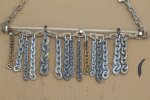
This the rig I use. It is simply hung of the back of our cat such that the chains are always on the seabed and the rig is moved through movement of the cat on its mooring. The gal lasts about 4 weeks.

What is interesting 'we' complain when we get 'only' 4 years life from our anchor chain - yet I can remove it in 4 weeks! Its obviously a greatly accelerated test.

When someone suggests small chain loses its gal more quickly - they have no idea. I've run the test 3 times now, to check different galvanising methods. Same results each time.

Here our mooring contractor and he inherited the business from his father (so maybe 60 years of history) cals the chain he uses 'Black Chain'. I since discover its simply unpainted chain, grit blasted and lightly oiled )with diesel.

There would be reason to use 'better' shackles as hardness, a feature of better alloy shackles, provides greater abrasion resistance. It would increase costs. However I suspect that if they fit its cheaper to use lower quality but bigger components - as more steel imparts more abrasion resistance. Here in Oz (or Sydney, we are required to have an annual mooring service and as we lease the 'space' from State government it has become a requirement of lease renewal to show proof of service.

.IMG_7587.jpeg

Vyv mentioned that mooring blocks like ours move in the tide. It 'blew' a few years ago and our mooring block, with catamaran and was driven around 20-30m from its location - we now have a 1t and 05t block.

Within sight of our moorings a mooring was laid for Superyachts (which visit Sydney over Xmas/New Year). Its laid with 3 x 1.5t Danforth types set at 120 degrees to each other with a central rise, connected by a swivel in the centre. The mooring was Classification Society approved and the flukes of the anchor set at 22 degrees to allow easy retrieval at servicing. (And people raise their eyebrows when I comment on anchor fluke angles).

Take care,

Jonathan
 
Last edited:
Apparently the mooring became all twisted up due to the owner not checking and that snapped the shackle,may of been poor quality,boats need periodic checking.
That's correct it was the boat next to mine with a bridle set up that was twisted to it's max for months but the owner just left it like that even when he was on the boat.
 
If I'm correct, 1 ton (UK 2240 lbs) of concrete is 14.9 cubic feet, salt water weighs 64 lbs/ cubic foot so 954 lbs water is displaced = 1,286 lbs weight of block.

And then the 1t block (in air) is not physically lifted in order for it to move - it is slid across (or through) the seabed.

Even more complicated - the 1t (in air) block sits on the seabed when originally deployed but with time, over the year (or part of year) that the block is deployed it settles into the sand and when retrieved (by crane) there is a suction element resisting retrieval - and I'm not sure what role suction plays on the block that is sliding. Sometimes when the blocks are retrieved there is sand lying on top of the block - suggesting that either someone throws buckets of sand at them - or they settle quite deeply.

Jonathan
 
In my experience offshore in the diving industry, rather than using a threaded shackle pin, tightened in a random way which may or may not damage the shackle, and might be difficult to undo, or might just simply undo itself, it's normal to use: Screenshot 2021-11-03 09.38.40.png
Indeed, I don't think that I've ever seen one of these fail a risk assessment, for this scale of attachment.
 
And then the 1t block (in air) is not physically lifted in order for it to move - it is slid across (or through) the seabed.

Even more complicated - the 1t (in air) block sits on the seabed when originally deployed but with time, over the year (or part of year) that the block is deployed it settles into the sand and when retrieved (by crane) there is a suction element resisting retrieval - and I'm not sure what role suction plays on the block that is sliding. Sometimes when the blocks are retrieved there is sand lying on top of the block - suggesting that either someone throws buckets of sand at them - or they settle quite deeply.

Jonathan
Very many years ago I sailed a regatta at Morecambe, a drying bay renowned for fast tidal flow. I got talking to a council employee responsible for channel markers, who pointed out a red buoy only just visible on the water surface. This buoy, chain and sinker was infamous for gradually disappearing beneath the sand. They had made attempts to recover them but were never able to dig deep enough. The buoy was removed regularly before it sank but the tackle was not recoverable.
 
I have tested 'our' chain, 6mm through to 12mm or the abrasion resistance of the gal coating on the seabed.. Size of the chain does not matter the galvanising wears of them all with equal rapidity. What is important is gal thickness, thicker gal (up to a point) lasts longer (too thick and if flakes).

This the rig I use. It is simply hung of the back of our cat such that the chains are always on the seabed and the rig is moved through movement of the cat on its mooring. The gal lasts about 4 weeks.

What is interesting 'we' complain when we get 'only' 4 years life from our anchor chain - yet I can remove it in 4 weeks! Its obviously a greatly accelerated test.

When someone suggests small chain loses its gal more quickly - they have no idea. I've run the test 3 times now, to check different galvanising methods. Same results each time.

Here our mooring contractor and he inherited the business from his father (so maybe 60 years of history) cals the chain he uses 'Black Chain'. I since discover its simply unpainted chain, grit blasted and lightly oiled )with diesel.

There would be reason to use 'better' shackles as hardness, a feature of better alloy shackles, provides greater abrasion resistance. It would increase costs. However I suspect that if they fit its cheaper to use lower quality but bigger components - as more steel imparts more abrasion resistance. Here in Oz (or Sydney, we are required to have an annual mooring service and as we lease the 'space' from State government it has become a requirement of lease renewal to show proof of service.

.View attachment 125221

Vyv mentioned that mooring blocks like ours move in the tide. It 'blew' a few years ago and our mooring block, with catamaran and was driven around 20-30m from its location - we now have a 1t and 05t block.

Within sight of our moorings a mooring was laid for Superyachts (which visit Sydney over Xmas/New Year). Its laid with 3 x 1.5t Danforth types set at 120 degrees to each other with a central rise, connected by a swivel in the centre. The mooring was Classification Society approved and the flukes of the anchor set at 22 degrees to allow easy retrieval at servicing. (And people raise their eyebrows when I comment on anchor fluke angles).

Take care,

Jonathan
I would have to take issue with your four week theory. For many years, although not the last two, we have been in the habit of leaving our boat anchored for periods of four weeks at a time. It has not removed all the galvanising anywhere on the chain. What does happen is that the galvanising is turned black, presumably because the anchorage is black peaty mud, which will be quite acidic. So much so that the last time the chain went to be regalvanised, an operative took a cursory glance, and thought it had been painted black, and grit blasted it before galvanising.
 
I would have to take issue with your four week theory. For many years, although not the last two, we have been in the habit of leaving our boat anchored for periods of four weeks at a time. It has not removed all the galvanising anywhere on the chain. What does happen is that the galvanising is turned black, presumably because the anchorage is black peaty mud, which will be quite acidic. So much so that the last time the chain went to be regalvanised, an operative took a cursory glance, and thought it had been painted black, and grit blasted it before galvanising.

I did mention that my test was an accelerated tests as obviously people who live aboard soon count 30 days at anchor and their galvanising is not worn away - it will last approximately 1,200 days at anchor. So my one month on the sea bed for my test rig (on silica sand) is the equivalent to those 1,200 days of a live aboard. Our seabed are much harsher which are based on silica sand, most sand is based on much softer materials, commonly calcium carbonates, feldspars etc. I was surprised at how quickly the gal wore off - but then I considered the wear of mooring components on the seabed - a 1" shackle might last 3 years, see my earlier picture of the worn shackle, - wearing 100 microns of gal is about right. I have not done the maths :) but the shackle wears where the two components, shackle and chain rub each other constantly adding fresh silica and are under constant tension - for my tests the gal is worn off with no, or minimal, tension - simply the links rubbing on the seabed. You might think the smaller chain would wear differently to the bigger chain - but they wear at roughly the same rate. Gal removal is a function of the coating thickness and quality of the galvanising (care taken in cleaning prior to galvanising) and the type of galvanising (some processes produce a harder gal coating the higher hardness results in better abrasion resistance. The ideal is a thicker coating of a harder galvanising.

A problem of a, true, liveaboard is that they may not notice the removal of the gal. Because they will constantly use the chain and any rust - the obvious sign of gal removal, will be constantly scoured as the chain is used. Once you have lost the gal you will also start to abrade the steel from which the chain is made - and steel loss obviously results in a weakening of the chain - see that picture of the shackle and link above. Commonly the chain is a much less abrasion resistant material than the gal (and most shackles) so wear, of the chain, will be at an accelerated rate (unless it is a HT chain in the first place).

Once you see rust on the chain - then is the time to plan to regalvanise - you cannot stop corrosion (of a chain) except by regalvanising.

You are correct that the acid seabeds will turn the galvanising black - but your galvanising is being attacked by the acid and is slowly dissolving. In such locations washing the chain copiously with fresh water to remove all the mud is strongly recommended - or the acid in the mud will continue to remove your galvanising when it sits in the chain locker. Such muds are anaerobic and the organisms living in the mud survive white happily without oxygen but exude sulphur compounds - and in the extreme you will smell the 'rotten egg' smell. Its a big problem in stagnant waters, old harbours, sewage works - the galvanising simply does not last. Fortunately such seabeds are not popular for anchoring - so for most people it is not an issue. Most people don't have an endless supply of fresh water but a good deck wash is the way to start and when you get to cleaner water - wash out the anchor locker.

Abrasive wear of galvanising occurs only on the surfaces directly exposed to the seabed (the crown and the outside of the long on the links - and the remaining gal offers some corrosion resistance to the bare surfaces) corrosion from anaerobic muds wears all the gal - simultaneously.

Apocryphally I have heard of people who have anchored in Thailand at the mouth of slow moving, hi nutrient level (poor sanitation, lots of high nutrient run off, fish farms), rivers who claim to have stripped all the gal off their chains - but I have never actually met any such unlucky voyagers. But gal stripping does happen in sewage works so it is a known and accepted issue - again - not many of us anchor in sewage works :)

If you want a high chain life - look after it and avoid smelly muds - if possible.

Take care, stay safe

Jonathan
 
Top