
yanay
Member
I have both sounders installed yet none is functional. The seafarer 700 dial displays interference - lights all over the dial - at most times. Rarely it would display a steady depth reading - both on the dial and in digits - yet I could not replicate or figure out in what scenarios this magic happens. The interference is certainly affected by electric devices. When the 12v lighter socket is on, it interferes in those rare ocassions there's a reading, so does the 12v-220v 375 Victron inverter.
 I tried installing 3 ferrite rings on a twisted wire, both positive and negative looped several times in the same rings, and separately. No change. Tried running the 12v line directly from the house battery, directly from that bank's bus bars, also directly from the starter battery. No change. Rigged 4 9V PP3 batteries in series but the amperage was insufficient to power it internally. Also covered the section of the coax run from where it exits the bilge with aluminum foil. No change. Purchasing and supplying it internally with a small 12V 4.5 amps battery is the one thing I did not try yet. One more clue is that when I remove the coax from the unit, there's nothing but a single orange light, when it's back in - lights all over.
The NASA unit screen was sun damaged and the digits are hardly visible. The buttons are also not functional. However when it is turned on, rapid clicks are heard from the head unit, not from the transducer below the hull in the water though. Last time the boat was put back in the water after haul out, there was a drip leak from the NASA transducer mount. I laid a 6-7 mm layer of underwater epoxy around it under the hull and the leak stopped. However it was still providing a reading a year ago. The seafarer intermittent interference began seemingly with no reason, about two years ago.
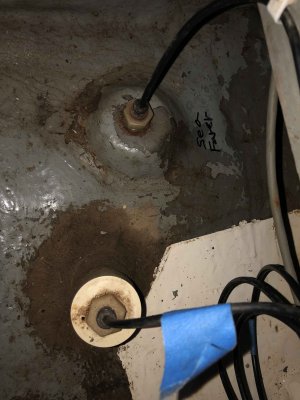
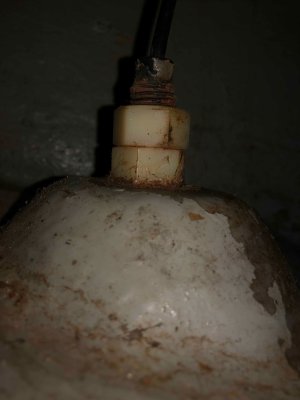
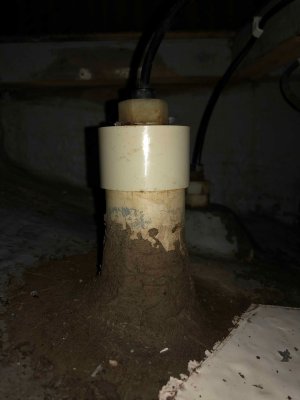
These two units are installed about 25 cm from each other, both on port. On the hull below there's only a single protrusion yet I can't be sure to which of the sounders it belongs, the two are installed too close. One is in hull the other through hull. The aft transducer is the NASA and seems to be in hull, but was leaking? So I may have covered with epoxy the protruding through hull transducer and it still stopped the leak? Strange.
The boat was left in the water for a year. When I returned to it recently I installed a repeater for the NASA but both read OUT, regardless, after 5 seconds of displaying U with a line above it and "0.6", indicating the keel offset.
I know the transducers are interchange so I run the Seafarer coax to the NASA unit. Had to remove the seafarer coax male plug from its original line since it is not compatible with the NASA socket and installed a compatible plug, no soldering, it's an open plug. The NASA unit is still reading OUT when connected to the Seafarer transducer.
I'm tied to a dock in about 2 meters depth, soft muddy bottom, tall seagrass.
Prior, when installing the NASA repeater I had to extend the original NASA coax to the master unit for which I used a disused Navtex line with embedded male and female plugs but the NASA never displayed anything but OUT.
I read the Seafarer coax shield braid is used to carry the return signal, not just shield, and the NASA unit does not. However I'm not sure how this plays in the mix.
By now I'm not sure which of the transducers, head units, cables, plugs is bad. I do have a gut feeling I can solve this with the gear I have and reluctant to purchase a new NASA. But I might have to. Any insights are highly appreciated. Thanks and sorry for the length.
I tried installing 3 ferrite rings on a twisted wire, both positive and negative looped several times in the same rings, and separately. No change. Tried running the 12v line directly from the house battery, directly from that bank's bus bars, also directly from the starter battery. No change. Rigged 4 9V PP3 batteries in series but the amperage was insufficient to power it internally. Also covered the section of the coax run from where it exits the bilge with aluminum foil. No change. Purchasing and supplying it internally with a small 12V 4.5 amps battery is the one thing I did not try yet. One more clue is that when I remove the coax from the unit, there's nothing but a single orange light, when it's back in - lights all over.The NASA unit screen was sun damaged and the digits are hardly visible. The buttons are also not functional. However when it is turned on, rapid clicks are heard from the head unit, not from the transducer below the hull in the water though. Last time the boat was put back in the water after haul out, there was a drip leak from the NASA transducer mount. I laid a 6-7 mm layer of underwater epoxy around it under the hull and the leak stopped. However it was still providing a reading a year ago. The seafarer intermittent interference began seemingly with no reason, about two years ago.
These two units are installed about 25 cm from each other, both on port. On the hull below there's only a single protrusion yet I can't be sure to which of the sounders it belongs, the two are installed too close. One is in hull the other through hull. The aft transducer is the NASA and seems to be in hull, but was leaking? So I may have covered with epoxy the protruding through hull transducer and it still stopped the leak? Strange.
The boat was left in the water for a year. When I returned to it recently I installed a repeater for the NASA but both read OUT, regardless, after 5 seconds of displaying U with a line above it and "0.6", indicating the keel offset.
I know the transducers are interchange so I run the Seafarer coax to the NASA unit. Had to remove the seafarer coax male plug from its original line since it is not compatible with the NASA socket and installed a compatible plug, no soldering, it's an open plug. The NASA unit is still reading OUT when connected to the Seafarer transducer.
I'm tied to a dock in about 2 meters depth, soft muddy bottom, tall seagrass.
Prior, when installing the NASA repeater I had to extend the original NASA coax to the master unit for which I used a disused Navtex line with embedded male and female plugs but the NASA never displayed anything but OUT.
I read the Seafarer coax shield braid is used to carry the return signal, not just shield, and the NASA unit does not. However I'm not sure how this plays in the mix.
By now I'm not sure which of the transducers, head units, cables, plugs is bad. I do have a gut feeling I can solve this with the gear I have and reluctant to purchase a new NASA. But I might have to. Any insights are highly appreciated. Thanks and sorry for the length.


