The Medway 1938. BFI Film .

oldgit

Well-Known Member
Joined
6 Nov 2001
Messages
29,315
Location
Medway
Visit site
Found by Chris Murr.
Source to Sea.
Actually the trip appears to have been down in reverse order to narrative.
https://player.bfi.org.uk/free/film/watch-watery-trail-river-medway-1938-online
Battleships and Sunderlands its all there.

Instead of going to Bluewater or Lakeside why not suggest to your dear wife that she finds her galoshes and discovers the source of the Medway, mid winter appears to be best.
 
Suspect a fairly well off couple ? ..especially with that car.Interesting to watch filling up with fuel and the heavenly absence of "other" motorists on rural roads.
......and difficult to age that couple seem 25-30 going on 50 ?
Everybody appears so old
 
Went to Duxford over weekend with grandsprogs, a Sunderland in main hall.
Did not realise nuclear bombs were so small,visions of Fat Man etc.
Interesting about Broken Arrow.
Also confirmed missed absolutely nothing by never flying on Concorde,claustrophobic or what :)
 
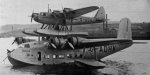
I wondered if the “C” class flying boat seen afloat (odd - portholes for passengers and a tarpaulin over what might be a forward turret under construction?) might be “Maia”? - but she is not.

Might it be covering up the hatch that these flying boats used to have in the bow from where a mooring could be picked up?Flying boat.jpg
 
I now think the flying boat seen afloat is an early Sunderland, perhaps a prototype. The bow was modified in trials to take a Frazer Nash turret which could slide back for mooring, and perhaps that is what is going on under the cover.

I have an American friend, Ian McColgin, who relates that his father, having commanded a bomber squadron in WW2, was happy to join Pan Am's Sky Gods, on demobilisation, as Sixth Officer (!) on flying boats; one of his tasks was indeed to open the nose hatch, take out the boathook, and either find the buoy and moor up or drop the anchor- on one occasion the Captain cut all engines short of the mooring and Sixth Officer McColgin executed a perfect dive from the bow platform and swam to the buoy with the painter. His mother having spent the war as a ferry pilot was graciously permitted to become a stewardess...
 
Last edited:
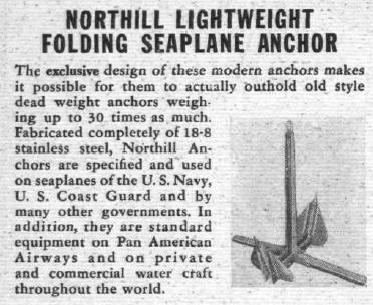
The Sunderlands were equipped with CQR anchors, with special Baby Blake WCs with aluminium castings in place of bronze, with Taylor’s paraffin stoves and with “Grabit” boathooks, but the CQR was actually developed by Professor Taylor for use on his own yacht. There’s his own account of his invention in the January 1938 “Yachting Monthly”. The anchor that was developed for seaplanes and later used for yachts was the Northill, which was invented by Northrop, as in Northrop Grumman.

Catalinas and Pan American Boeing flying boats had Northills, Imperial Airways “Empire” flying boats and Sunderlands had CQRs!

 
Last edited:
Those tunnels and those of Fort Clarence , immediately above, were the somewhat dangerous playgrounds of certain posters in early 1960s.
Remains of one wooden ramp and a concrete hard, now occupied buy Medway Rowing club,still remain along the Esplanade.
In the early 1960s some small derelict naval craft, poss corvettes and minesweepers were still moored just above what is now RCC.
Being the Medway Towns everything not bolted down on the boats had been "liberated" by the locals.
 
Last edited:
Fasinating film, thanks for posting it. My uncle who was killed in December 1943 was in Coastal Command and flew in Sunderlands so to see them was particularly interesting.
 
I wondered if the flying boat seen afloat (odd - portholes for passengers and a tarpaulin over what might be a forward turret under construction?) might be “Maia”? - but she is not.


https://en.m.wikipedia.org/wiki/Short_Mayo_Composite

I think that is a Sunderland. The forward turret could be slid back into the fuselage to provide a forward cockpit (nautical) for mooring. It would be reasonable to rig a canvas cover over this to keep the rain out if moored for a while. The portholes are also right for a Sunderland, including the three under the wing where there was a hatch to allow the bomb racks to slide out.
 
Top