Swan neck - through deck electrical

CT846

New Member
Joined
10 Jan 2025
Messages
6
Visit site
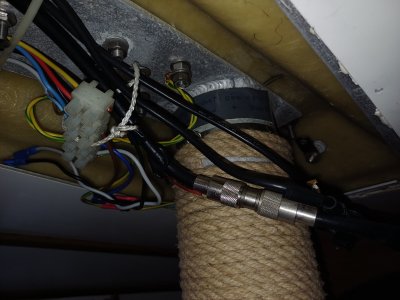
The electrical connections from my mast (wind instrument, VHF aerial, lights) are all badly corroded where they connect to through-deck plugs & sockets. I'm considering switching to a swan neck fitting to do away with exposed connectors so that I can run all of the cables through the one port & connect them inboard.
I've seen a few suggestions for waterproofing the end of the swan neck ranging from sponge to plasticine. Any good solutions to stopping breaking wave / moisture ingress and has anyone experienced any electrical interference by running multiple cables through the one port?
 
I have two swan necks on the stern. I put silicon in mine. Which was mainly to stop spiders living in them! This was a mistake as it was a bugger to dig out when I changed the wires. I have gps, stereo aerial navtext aerial and starling through one of them. All work fine. Hard to get through the hole though. Basically I don’t know the answer to what to use. But don’t use silicon sealant.
 
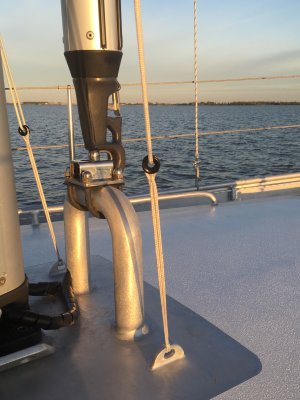
A swan neck is the ideal solution in my view. It is surprising they are not used more commonly. The modern inverted "U” has some advantages (see photo).

The waterproof nature is not just dependent on the sealing mechanism as it is with most deck glands. We have jammed some loose closed-cell foam into the entrance of ours as a belt and braces approach, but this is likely overkill, especially as the swan neck is tall.

Anyway, it has never leaked even in some challenging conditions.

There is no electrical interference despite data (wind instruments, radar, VHF, AIS etc) and power cables (navigation and spreader lights) combined through the same exit.

One significant advantage is that feeding extra wires is easy without the need for extra holes or sealant.


IMG_6678.jpeg
 
Last edited:
I have used this one from Force 4 on the stern deck for stern light, AIS antenna, tiller pilot and solar panels. No problems and it saves making multiple holes for separate glands. I've not had a problem with water ingress but unless I am pooped there is never much water that far aft. You could add an extra bit of hose to extend it if you were worried about water ingress.
Swan neck
 
I haven't experienced any ingress from mast one and am fitting a stern one over the winter. A bit of foam would do it, worse case you get the odd drip.
 
Another vote for cable glands.
I have 2 rectangular glands one on each side of the mast, they take all the mast cables.
The only problem I've had was stripping the threads in the plastic base when compressing the seal. I fixed that with helicoils.
No water ingress over many years.
I have blank seals (no holes) for use in the winter, when the mast is down.
 
A swan neck is the ideal solution in my view. It is surprising they are not used more commonly. The modern inverted "U” has some advantages (see photo).

The waterproof nature is not just dependent on the sealing mechanism as it is with most deck glands. We have jammed some loose closed-cell foam into the entrance of ours as a belt and braces approach, but this is likely overkill, especially as the swan neck is tall.

Anyway, it has never leaked even in some challenging conditions.

There is no electrical interference despite data (wind instruments, radar, VHF, AIS etc) and power cables (navigation and spreader lights) combined through the same exit.

One significant advantage is that feeding extra wires is easy without the need for extra holes or sealant.


View attachment 202429

Not exactly the usual Swan-neck !!
 
I am going through this exercise of sorting out 5 dissimilar sized cables .. two with end fittings that I would be extremely reluctant to remove and the refit - one being the B&G Network cable ..
My cables passed through a single gland / hole about 35mm diameter ... previous owner having lost the part of the fitting above deck .. so yard had silicon + self-amalgamting taped it ... leaked of course.
Question is - how to cater for 5 different sized cables, two with end fittings and have a water-tight seal without drilling more holes !! The Swan neck could be answer - but only if the end fittings will go round the curvature .. the B&G fitting is at least 40mm long ..

20251102_125427.jpg

Seen there against the rope ...
 
Last edited:
I have two swan necks, one for each mast. Mine are home made, welded using standard stainless weldable bends. Definitely fit and forget. I jam some soft foam into them, but it's just to stop insects.
 
A swan neck is the ideal solution in my view. It is surprising they are not used more commonly. The modern inverted "U” has some advantages (see photo).

The waterproof nature is not just dependent on the sealing mechanism as it is with most deck glands. We have jammed some loose closed-cell foam into the entrance of ours as a belt and braces approach, but this is likely overkill, especially as the swan neck is tall.

Anyway, it has never leaked even in some challenging conditions.

There is no electrical interference despite data (wind instruments, radar, VHF, AIS etc) and power cables (navigation and spreader lights) combined through the same exit.

One significant advantage is that feeding extra wires is easy without the need for extra holes or sealant.


View attachment 202429
Thank you for all of the suggestions. I think that the swan neck is the way ahead & using something like the suggested 'foam bung' to plug the end. My concern was exactly that with using something like silicon that it would be a nightmare to remove when the time comes!
 
I fitted a swan neck a few years ago in front of the mast and use no sealing in the opening. So far never had anything come through. They just work.
 
My boat came with a swan neck. After one episode of a small splash getting in I shoved half a sponge in and have had no trouble since even with green water over the deck.
 
I think half the answer with Swan Necks - is the orientation ... and if you leave the cable entry fully open.

I think this may be one occasion where self-amalgamating tape applied to at least reduce the entry to similar to cables total diameter can go a long way to creating a reliable cable route.

Its certainly a thought I am having.
 
How about CT1'ing the cables as a packer once they're in place? It'll certainly seal it, and has the advantage of being pliant during its setting period, to make it look neat.
 
Top