Sterling Pro Charge Ultra 60A - Fuses blowing

Richard10002

Well-Known Member
Joined
17 Mar 2006
Messages
18,979
Location
Manchester
Visit site
Had this since March 2018 and, last week, one of the 2 x 40A Car type blade fuses blew, (the fuses are on board the charger, so protecting something in the charger).

I fitted 2 x 30A blade fuses, and ran the charger at 75% power, (45A), and it seemed to work fine all last week. On Sunday I fitted 2 x 40A fuses that I had ordered, continued running it at 75% power and, after a few hours, one of the fuses blew again.

I don't know if it's the same fuse socket that has blown both times.

Presumably, something is causing more than 40A to flow through one of these fuses, or more than 80A through the pair, (if they are doubled up to provide 80A protection?). Hope that makes sense.

Does anyone know what these fuses protect in the charger, and what might have gone wrong to cause one to blow?
 
I suspect the fuses are in parallel on the circuit board.
For one to blow but the other remain intact, it must be taking most if not all of the current.

Have a good look at the fuse holders & soldering around the one that does not blow.

Corrosion or a 'dry' solder joint. Maybe a faulty pcb track ?
 
I suspect the fuses are in parallel on the circuit board.
For one to blow but the other remain intact, it must be taking most if not all of the current.

Have a good look at the fuse holders & soldering around the one that does not blow.

Corrosion or a 'dry' solder joint. Maybe a faulty pcb track ?

I'll have to disconnect it and take it off the wall to have a good look, although, even if I find one of the issues you mention, I'm not confident of soldering or similar on a PCB, so will have to find another way of charging, (I only have this charger and solar for my lithium bank, which feeds the domestic side of things).

In the meantime, the charger can be set to charge at 60A, 45A, 30A, and 15A.

1) Could I set it to charge at 30A, so that neither of the fuses would be overcome, even if only one was taking the full current.

2) If in parallel, (which I think they are), could I fit just 1 x 40A fuse, and leave the dodgy looking socket empty.

Just looking for a short term solution while I see about getting the alternator to charge these batteries... considering a Victron Orion DC-DC charger, but dont want to panic buy.

Wont be doing anything until tomorrow at the earliest.

Thanks for the help.
 
I suspect the fuses are in parallel on the circuit board.
For one to blow but the other remain intact, it must be taking most if not all of the current.

Have a good look at the fuse holders & soldering around the one that does not blow.

Corrosion or a 'dry' solder joint. Maybe a faulty pcb track ?

It's been running fine all day at 30A, (50% setting), so looks like that's a temporary work around, although a long time to get 360Ah into the battery bank ! :)

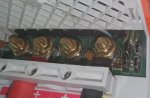
Here's a photo of the fuse sockets - Looks like the one on the right is the one that blows, as it's a bit matte grey, rather than shiny. Don't know if anyone can see what the issue might be. I'm wondering if someone good with electronics and PCBs could make a connection whereby a proper fuse, (Mega 80A), could be fitted, perhaps screwed onto the outside of the case. The two parallel 40A blade fuses seem to be a cheap bodge designed into the charger.

Pro Charge Ultra Fuse Sockets Cropped 1.jpg
 
Isn't that the recommendation in the Sterling manual?

Yes, It was a requirement for models up to the Ultra, a recommendation with the Ultra. The manual for the Ultra says:

Any outputs not being used should be linked across to one that is, this is not a requirement for these new models but is good practice as it helps spread loads etc.
 
It's been running fine all day at 30A, (50% setting), so looks like that's a temporary work around, although a long time to get 360Ah into the battery bank ! :)

Here's a photo of the fuse sockets - Looks like the one on the right is the one that blows, as it's a bit matte grey, rather than shiny. Don't know if anyone can see what the issue might be. I'm wondering if someone good with electronics and PCBs could make a connection whereby a proper fuse, (Mega 80A), could be fitted, perhaps screwed onto the outside of the case. The two parallel 40A blade fuses seem to be a cheap bodge designed into the charger.

View attachment 102275

The fuses are in the negative side, so are common to all 3 outputs.

Looking at the photo, the upper fuse connector looks like a clean might help. Its the dimple inside that makes the contact. With 30A running through it, it doesn't take much contact resistance to unbalance the current between the fuses.

I agree its a bit of cost saving bodge to use 2 cheaper fuses & holders, where a mega fuse or similar would add quite a bit to the cost.

Having said that, I like the quality of sterling chargers, only had one fail where a hose blew& soaked it in salt water.

I would like the terminals to be a bit more meaty.
 
Do we know whether the OP has an old version or a new version?

Pretty sure I have the new version, where it is only a recommendation, although I will probably connect them when I get it off the wall, if I can get the extra cables and ring terminals in.

Notwithstanding that, I don't think not connecting the terminals will have either caused damage to one of the fuse holders, nor will connecting them fix it.

It seems that these are 2 parallel fuses, making a total of an 80A fuse, (+/-). I have read that it was a money saving exercise, and must admit that it looks like a bit of a bodge in the design.
 
Pretty sure I have the new version, where it is only a recommendation, although I will probably connect them when I get it off the wall, if I can get the extra cables and ring terminals in.

Notwithstanding that, I don't think not connecting the terminals will have either caused damage to one of the fuse holders, nor will connecting them fix it.

It seems that these are 2 parallel fuses, making a total of an 80A fuse, (+/-). I have read that it was a money saving exercise, and must admit that it looks like a bit of a bodge in the design.
Use one of these,
Spare 9 Way Bus Bar for 100 Amp Isolator or 63 Amp RCD cut down to suit.
 
Got it off the wall today and took the cover off, (easier said than done :) )

wire brushed the fuse holders, tested for continuity and got it where expected. Tightened up the holders a bit, then put it back together. Hopefully I’ve fitted all the cables OK, and it will fire up as hoped.

for bridging the three positives, I’ve found some copper pipe holders which are about the right size when straightened out. I’ll double them up, drill some holes, and they should be as good as the bus bars above.

If this doesn’t work, I’m buying a Victron 50A Smart Charger IP43!
 
Got it off the wall today and took the cover off, (easier said than done :) )

wire brushed the fuse holders, tested for continuity and got it where expected. Tightened up the holders a bit, then put it back together. Hopefully I’ve fitted all the cables OK, and it will fire up as hoped.

for bridging the three positives, I’ve found some copper pipe holders which are about the right size when straightened out. I’ll double them up, drill some holes, and they should be as good as the bus bars above.

If this doesn’t work, I’m buying a Victron 50A Smart Charger IP43!

You've probably done as much as you can Richard, hope it works for you. If not, your choice of new charger gets (y)from me.
 
Fitted and fired it up today. Bit the bullet and set it at full power, 60A. Ran for just over 2 hours until the batteries were full and all was well.

My guess is that, if the 60A had been flowing through only one fuse, it would have blown over a 2 hour period so, maybe, it's fixed! :) Time will tell.

The most disappointing thing in this experience was that, upon contacting Sterling for help, I had an email exchange where Charles Sterling "told" me repeatedly to just fit a bigger fuse because the thing is current limited. I even sent him the picture of the fuses I was referring to. One could ask why they are there, if you can just "fit bigger until it works".
 
Fitted and fired it up today. Bit the bullet and set it at full power, 60A. Ran for just over 2 hours until the batteries were full and all was well.

My guess is that, if the 60A had been flowing through only one fuse, it would have blown over a 2 hour period so, maybe, it's fixed! :) Time will tell.

The most disappointing thing in this experience was that, upon contacting Sterling for help, I had an email exchange where Charles Sterling "told" me repeatedly to just fit a bigger fuse because the thing is current limited. I even sent him the picture of the fuses I was referring to. One could ask why they are there, if you can just "fit bigger until it works".

Especially disappointing as they don't make those fuses any bigger than 40a

I no longer fit anything Sterling
 
Top