ST4000+ autopilot control head, wheel drive

scrambledegg

Well-Known Member
Joined
2 Nov 2015
Messages
264
Location
Portsmouth
Visit site
This has come up before I know. Thank you for your forbearance.
Two years ago I tackled the failure of the unit (no output on the motor drive terminals, otherwise aok) by sending it to the Service Centre at Fareham. Cost £225. They replaced the PCB.
Last time I took the boat out, guess what, exactly the same failure, despite hardly having used the autopilot in that time.
It seems to me that this failure is no accident. This is a design fault. Even if I had some other fault such as a short within the motor, the drive electronics should withstand it.

What can I do?
a) previous advice has been to replace control unit with another one, st600 something, Is that still viable?
b) replace entire system, with what? Not very confident about Raymarine
c) repair. Fareham Service Centre repair is simply going to replace with similarly compromised circuit.
d) self repair. Does anyone have a circuit diagram of it they could show me? That person would gain my lifelong gratitude and actual real beer upon meeting!

Thanks for your thoughts
Jeremy
 
Does anyone have a circuit diagram of it they could show me? That person would gain my lifelong gratitude and actual real beer upon meeting!

I have a PDF of the Service Manual, which contains circuit diagrams and PCB layouts. Send me a PM with your email address if you'd like it, or I guess you could find it on the internet yourself.
 
When about three years old my ST4000 wheelpilot control head died, so replaced with a new one - at that time still available from Raymarine. New one supplied was faulty. Raymarine then sent another which is now still OK (touching wood) ten years later. Another similar vintage ST60 head failed last year, repaired by Service Centre - reported fault water ingress. Raymarine would not repair - offered small discount on new i50 unit.

Clearly my set of four ST60 era heads are getting long in the tooth. Interesting to hear what you decide.
 
I have a PDF of the Service Manual, which contains circuit diagrams and PCB layouts. Send me a PM with your email address if you'd like it, or I guess you could find it on the internet yourself.

Found it. Well done that man!
I am going to forensically establish the point or points of failure, to the best of my ability.
If anybody has any other viable solution, I am still very interested.
 
I am pleased to report that I have diagnosed the failure of my st4000+ control head and succeeded in repairing it.
Here is what I found :-
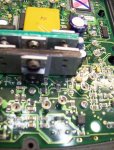
Firstly I found a resistor ( schematic ref: R6 ) had detached from its solder pads on the pcb with signs of burning around (see image below, resistor is the wonky looking one just below centre of image):
st4000+ initial damage (reduced).jpg

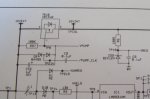
This resistor belongs here on the circuit diagram:
st4000+ circuit detail.jpg
R6 in combination with Zener diode ZD2 form a crude voltage regulator and produce voltage rail: "VREG", which is at approximately 12V. The VREG supplies an intermediate stage in the power circuit that drives the motor. I think it exists to limit the voltage to that intermediate stage if the battery voltage coming into the unit rises significantly above 12V, which it might do when the battery is being charged.
While investigating R6 I also discovered that ZD2 had also failed - it had gone short circuit. The likely failure sequence is therefore that ZD2 failed first which would put the full battery voltage across R6, rapidly overheating it.
Now ZD2 is of type: BZX12 which has a max power dissipation of 300mW, but only if the heat dissipation from the pcb tracking is as good as in the test circuit described in its datasheet. Needless to say the tracking to it in the control head is nowhere near as good as that described in the BZX12's datasheet, with only two long skinny tracks connecting to it and no ground or power planes in the pcb.
If the battery voltage rises to 14.1V, as i believe would be relatively normal when the battery is being charged, the power dissipation of ZD2 would be around 140mW. Given the poor pcb layout I think this is too marginal and was likely enough to blow it.

The Fix
---------
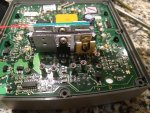
I decided to do away with R6 and ZD2 and instead generate a 12V regulated supply using a small 12V low drop-out regulator, which would regulate the 12v more tightly and have enough power handling. The regulator I used is a Texas Instruments TL750L12-CLP, which comes in a TO-92 package. I grafted this regulator into the circuit and also gave it a small clip-on heat sink to be on the safe side, both of which I sourced from eBay (search TO92 brass clipon heatsink) See it below:
st4000+ LDO added (reduced).jpg

The small, brass heatsink does not make contact with the larger heatsink behind it.

To my great joy my autohelm is now working nicely and it has so far lasted a 4-day cruise, no problem.
(though I am now regretting that I spent £225 for Fareham Service Centre to repair it the first time)
 
I didn't bother getting inside the unit (it was ST6000, but I suppose the final stage is identical) and just checked the remaining output on the motor terminals. It was about 6 V, opposite polarity for each direction. I assume it was a control voltage for the now destroyed solid state circuitry (mosfets?). I used this voltage to operate 2 external miniature 6V relays (coils connected thru diodes in opposite polarities) and used the NO of these to operate 40A relays controlling a B&G hydraulic steering unit. Rather crude, but it has been working spotlessly for me for some 4 years now. BTW: after some experience with the other parts of the ST6000 I would't touch anything by Raymarine ever again.
 
An inventive solution, Jiris, which ramps up the power needed for a hydraulic actuator, I guess.
The one thing going in Raymarine's favour for the st4000+ is that they at least provided the circuit diagram in the service manual. It seems they do also (or maybe did) for the st6000. It's quite unusual these days.
 
An inventive solution, Jiris, which ramps up the power needed for a hydraulic actuator, I guess.
The one thing going in Raymarine's favour for the st4000+ is that they at least provided the circuit diagram in the service manual. It seems they do also (or maybe did) for the st6000. It's quite unusual these days.
Unfortunately, only the service manual of the ST 5000 PLUS is missing ... which is suitable for driving a linear actuator ... and I could understand what differences it has from the st 4000 (more powerful mosfets?)
 
Top