SS Fuel Clearing tank - replacement

Divemaster1

Well-Known Member
Joined
15 Jan 2002
Messages
4,456
Location
Aberdeenshire, Scotland
Visit site
We carry about 1700L fuel onboard in two seperate tanks (mild steel).

These two tanks gravity feed a seperate SS Clearing tank of approx 60L (top of this is 3 Cm below bottom of main tanks).

Fuel take off's from the top of clearing tank are 13mm and this has a seperate drain point at low point aft (potential water, pressurising fuel systems etc.).

This SS clearking tank have developed a small leak (1 x drip about every 3 minutes..), and will need to be replaced.

Knowing that SS tanks are not the best alternative, what does the forum believe is the best alternative:

1) Replace with a bespoke manufacture a new tank in Mild Steel based on the existing SS ?
2) Look at preplacing the tank with a standard offering in Polythane (such as the 60L from Vetus, which will slot straight in)?
3) Consider other alternatives ? (suggestions welcome).

In the mean time thre is very low pressure on the tank as supply is switched off...
 
thre is very low pressure on the tank as supply is switched off...

I would not spec the new tank based on that assumption. The clearing tank should be able to take the pressure caused by the full head of the main tanks, imho. Therefore I would get a custom made aluminium tank, pressure tested etc. 316oval.co.uk (Pennpromo of this forum) makes lovely custom aluminium tanks
 
Jfm ... "Low pressure" was referring to that supply was swithed off currently when we are off the boat and in harbour.

thought aluminium was equally as "brittle" as SS ... and not "preferred"... had Alu water tank which ended up leaking as well, (hence asking question) ... replaced many years ago...
 
Jfm ... "Low pressure" was referring to that supply was swithed off currently when we are off the boat and in harbour.

thought aluminium was equally as "brittle" as SS ... and not "preferred"... had Alu water tank which ended up leaking as well, (hence asking question) ... replaced many years ago...

Pennpromo will I hope chip in and advise us. Aluminium comes in zillions of different alloys, of which plenty are malleable and not brittle. All my tanks are made of welded aluminium!

Plastic is a great materal for the tank in general but I don't love the fittings used in plastic tanks (which tend to be compression based) in high pressure situations. I much prefer the fittings to be welded on bosses, as you can have with an alloy tank

A big user of plastic tanks is Sunseeker. Their tanks are (generally) GRP, moulded into the hull, which is possible because they use fewer frames than other hull builders. In these tanks however there are no skin fittings at the bottom nor any higher tanks putting a pressure head onto the lower tank, so they don't have to worry about failure of skin fittings. But in your case you are surely going to have a bunch of metal tank skin fittings, yuk, if you install a plastic tank
 
Jfm ... "Low pressure" was referring to that supply was swithed off currently when we are off the boat and in harbour.

thought aluminium was equally as "brittle" as SS ... and not "preferred"... had Alu water tank which ended up leaking as well, (hence asking question) ... replaced many years ago...
Avoid stainless as it is too ridged for fast boats ponding waves.
Aluminium tanks have the following weaknesses but brittle isnt one.


Easily corroded if in contact with bilge water .
Difficult to get the weld mix right , if gas mix is wrong you get soot inbetween the weld which leaks.

I had 4 aluminium tanks in my petrol bayliner.

1) corroded from bilge water
2) leaked due to poor weld mix
2i) had to be taken out to be repaired but still leaked
3) leaked due to poor weld mix
4) made in USA as special order and flown to me at the expense of professional and highly regarded marine company .

As long as you are clear from bilge water then aluminium is a sensible choice as long as you take jfm's advice about high quality producer ( I used a very reputable long established marine welder on Grimsby Docks who should have been able to do the job but eventually gave up and had one flown from USA for me).

mild steel takes some beating especially if it is going to be full to the brim all the time ?
 
Thanks DAKA and jfm...

Based upon what you say and couple this to the fact that this tank is located very low in the hull (10 - 15 Cm above bottom of hull V), it looks like mild steel properly coated etc., is the best option... and yes, this tank will be full to the brim all the time as engine fuel is lifted from the top of the tank (constant overpressure from the main tanks), not at the bottom ..... hence the use of the words "clearing tank".
 
Divemaster, we make our tanks from 5251 H2 aluminium which is very malleable and bendable which is ideal for tanks. Generally you should have no issues whatsoever with either 316L stainless or 5251 as long as they are designed properly.
CE approvals have recently been tightened up and all diesel tanks have to have inspection hatches of 120mm clear opening. I am actually averse to this as they are a great source of leaks!
All our tanks have rolled corners and we move the weld out of the corner, which we pioneered about 20 years ago.
All tanks are pressure tested to suite the application.
Please don't go mild steel, its a temporary fix, eventually the bottom will rust out; it's a marine environment after all.
I don't know of any major boat builder now using mild steel for their tanks.
jfm, thanks for the recommendation !
Alf, Very happy to have a look at your specific requirements and advise.
SIMON
 
Mild steel will not 'rust out' when constantly full. Even standard mild steel tanks will last for 40 years or more if epoxy coated on the outside and cleaned out internally now an then. Also vastly cheaper and much stronger.
 
Mild steel will not 'rust out' when constantly full. Even standard mild steel tanks will last for 40 years or more if epoxy coated on the outside and cleaned out internally now an then. Also vastly cheaper and much stronger.

Coupled with almost anyone (used to welding) can knock one up in a workshop one so Divemaster can just call in at his local fabricator (check they have experience of fuel tanks).

I have no doubt Pennpromo can fabricate a tank safely in aluminium but he uses a specialist technique not widely in use in local workshops.
 
Gents: I have to disagree: any mild steel tank will eventually rust out, the coating only needs to be damaged on the bottom and it will go, particularly if sat on rubber or foam tape and mixed with salt water under.
"Almost anyone used to welding can knock one up in a workshop": unfortunately its not as simple as that: They could but:
If your boat has a CE mark, and it should, you have to use a CE approved tank fabricator, otherwise come re-sale time, or god forbid you have a tank related insurance claim and you will have problems.
Standards are continually changing and you have to keep up with them: an analogy: would you get someone to "knock up" a car fuel tank or "spin you up" some engine bearings/ parts?
With the increasing costs of CE, quality control, product liability insurance of £10M specifically for tanks, that's why a properly constructed marine fuel tank is not a cheap item I am afraid. Simon.
 
All,

There are obviously much more to this than what I thought ... so to give you a better picture ...

Tank sits with approx dim of L x W X H (600mm x 400mm x 300mm) ... so about 70 L.. on 4x 20 mm tall "feet" and central longitudional support on plastic sheeted 15 mm marine ply (so 20 mm above plastic sheet). Marine Ply is located approx 150 mm above bottom of V hull and is supported by central keel "stringer" and side fixings into the next two stringers from central location in each sideways direction and into the forward bulkhead. Supply from main tanks are from 1 1/2" balance pipe between tanks (this balance pipe is approx half way down the depth of the clearing tank and not as illustrated). The main tanks (mild steel) above are supported (and fixed to) both Stringers and bulkheads.

Hope this, with this rough illustration, should make everyone a bit more informed...

thanks for all input so far !!
 
Interesting thread and slightly highjacking it hope Alf doesn't mind...

was about to get my nice'n rusty distribution or clearing if you wish approx 4lt mild steel tank to the guy that did my ss exhaust elbows and ask him to do one in 316.

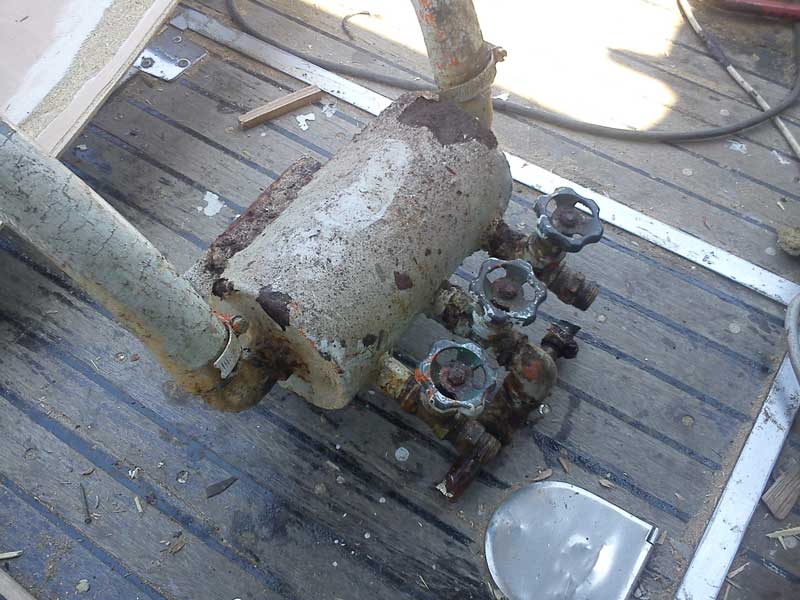
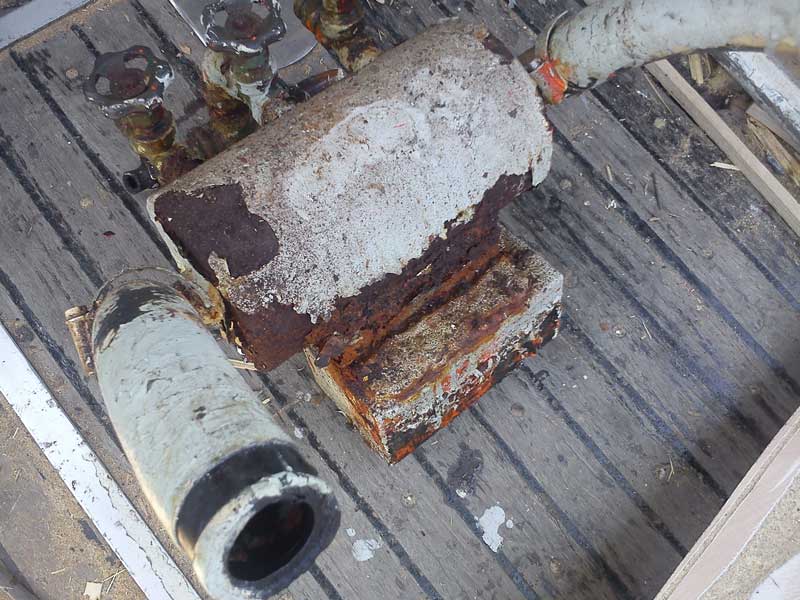
For whoever says that mild steel wont rust a couple of pics:

clearingtank_1.jpg


clearingtank_2.jpg

(the square bit underneath in pic2 is a block of wood that was originally glued to the frame (and or keel, not sure) and the box was bolted on it. Decided to part and stay with the tank...

mind you it's NOT leaking, but I guess it's a matter of time. Due to some dodgy patches, sea water was licking the bottom of this one regularly for about a year.
Similar setup with Alf's boat, only 4 tanks along the beam in front of the engines, two on port two on strbrd, joined together and all in two come in this small can/tank.
Three outlets, one for each engine and middle one tees off to the visual tank level gauge and the generator. Mind, haven't spotted a return pipe from the gen to the tanks, will have another good look tomorrow!

Any reason I should have a larger one? I doubt, but tbh I cannot really see the point in the 60-70lt Alf has onboard.

cheers

V.
 
Interesting thread and slightly highjacking it hope Alf doesn't mind...

...............................For whoever says that mild steel wont rust .....

Would be interesting to see how this one looks inside ... and how much material is left after 40 years in hostile environment.. :)

Piece of 10 or 12" pipe cutoff may do the job as well... :D ... but agree, probably don't need the size I have, but please make sure the new one has a drain point installed at the lowest part as well as engines & genny take-off....
 
Would be interesting to see how this one looks inside ... and how much material is left after 40 years in hostile environment.. :)

Piece of 10 or 12" pipe cutoff may do the job as well... :D ... but agree, probably don't need the size I have, but please make sure the new one has a drain point installed at the lowest part as well as engines & genny take-off....

Interesting thought,

I'll attack it tomorrow with the angle grinder and see what's in there :D

I'll specify a drain point at the bottom. Note though Alf that my three exits are horizontal and not on the top of the box (shouldn't make much difference, also the box is fairly small so may angle the exits upwards ;)

cheers

V.
 
Top