Square leading edge to rodder?

Ship'sCat

Active Member
Joined
20 Sep 2019
Messages
67
Visit site
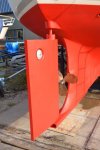
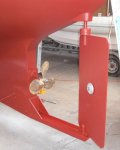
My 23ft triple keel sloop has a rudder made from teak and mahogany, it seems. It is fixed to the transom with bronze pintles like a big dinghy rudder. Thus it has a front edge exposed to the oncoming current. The trailing edge has a nice taper. However the front edge is virtually square apart from a small radius at each edge. Being about an inch thick it seems to me it must be producing unnecessary drag, and should also be tapered for streamlining? It comes from a reputable designer and maker. Does anyone know if a square edge here is indeed the appropriate and scientific/ properly engineered thing?
 
I tend to agree with you, an exposed square leading edge creates turbulence reducing the efficiency of the front edge of the rudder which has the most power . Generally the rudder might have a blunt leading edge where it is in the shadow of the deadwood above & below the propeller cavity but in the propeller cavity a streamlined flow should smooth the flow of water over the rudder.. Some builders also reduce the rudder efficiency by cutting the leading edge of the rudder away in the vicinity of the propeller to allow prop removal. This also decreases the rudder effectiveness & the slight loss of prop wash for close manoeuvring . The most powerful part of the rudder is a full & continuous vertical leading edge in the older timber vessel design..
 
Failure to read the Original Post fully, but nevertheless where the leading edge is exposed to the water flow, anything that creates turbulence has the potential to slow the boat & reduce efficiency. it still remains the fact that the leading edge of the rudder is the most effective part of the rudder compared to the trailing edge.
 
Reputable designer and good builders so the omisión of a streamlined leading edge related to production costs or assembly detail as rudder cheeks are squaredjust a thought
 
Reputable designer and good builders so the omisión of a streamlined leading edge related to production costs or assembly detail as rudder cheeks are squaredjust a thought
According to "Yachts and Yachting" review of the Halcyon 23: "At about three knots, a slight vibration developed on the helm for which the cause was not apparent. This may have been due to a lack of fairing on the leading edge of the rudder blade." My boat will be going into the water soon for the first time in my ownership. So this is partly why I am asking the Forum for observations on this aspect. Thanks.
 
According to "Yachts and Yachting" review of the Halcyon 23: "At about three knots, a slight vibration developed on the helm for which the cause was not apparent. This may have been due to a lack of fairing on the leading edge of the rudder blade." My boat will be going into the water soon for the first time in my ownership. So this is partly why I am asking the Forum for observations on this aspect. Thanks.
What about screwing on a fairing piece and see how it goes,the observation in the magazine was probably right
 
My 23ft triple keel sloop has a rudder made from teak and mahogany, it seems. It is fixed to the transom with bronze pintles like a big dinghy rudder. Thus it has a front edge exposed to the oncoming current. The trailing edge has a nice taper. However the front edge is virtually square apart from a small radius at each edge. Being about an inch thick it seems to me it must be producing unnecessary drag, and should also be tapered for streamlining? It comes from a reputable designer and maker. Does anyone know if a square edge here is indeed the appropriate and scientific/ properly engineered thing?
Whilst blunt is probably wrong (unless directly behind a skeg or keel), you don’t want the same taper as there is at the rear edge. Tend to be more rounded at the front, to keep the flow attached when the rudder is at an angle.
 
Agree with Dunedin. Optimum shape is a rounded leading edge followed by a long taper to a fine trailing edge. If you want to get technical look up NACA profiles for rudders (and keels) on the internet.

Incidentally, a previous boat had an auxiliary rudder type windvane steering system. I improved the performance by fitting a "fence" at the static waterline using alloy sheet about 2cm. wide around the rudder. This stopped air being sucked down the blade by the lee vortex. If your rudder blade continues above the waterline it may be worth considering.
 
Last edited:
This is remarkably apposite, as I have just come back into the office from fashioning a NACA 0008 template for fairing the rounded front edge of my flat 40mm fin keel section. Here is the online template site that I used, but I've linked a 12% profile, as designers favour the fatter sections for rudders - NACA0012H for VAWT from Sandia report SAND80-2114 (naca0012h-sa) - Just blow it up/down to the size you want, print it out of paper, cut the template for just the leading edge and get busy with the angle grinder!

Bonne chance
 
Doubt you will notice any difference if you rounded the edge - in fact at the moment you don't know how it is going to behave. Just get it in the water and have fun.
 
Simple hydrodynamics . Fair the front end of a free standing rudder. If on the aft end of a keel , just take the corners off.
I grew up by a drawing board. Father was an aerodynamics trained engineer turned yacht designer. I learned a lot back then.
 
The best type of profile for a rudder is a four digit NACA section of 12% cord.
Contrary to some statements, profiling the rudder makes a considerable difference to the steering behaviour of a boat; it also drastically reduces resistance.

Our boat, also from the pen of a "reputable designer", had a flat plate rudder behind a 5-7" wide squared off deadwood. The rudder would stall out regularly in modest conditions leaving us without control and the boat was near impossible to tack, especially at low speeds.
I profiled the rudder and faired in the deadwood. The improvement in handling has been incomparable. She answers to the slightest touch of the helm and tacks reliably in speeds as low as 0.6kts. The boat is also noticeably faster as well.

A flat, non profiled rudder of 5 sqft, such as ours was, will generate at 10 degr and a speed of 6kts a resistance of 67 pounds. A profiled rudder of the same size will generate 24 ponds. To put that into relationship to total resistance on our boat: the non-profiled rudder will reduce our speed by 1.99 kts versus 0,7 kts for the profiled form - a net gain of 1.3 kts.

reduced rudder.JPGSAM_0426 low res (2).JPG
 
Top