
Specifying an Electrical System For a New Boat (In 1999)

PaulRainbow

Well-Known Member
Joined
16 May 2016
Messages
19,579
Location
Suffolk
Visit site
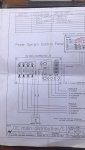
This particular boat was built in Holland in 1999 to a high standard, with Mastervolt switch panels, mains charger, alternator with external regulator, inverter etc. The electrical system is documented and has a schematic showing fuses etc.
IMG-20210625-WA0003.jpg

Last Friday the new owner called me to say that shortly after turning the kettle on (using the inverter) the kettle stopped boiling and there was no output from the inverter. I got him to follow the inverter cables and he found the fuse, which was clearly blown ( he sent me a pic). Noting that it was a 160A fuse and knowing that the boat had a 2500W inverter, i told the owner that the fuse was under rated, it should be a 300A fuse for a 2500W inverter. He cited the schematic and told me that is showed a 16A fuse and that was the original schematic from when the boat was built. I insisted that the fuse was wrong, it should be 300A, if the system was 24V a 160A fuse would have been correct.

He reminded me the boat was all 12V (i knew this) but as he did so, he noticed the detail, top right, which i've circled in red. So, built using 12V systems and a 24V design schematic, all of the fuses greatly under rated, except one. In the 22 years since the boat was built i wonder how many times that inverter fuse has blown ?

All fuses now replaced with the correct ones and everything is working exactly as it should, only took 22 years to get there ?
 
This particular boat was built in Holland in 1999 to a high standard, with Mastervolt switch panels, mains charger, alternator with external regulator, inverter etc. The electrical system is documented and has a schematic showing fuses etc.

View attachment 118120

Last Friday the new owner called me to say that shortly after turning the kettle on (using the inverter) the kettle stopped boiling and there was no output from the inverter. I got him to follow the inverter cables and he found the fuse, which was clearly blown ( he sent me a pic). Noting that it was a 160A fuse and knowing that the boat had a 2500W inverter, i told the owner that the fuse was under rated, it should be a 300A fuse for a 2500W inverter. He cited the schematic and told me that is showed a 16A fuse and that was the original schematic from when the boat was built. I insisted that the fuse was wrong, it should be 300A, if the system was 24V a 160A fuse would have been correct.

He reminded me the boat was all 12V (i knew this) but as he did so, he noticed the detail, top right, which i've circled in red. So, built using 12V systems and a 24V design schematic, all of the fuses greatly under rated, except one. In the 22 years since the boat was built i wonder how many times that inverter fuse has blown ?

All fuses now replaced with the correct ones and everything is working exactly as it should, only took 22 years to get there ?

Main battery cables a bit thin, unless they are thicker than the diagram shows.
 
Maybe the fuse never blew - because they never used the batteries and the invertor to power a kettle.

We have an inverter/charger but we would never use the batteries to boil a kettle, nor use a toaster nor the microwave. If you use these devices your battery drain is huge (and the power used takes a long time to replace).

We carry an electric kettle, toaster and microwave - which we use for the occasional time we are in marina or in a yard (say for antifouling). The rest of the time we use a kettle on the stove top, gas grill for the toast and a steamer instead of a microwave. But we can accept and are wired for shore power.

Maybe the original owner knew the fuse was undersized - because he did not use an electric kettle and had no intention of draining his batteries.

Jonathan
 
We have an inverter/charger but we would never use the batteries to boil a kettle, nor use a toaster nor the microwave. If you use these devices your battery drain is huge (and the power used takes a long time to replace).

Do you use your inverter for anything? There seems little point having one if you don't take advantage of it. Boiling a kettle typically only uses 8-10Ah.
 
Do you use your inverter for anything? There seems little point having one if you don't take advantage of it. Boiling a kettle typically only uses 8-10Ah.

There are surprisingly a large number of devices that rely on electricity, maybe you have heard of them, computers, phones, iPads, cameras, then nav equipment, autopilot and desal unit then the fridge and freezer. . Ours is an inverter charger so it is used to re-charge batteries, when on shore power, Power tools, as the name suggests, use power and unfortunately I have not found a way of operating them on bottled gas. Why would we use 'scarce' battery power for a kettle when we carry 2 x 8kg bottles of gas.

There seems no point in having a hob and gas -...... if you do not use them :). The nice thing about our gas heated kettle - it shouts (or in fact whistles) at us when its done.

I did not say we cannot use an electric kettle I said there are better ways, for us, to boil water.

We do use the inverter for our bread maker. We could knead by hand and bake in the oven - but it is more convenient to do it automatically.

If we visited a marina every night we could recharge the batteries with ease - but where we go there are no marinas and we need the battery capacity to deep freeze the crayfish and tuna - as along with no marinas there are no supermarkets, nor roads and the nearest inhabitants are maybe 200nm away, there is no fresh water tap (we could collect in buckets - as they did 200 years ago - desal seems a good alternative. . Electricity to us is a limited finite resource - the gas lasts, and lasts.

Now - if you have some good ideas to replace 'energy' that's better than 2 x 9kg gas bottles and allow us to use an electric kettle, toaster and microwave with free abandon - I'm listening.

Jonathan
 
Now - if you have some good ideas to replace 'energy' that's better than 2 x 9kg gas bottles and allow us to use an electric kettle, toaster and microwave with free abandon - I'm listening.

In your circumstances, a diesel generator could be an attractive option.
 
Maybe the fuse never blew - because they never used the batteries and the invertor to power a kettle.

When the new owner viewed the boat the inverteer wasn't working. This was reported back to the seller, who said "just a fuse, i've fixed it".

If you don't want to use equipment that consumes 2500W of AC power you fit a smaller inverter, surely ? A 160A fuse on a 12V system would be about right for a 1500W inverter. If you fit a 2500W inverter you fit a 300A fuse (on a 12V system), the fuse protects the wiring, the inverter will shut down if you overload it (decent inverter).

We have an inverter/charger but we would never use the batteries to boil a kettle, nor use a toaster nor the microwave. If you use these devices your battery drain is huge (and the power used takes a long time to replace).

I don't even have an inverter,so when i'm away from shore power my electric kettle doesn't work, i use gas. But, i work on boats that do use inverters for kettles, microwaves, toasters etc and they cope fine, if the charging systems are suitably rated. Lots of biggish mobos are fitted with AC equipment and rely on solar/generators/engines to produced the power. The boat in question here is a motorboat, with a generator and twin alternators.

We carry an electric kettle, toaster and microwave - which we use for the occasional time we are in marina or in a yard (say for antifouling). The rest of the time we use a kettle on the stove top, gas grill for the toast and a steamer instead of a microwave. But we can accept and are wired for shore power.

Maybe the original owner knew the fuse was undersized - because he did not use an electric kettle and had no intention of draining his batteries.

Jonathan

Respectfully Jonathan, i think you missed the point of the thread. Which was that the boat was built in 1999 to a design plan based on a 24V system, which turned out to be a 12V system, hence all of the main fuses being grossly under rated and the error not being spotted for 22 years.
 
My 800w 240w immersion heater has been running happily on a 3A fuse. Within the margin of error perhaps!

The 240 figure is obviously a type, should be 240V

240V divided by 800W = 3A Your fuse is correct

The issue with the installation i posted about is this:

A 2500W inverter will draw 250A from the batteries @ 2500W, a 160A fuse is obviously not a high enough rating here. If the system was 24V, which the schematic shows, the voltage would be double, so the amps will be halved, so the 160A would have been correct.
 
Paul,

My point was that if the owner of the yacht when new did not overload the fuse then it would not blow and he would not know. If it was a Mobo maybe he spent his time commuting between marinas, used shore power, and never stressed his inverter.

We have systems on our cat, bilge pumps - they have never been used in anger, we have a DSC facility on our VHF, never used, We have an EPIRB, never used (and we simply 'hope' it works). We have storm jib, we tried it for fit - but its never been used.

With a gas stove and oodles of gas in bottles then the only reason for us to use an electric kettle is with shore power. I have yet to meet a yacht owner who has so much access to oodles of electricity that they would use an electric kettle, microwave in preference to gas. Having enough electricity to use it for a kettle implies very regular use of shore power or much motoring and little use of their anchor - or a big gen set destroying the peace and tranquillity of the anchorage for everyone round them.

Most yacht owners I know treat electricity like gold dust or diamonds - something to be saved and if there are alternatives - use them. Sadly our ability to require electricity is increasing faster than our ability to produce and save it - on a sail boat.

I would be interested in the people who use an electric kettle in an anchorage on a sail boat and how they generate and save power. I accept that a kettle might not use much power, - but its a philosophy - look after the pennies and the amps will look after themselves. :)

Jonathan
 
Paul,

My point was that if the owner of the yacht when new did not overload the fuse then it would not blow and he would not know. If it was a Mobo maybe he spent his time commuting between marinas, used shore power, and never stressed his inverter.

We have systems on our cat, bilge pumps - they have never been used in anger, we have a DSC facility on our VHF, never used, We have an EPIRB, never used (and we simply 'hope' it works). We have storm jib, we tried it for fit - but its never been used.

With a gas stove and oodles of gas in bottles then the only reason for us to use an electric kettle is with shore power. I have yet to meet a yacht owner who has so much access to oodles of electricity that they would use an electric kettle, microwave in preference to gas. Having enough electricity to use it for a kettle implies very regular use of shore power or much motoring and little use of their anchor - or a big gen set destroying the peace and tranquillity of the anchorage for everyone round them.

Most yacht owners I know treat electricity like gold dust or diamonds - something to be saved and if there are alternatives - use them. Sadly our ability to require electricity is increasing faster than our ability to produce and save it - on a sail boat.

I would be interested in the people who use an electric kettle in an anchorage on a sail boat and how they generate and save power. I accept that a kettle might not use much power, - but its a philosophy - look after the pennies and the amps will look after themselves. :)

Jonathan

We have a Wallas diesel stove because I don't want to run out of gas - electricity can be regenerated but fuel for cooking can't (unless you have a cat with a few kW of PV and an induction hob!).
 
We have a Wallas diesel stove because I don't want to run out of gas - electricity can be regenerated but fuel for cooking can't (unless you have a cat with a few kW of PV and an induction hob!).

No induction hob!

In Curacao and places like I can believe gas might be an issue :(. In Oz mostly where we can source diesel we can also source gas. But I do confess we have had to cut short a stay, in SW Tasmania, because we had to re-stock with more gas - only a long day sail, 14 hours, away (and had plenty of diesel)

But if you have an inverter do you boil a kettle using 240v (or 110v) AC or stick a kettle on the, diesel, stove.

Jonathan
 
No induction hob!

In Curacao and places like I can believe gas might be an issue :(. In Oz mostly where we can source diesel we can also source gas. But I do confess we have had to cut short a stay, in SW Tasmania, because we had to re-stock with more gas - only a long day sail, 14 hours, away (and had plenty of diesel)

But if you have an inverter do you boil a kettle using 240v (or 110v) AC or stick a kettle on the, diesel, stove.

Jonathan
We don't even own an electric kettle. The diesel stove is slow to warm up so we boil a full kettle first thing in the morning and pour it into an insulated jug for use throughout the day. We have a 3kW inverter but we don't use it much - occasionally TV, charging some devices we don't have DC chargers for, and power tools.
 
Don't judge other boats by how you use your own.

This particular boat has no gas onboard. It has a combination microwave/fan oven, electric hob, 240V fridge, 240V hot water heater etc. It is fitted with a generator and an inverter (which can now be used). It is not an uncommon setup for a modest sized motorboat. Since Monday, it also has some solar power, so hopefully less use of the generator.

As for the comments about hopping from marina to marina using shore power, i don't know if that's what they did or not.

I have another customer with a 62ft Sunseeker, that has mains cooker, hob, oven, fridge, freezer, washing maching, dish washer, microwave, kettle etc etc etc. It has a 13kva generator and no solar power. No amount of marina hopping with this one is going to do away with the generator completely, the 32A shore power system couldn't possibly supply enough power to run that lot.

Plenty of weekend sailors fit mains devices, rather than gas. I decent bank of batteries and some solar power and boiling an electric kettle, cooking using an induction hob or a mains pressure cooker, or a microwave is no problem.

Personally, i'm more in line with Jonathans philosophy. My boat is almost all 12V, apart from a kettle, microwave, calorifier and a printer. If i'm away from shore power i use a gas kettle and i always cook with gas and a little bit of microwaving when on shore power, a pressure cooker and a thermal cooker make the gas last a long time. My power comes mostly from solar, which in the Summer more or less keeps up with my needs.
 
Interesting that Paul and Roaring Girl both use a thermos (thermal cooker and to store hot water). They don't get much mention. Also interesting that Paul carries a printer.

We use a thermal cooker - Shuttle Chef - frequently for the reasons Paul outlines (great when on long passages).

Jonathan
 
Top