Sound Insulation

smithy

Well-Known Member
Joined
17 Apr 2011
Messages
367
Location
Glasgow
Visit site
I'm thinking of putting some sound insulation in but the engine compartment is open at the back meaning I would have to insulate a large area. Is it worth putting in some kind of removable bulkhead to cut down the size of the insulated area? It looks awkward to work around the exhaust and cockpit drains. Anyone tried this?
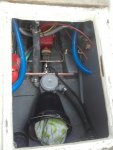
20190922_163058_resized.jpg
 

Attachments

  • 20190922_163058_resized.jpg
    20190922_163058_resized.jpg
    225.6 KB · Views: 25
Just fitting good quality sound proofing to the access hatch should make a noticeable difference .try that before getting into the complication of soundproofing your cockpit lockers.:rolleyes:
 
Like you I'd have big problems sound proofing the aft bulkhead of the engine compartment but no problem with the front or sides. I thought of putting some sound proofing on the other side of the bulkhead but I'll have to get some advice there

.
 
I fitted a removable cover panel at the aft of my engine, between the gearbox and thrust bearing and stern seal.

I then fitted sound insulating foam onto the inside of the removable panels.
 
I hadn't thought of a "removable cover panel at the aft of my engine" but that sound like a good move. Thanks
 
I think that insulating the whole space will probably work out slightly easier overall, for both the initial job and subsequent access, at the cost of requiring more material (and good sound insulation isn't cheap).

I didn't have any particular problems working around the various large hoses in my engine bay - for fixed insulation, of course. Making something removable fit tightly around the pipes is a big part of why I reckon the partition option is harder.

EDIT: This is the soundproofing material I fitted in Ariam: https://www.nkgroup.co.uk/product/noisekiller-lead-sandwich-material/ . It was easy to work with and has made a huge difference to the noise on deck and in the cabin. Also get some 4" foil tape (about twice as much as you think you'll need ;) ) to cover joints between panels and seal any exposed edges. The sandwich material is best mounted with screws and penny-washers for additional support, especially on overhead sections, rather than relying on the adhesive alone.

Pete
 
Last edited:
I think that insulating the whole space will probably work out slightly easier overall, for both the initial job and subsequent access, at the cost of requiring more material (and good sound insulation isn't cheap).

I didn't have any particular problems working around the various large hoses in my engine bay - for fixed insulation, of course. Making something removable fit tightly around the pipes is a big part of why I reckon the partition option is harder.

I'd agree with that - it's important to minimise gaps. For that reason it's always worth adding draught excluder type strips on all edges of the access hatches.

It also helps to soundproof the air intake for the engine compartment, to minimise airborne noise. On my old HR352, the air intake to the engine compartment was a 90mm duct from a sheltered area in the cockpit. I found that building baffles, covered in cheap foam-backed carpet, in the area where the duct sucked air from made a big difference to engine noise in the cockpit.
 
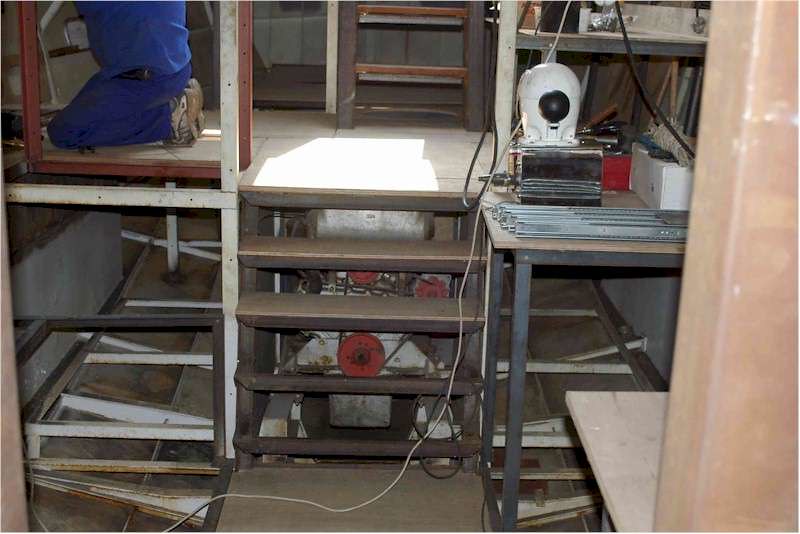
This is a pic of the front cover behind the heat exchanger. It is a set of hinged steps between the saloon and galley area/level

]
35953344461_5d37cd9167_b.jpg


This is a pic of the back cover of my engine cover. This is in 3 parts the pic shows the top vertical.

35953336851_d56cd0520a_b.jpg


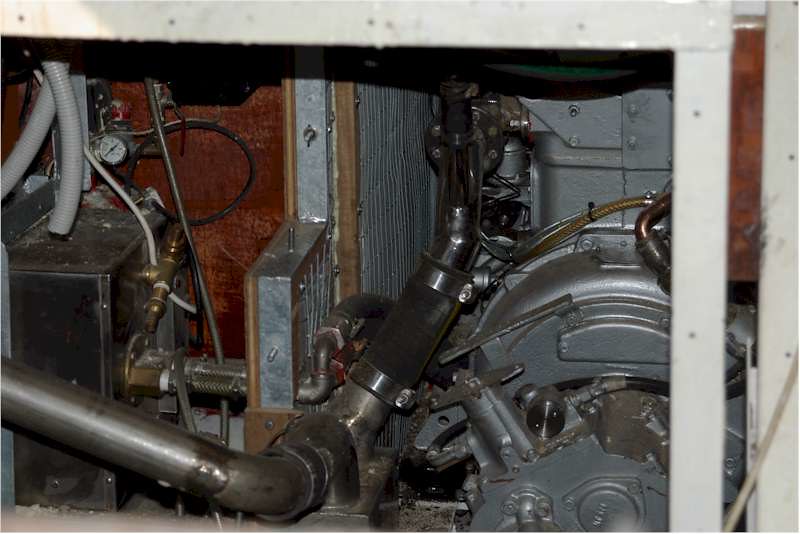
This is the back of the engine and gearbox with the covers removed. The 3 covers are attached to the galvanized bracket with studs sticking out. The panels are locate on the studs and held on with wing nuts.

36046270506_3396bf3cab_c.jpg


These are the lifting saloon/ wheelhouse steps which will be the engine front cover. Insulation behind.

35696486100_f436be3f63_c.jpg


Insulated engine bay before engine fitted.

36046392386_89ff3d0b63_b.jpg


Engine bay with engine fitted.

35246467244_2c78acfca7_b.jpg


35917800842_3aec852d21_b.jpg


I retained the insulation by using galvanized wire mesh screwed to edge blocks that fitted into each other to make a sound deflection/absorbing joint.

I am considering using foam strip to seal the engine box better.
 
I fitted a removable cover panel at the aft of my engine, between the gearbox and thrust bearing and stern seal.

I then fitted sound insulating foam onto the inside of the removable panels.

Any problems with increased engine room temperature? do you have a blower in there?
 
Any problems with increased engine room temperature? do you have a blower in there?

The engine room does get warm but not too hot. I do have 2 external vents with blowers and butterfly valves to close then off in case of fire. Never needed the blowers as the engine itself pumps quite at lot of air through its intake.
 
FYI while I was redoing my engine bay I found some reasonably priced self adhering sound/heat shielding from the Chinese. Has been in boat for three years now and seems to be doing alright.
 
FYI while I was redoing my engine bay I found some reasonably priced self adhering sound/heat shielding from the Chinese. Has been in boat for three years now and seems to be doing alright.
Do you still have a link to the supplier?

ASAP do packs of four sheets which should do it if I go down the bulkhead line. If i do just the hatch I've got a feeling that I might end up wishing I should have insulated the lot. Is the 23mm adequate or is it worth spending the extra and getting the 32mm?
 
Something like this sounds quite cheap. That surprises me because the last time I looked (some time ago) it was very expensive.

https://www.ebay.com.au/itm/12x-Gla...553866&hash=item2f10443bef:g:pTgAAOSwNnRYmFFL

There’s always something cheap available; the question is whether it’s any good.

I would be sceptical of any product which is both thin and doesn’t contain lead or some similar very dense substance. It might be possible to substitute for lead with thickness, but if you want thin then you need that heavy barrier (and it needs to be suspended between other layers that isolate it from the surface).

The other stuff you looked at was probably expensive because of the lead, and it probably worked. This stuff is cheap and describes itself as a “lightweight foam laminate”. It probably does something to reduce noise, but nothing like as much as a proper suspended lead barrier.

Pete
 
prv

I have to agree. My memories go back to the days when I had to organize sound proofing for doctor's rooms and lead was always a component.

Clive
 
prv

I have to agree. My memories go back to the days when I had to organize sound proofing for doctor's rooms and lead was always a component.

Clive


When I did it in my joinery & fitting out days the method was to provide separated wall skins of different construction to break the frequency of the sound. It did not need lead & the construction was surprisingly light. As a student I went to the building research establishment & their sound room was surrounded in foam formed like lots of spikes 2 feet long stuck to the walls & we walked out into the room on a floor formed from wires suspended above the same foam on the floor. No hint of lead anywhere. We were all struck by the silence, having never realised how noisy everything around us is. Even trying to talk was odd as there was no sound reflection.

The Timber Research & Development Association demonstrated how to make sound deadened walls out of timber construction with sound deadening plasterboard. But 2 walls not connected. Once again very light construction.

To reduce transfer of sound you want to break the frequency & resonance of the medium between. So if, for example, you want to make double glazed units more effective, make one pane 4mm thick and the second 6mm thick, with as large an air gap as practical. 3 skins are even better, but then you also have to look at how the frames are constructed as sound can be transmitted through the frame.

So that leads me to believe that the best foam sound deadening material will, possibly, be made from laminates of different construction. Thus, they are able to perform Ok whilst being fairly thin & light.

However, in my own house I made sure that the party walls were thick concrete block.I cannot imagine that round the OP's engine bay.
 
Last edited:
I'm sure you are right but I was just organizing soundproofing an existing door. (The walls would have been brick so no problem there)

In the school thaterette the old chap (Con Grimm) stuck opened egg cartons to all the walls, Certainly that seemed to have an effect on noise - maybe stopping echoing?
 
prv

I have to agree. My memories go back to the days when I had to organize sound proofing for doctor's rooms and lead was always a component.

Clive

I agree with Pete

The best sound insulation has a layer of lead sheet between layers of foam which are different densities to overcome resonance.

The inner layer also has a egg shaped layer of foam , mine had a layer of woven glass fibre.

Some cheaper but still effective replaces the lead with a layer of dense plastic sheet.
 
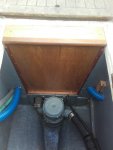
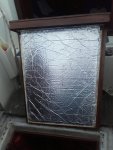
I though I would put the finished job up. After listening to the advise on here I decided to build a removable bulkhead before insulating. The engine is definitely quieter but I will not know just how much until I launch the boat. I hadn't realised the amount of work in fitting the insulation, every part had to be templated to fit around the hoses. I left a gap around the exhuast as there is some movement here and this should be big enough for the air intake.

20200405_170344_resized_2-1.jpg20200607_163850_resized.jpg20200607_163822_resized.jpg20200607_163940_resized.jpg
 
I left a gap around the exhuast as there is some movement here and this should be big enough for the air intake.

Any gap you leave will allow noise to escape out but you can reduce the noise by making the noise go around corners with flanges that still allow movement in the direction needed. My exhaust /sound insulation was in the fixed part of the exhaust and the flexible exhaust hose inside the soundproofing.

Air will get in via the bilge anyway.
 
Top