Soft hull from years of use. How important is it?

Foolish Muse

Well-Known Member
Joined
27 Dec 2012
Messages
375
Visit site
In another forum I read someone refer to soft hulls on the Figaro II from 14 years of use. I'd not thought of this issue before. Is it really an issue with modern fiberglass boats?

On the Olson 30 they've added a "beam of destiny" across the main bulkhead and a "jockstrap" from the bulkhead to the mast foot in order to stiffen up the hull. But this was done shortly after the boats were built to correct an inherent flexibility in the hull. You can see both in this photo:
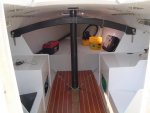
Olson 30.jpg

Would such additions solve any soft hull problem on a Figaro II or any other boat?
 
Any additional context? A quick google didn't find the other forum and related threads.

To me soft hull might mean anything from hull isn't quite as stiff as it used to be so not quite such a good racer... Through to heavily fatigued GRP that's lost a lot of strength. Or just rotten core material leading to squidgy deck...
 
Any additional context?

Any hull flexes a bit in use. And obviously hard use with high winds on a choppy sea would lead to greater flexing. But does this flexing increase with the age of the boat? Would a very well designed/built boat like the Figaro II be immune to degradation from flexing? And by how much would a decade of flexing lead to reduction in boat speed or safety? I'm looking for thoughts or experience with this.
 
Racing boats use huge rig tensions - and want boat structures which are very rigid so as to keep things like the forestay tension constant bashing upwind. With time the structure will get less rigid, and may therefore lose a few yards on a round the cans race, or a bit more offshore.
Not a huge issue for typical cruisers - though things like collapsed deck supports in ex race boats can be a bigger concern (or poor design and construction such as led to some wobbly bilge keels etc on pure cruisers)
 
Re the "Beam of destiny" The load path for cap shrouds includes the shroud itself and mast compression but more importantly the path chain plates down to the keel then up to the base of the mast. or in some cases with keel stepped mast just to the keel. The load is trying to pull the chain plates up but also in towards the centre line. Usually a solid cabin top will resist the inward loads easily. Unless of course you have rotten sandwich type cabin top. The hull itself usually takes the up pull of the chain plates assuming that the chain plate load is taken down into the hull.
So if OP has concerns about hull flexing then he needs to determine just what area of the load path is giving.
Just a word of caution however. The extreme load tensions advocated by rigging people do not take into account hull flexing so IMHO are too high. Secondly under pressure on a hard beat with boat well heeled it is inevitable that lee shrouds go slack. Any attempt to avert this is IMHO futile indeed damaging to the hull. Certainly if you do go for high static rig tension you should alleviate this tension after sailing. Use a high field lever.
So the Beam of destiny IMHO was an over kill taking away head room. It was obviously to stop the chain plates and associated area from being compressed inward. Stiffening the cabin top especially with carbon fibre and ensuring core is good would be a start. Perhaps increasing the depth of the cabin top would also help. Also the contact of the keel stepped mast at the cabin top is essential to support the cabin top against this compression inwards.
Then of course there is the concern re forestay tension under load. Again the load path is via the hull from bow to under the mast (keel stepped or support pole) then through the hull to the back stay attachment. With resistance to compression via the deck and cockpit. Normally this is not so much of a concern there being plenty of stiffness in the hull. Check the path forestay attach down to hull and likewise backstay attach down to hull and keel.
So hopefully this will give OP some ideas on presence or not of a soft hull and places to look for stiffening. olewill
 
An under deck "top hat" GRP moulding could replace the beam of destiny surely? Mind you, that arrangement in the photo looks bombproof if way over the top.
 
"Soft Hulls' can be used to describe two conditions.

One, like the Ohlson, is where the overall structure is unable to resist the global loads from either the keel or the rig etc. This is usually because the structure wasn't engineered well enough in the first place. But it can also be a durability problem when the initial structure was only just good enough and high loads causes some degradation of the hull / internal structure for instance, leading to increased movement.

The other is where the panel stiffness is not good enough and as the grp flexes it begins to loose what stiffness it had and the 'oil canning' of panels increases with time.

Do you know what problem the Figaro has?
 
If it's gone soft, it just means that you won't be able to put so much rig tension on without the boat bending, and it might pant a bit more into a sea. Not really a problem is you don't want to race it. If you do want to race, you won't be competitive because the flex in the boat will reduce the amount of drive produced from the rig.
 
Thanks for the comments. I have a feeling that in a year or two, all of the Figaro II's will be available at a terrific price when the corporate sponsors move to the Figaro III's and just want to get the II"s off their books. I think the market would be hard pressed to absorb 100 specialized singlehanding racing boats, so prices could drop sharply and someone like me, who's been drooling over the Figaro II for a long time, can pick one up on the cheap.

Unfortunately, something like hull flex or stiffness would be very difficult for a surveyor to pick up during a standard on-the-hard survey. How could one determine that hull A is perfectly stiff while hull B is flexing?
 
Surely this is why most cruising designs have a full bulkhead amidst the stressed area? The structure in th photo should outlast the rest of the boat! Adding a bulkhead with a mast support fastened to it would achieve much the same.

Rob.
 
Yes, hulls do flex, even in a fore and aft plane...especially when built to the limit as is the case with out-and-out racing machines. Remember this scene?

fcifx4.jpg


The idea, usually, is to make sure that the mast and the shrouds form a strong structure that is virtually independent of the hull; the hull virtually becomes a minimalist appendage that is fixed to and moves with the rigging structure. This is not a big problem in the athwartship plane ( think of an airliner's wings and the massive hoops that support them and then the fuselage that is 'just' hanging from them). But the fore& aft plane is not so easy, as can be seen in the photo above.

'Ordinary' racers are not so extreme and 'cruisers' are nowhere near. In my view, the Figaro was designed to be an affordable racer that was 'a cut above the rest' and that had scantlings that were close to the minimum.

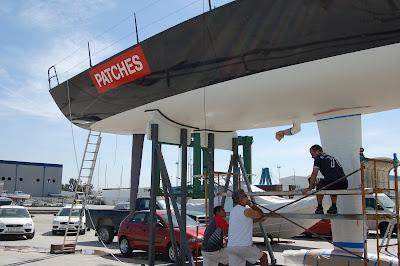
I experienced something similar, some ten years ago (IIRC), with a boat named 'Patches', a Reichel Pugh design racer. The structural cracks that I found radiating from the keel attachment out into the carbon hull were impressive enough - to put it mildly - that the boat was not raced in that year's RMSR. She later had other structural failures in Sicily and 'died'. Overhearing the heated arguments between the owner, the designer and the builder was quite an experience!

So, what to do? Some design shortcomings are easily put right, e.g., the floppy bilge keels on the early Centaurs, but some others are not. IMHO, unless one has deep pockets and is irretrievably attracted to such unfortunate boats then one would be well advised to steer clear of them.

DSC_1281.JPG
 
Last edited:
Way back in the 70's our university canoe club purchased new GRP canoes. Being young and enthusiastic we used to carry passengers on the aft deck. After a few weeks the convex decks would flex down and have to be pushed back in to shape. By the end of the season they were more like damp cardboard.

Each time the deck was flexed the rigid resin developed minor cracks to allow the movement. Eventually we were left with a mass of resin granules held together by the glass mat. This was an extreme example of soft GRP, but has made me wary of any flexing in a hull.

Basically the glass is flexible and holds the brittle resin together. Or do modern laminates use a flexible resin??
 
Many years ago Bob Stuart ( Father of designer Andrew of Limbo fame) had a 3/4 tonner built called Dingo. The designer went aboard & stretched a thin line through the middle of the boat from bow to stern whilst the rigging was slack.
They then tensioned the rig & measured the change in dimension from keel bolts to line before & after the rig change. Apparently the rig bent the boat by 1.5 inches. The designer was very pleased as this was exactly what he expected.
Boats will bend as stresses are applied in different ways & presumably they flex whilst at sea.
I know that my own boat will bend if not placed on the shore stand properly & the fore cabin door will stick or the floor board will kick up just behind the keel if badly supported. It is a 31ft Hanse.
If this flexing occurs over a long period there must be some detrimental effect on the GRP, particularly at junctions
 
Unfortunately, something like hull flex or stiffness would be very difficult for a surveyor to pick up during a standard on-the-hard survey. How could one determine that hull A is perfectly stiff while hull B is flexing?

Maybe use a rigging tension meter and a spanish windlass between the shrouds across the beam to see how much the tension can be increased ?

Boo2
 
Top