Laminar Flow
Well-Known Member
Hi, everyone. I thought I would post an interesting approach to predict hull speed developed by Dave Ger, author of several books on boaty things and Prof at the venerable West Lawn School of Yacht Design.
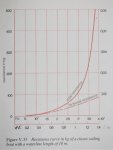
It goes beyond the traditional method of determining hull speed, which is square root of DWL multiplied by 1.34, by introducing Displacement/Length ratio as a relevant factor. His approach recognizes that light displacement vessels can exceed what used to be once regarded as an impermeable barrier.
The new formula is: square root DWL x factor (SL)
Whereas SL is: 8.26 / DL ratio to the power of 0.311
For my boat with a 28.25' DWL and a DL of 322 SL works out to be about 7.3kts.By the traditional method it would be 7.12kts.
(It should be noted that we have frequently sustained speeds of 7.5kts and occasionally 7.8kts. This, I suspect, has more to do with our high prismatic coefficient (0.61) which is fine on a reach, but gives us a bit of a blunt nose for going to weather (fast) in any kind of sea)
Now, if I could put my boat on a diet and, just to say, miraculously lost 3 tons, I would then have a DL of 244 and could expect a nominal top speed of nearly 8kts (7.97).
Just a word of caution on DL ratios: the displacements given in brochures and in publications such as Sailbota Data need to be taken as empty boat values at best.
I just recently helped a friend haul his boat and that was listed in Sailboat Data as weighing 21500#. In fact, it came out at 33000#, almost a third heavier. Interestingly he didn't seem to have that much stuff on board, beyond the regular cruising gear and no provisioning. It did set me to thinking and I'll be looking to rent a locker at our marina to store all the things we do not constantly need on board.
So, borrow your kid's scientific calculator and have some fun.
It goes beyond the traditional method of determining hull speed, which is square root of DWL multiplied by 1.34, by introducing Displacement/Length ratio as a relevant factor. His approach recognizes that light displacement vessels can exceed what used to be once regarded as an impermeable barrier.
The new formula is: square root DWL x factor (SL)
Whereas SL is: 8.26 / DL ratio to the power of 0.311
For my boat with a 28.25' DWL and a DL of 322 SL works out to be about 7.3kts.By the traditional method it would be 7.12kts.
(It should be noted that we have frequently sustained speeds of 7.5kts and occasionally 7.8kts. This, I suspect, has more to do with our high prismatic coefficient (0.61) which is fine on a reach, but gives us a bit of a blunt nose for going to weather (fast) in any kind of sea)
Now, if I could put my boat on a diet and, just to say, miraculously lost 3 tons, I would then have a DL of 244 and could expect a nominal top speed of nearly 8kts (7.97).
Just a word of caution on DL ratios: the displacements given in brochures and in publications such as Sailbota Data need to be taken as empty boat values at best.
I just recently helped a friend haul his boat and that was listed in Sailboat Data as weighing 21500#. In fact, it came out at 33000#, almost a third heavier. Interestingly he didn't seem to have that much stuff on board, beyond the regular cruising gear and no provisioning. It did set me to thinking and I'll be looking to rent a locker at our marina to store all the things we do not constantly need on board.
So, borrow your kid's scientific calculator and have some fun.