Slack water time - Corryvrecken example (pedantic)

Amulet

Well-Known Member
Joined
25 Jun 2007
Messages
1,837
Location
Oban
www.flickr.com
CCC sailing directions enable estimates of:
Time at which tide turns east (ebb)
Time at which tide turns west (flood)
Duration of slack - 15 mins springs, 1 hour neaps.

Would you interpret this to mean that the "slack period" precedes the "turn time"?
or
"Slack period" spans the "turn time"?

A bit academic at 15 mins, but worth knowing at 1 hour.

Mostly for fun (I should get out more) I was tabulating this and calculating the interpolations etc. It'd be nice to do it as well as possible.
 
My anecdotal evidence is that the CCC sailing directions differ by as much as an hour from the UKHO large scale data and are always more accurate. I was trying to tabulate those data because we recently noticed a huge difference between a UKHO based tidal app and CCC (which was correct with impressive precision). However, irrespective, my question really is what the CCC language is intended to mean. Maybe I should ask them not the forum!
 
My anecdotal evidence is that the CCC sailing directions differ by as much as an hour from the UKHO large scale data and are always more accurate. I was trying to tabulate those data because we recently noticed a huge difference between a UKHO based tidal app and CCC (which was correct with impressive precision). However, irrespective, my question really is what the CCC language is intended to mean. Maybe I should ask them not the forum!


The thing to be aware of is that slack water at Corryvreckan, and the other nearby gates tidal gates, is NOT HW or LW.

The tidal range is different on each side of Jura, so:
- at HW and LW there's a couple of feet difference in sea level so there's still a lot of flow
- slack water is when the height either side is the same, which depends on how quickly the tide is ebbing/flooding, hence almost instantaneous at springs.


[Edit .. to try and put it in perspective] The rule of twelfths doesn't apply on the east side (Sound of Jura) for topographical reasons. Most of the flood and ebb occur in the first few hours, and there's little change in height after that (still plenty of current though). So, on the flood for example, the tide is higher on the outside both before and after HW and C'veckan runs strongly until the levels equalise for a short period (slackish); it's similar on the ebb, with the water in the north of the Sound changing direction, but still ebbing, through the C'veckans (and Cuan and Luing) as the ebb on the ocean side drops further and faster.


I'd be curious to know how your calculations and observations compare with mine
 
Last edited:
The thing to be aware of is that slack water at Corryvreckan, and the other nearby gates tidal gates, is NOT HW or LW
...
I'd be curious to know how your calculations and observations compare with mine

Yes, I am aware of the fact that the flow changes at a different time to high and low water. This is why I, as I indicated, I am calculating from the CCC observed times start of E and W flow. These are given relative to Oban and differ for springs and neaps so interpolation is needed.

I have no observations for Corryvreckan, but have seen the start of flood in Cuan predicted a full hour later than UKHO. The CCC was correct.

My question was about the language of CCC.

If they say the W flow begins at, say, 1700 and there is 60 mins slack does this mean:
Slack from 1600 to 1700
OR
slack from 1630 to 1730

At this point the discussion is about how you'd interpret that language, not who's right.
 
Yes, I am aware of the fact that the flow changes at a different time to high and low water. This is why I, as I indicated, I am calculating from the CCC observed times start of E and W flow. These are given relative to Oban and differ for springs and neaps so interpolation is needed.

I have no observations for Corryvreckan, but have seen the start of flood in Cuan predicted a full hour later than UKHO. The CCC was correct.

My question was about the language of CCC.

If they say the W flow begins at, say, 1700 and there is 60 mins slack does this mean:
Slack from 1600 to 1700
OR
slack from 1630 to 1730

At this point the discussion is about how you'd interpret that language, not who's right.

1700 ... until then the water was all heading in the same direction. The slack is only because the water on the inner side stopped rising, and the resulting sloshing around takes a while to sort itself out before the flow is established in the new direction.
 
My anecdotal evidence is that the CCC sailing directions differ by as much as an hour from the UKHO large scale data and are always more accurate.

My anecdotal evidence is that the CCC tide times can be complete fantasy. They get the Mull of Kintyre wrong by several hours, for example, or at least they do in my 1991 version. Perhaps they have updated it by now.
 
1700 ... until then the water was all heading in the same direction. The slack is only because the water on the inner side stopped rising, and the resulting sloshing around takes a while to sort itself out before the flow is established in the new direction.

Sorry, don't quite understand your answer. I do understand what slack water involves.

If their calculation says that the westward FLOW BEGINS at 1700 and that there is an hour of slack. My question was when does this hour START and END. (My guess is 1600 to 1700, but post #2 answered exactly the question I'd asked and disagreed - which was a very useful response because I think there is ambiguity.)

At this stage I have no interest in whether they are right, wrong, accurate or inaccurate. For all I know it could be far from accurate - apparently is at the Mull of Kintyre. The only question I was asking was what we should interpret their statement to MEAN.

My goal was to tabulate their predictions for an entire season so that we can see if they are right. I accept the caveat in the accompanying text indicates that there is substantial and inescapable unpredictability in some places. I was using Corryvrecken as an example to discuss the principle not the detail.
 
Sorry, don't quite understand your answer. I do understand what slack water involves.

If their calculation says that the westward FLOW BEGINS at 1700 and that there is an hour of slack. My question was when does this hour START and END. (My guess is 1600 to 1700, but post #2 answered exactly the question I'd asked and disagreed - which was a very useful response because I think there is ambiguity.)

At this stage I have no interest in whether they are right, wrong, accurate or inaccurate. For all I know it could be far from accurate - apparently is at the Mull of Kintyre. The only question I was asking was what we should interpret their statement to MEAN.

My goal was to tabulate their predictions for an entire season so that we can see if they are right. I accept the caveat in the accompanying text indicates that there is substantial and inescapable unpredictability in some places. I was using Corryvrecken as an example to discuss the principle not the detail.
 
If their calculation says that the westward FLOW BEGINS at 1700 and that there is an hour of slack. My question was when does this hour START and END.

If they said that there was an hour of slack and that westward flow began at 1700 then I would expect slack from 1600 to 1700.

But is that what they say? I am pretty sure that in my copies they say "the tide ebbs from east to west", so in that case if local HW was at 1700 I'd expect slack from 1630 - 1730.

Can you give us the exact wording which is confusing you?
 
Last edited:
If they said that there was an hour of slack and that westward flow began at 1700 then I would expect slack from 1600 to 1700.

But is that what they say? I am pretty sure that in my copies they say "the flood ebbs from east to west", so in that case if local HW was at 1700 I'd expect slack from 1630 - 1730.
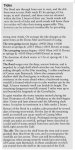
I'm glad to say that that there is no statement that the "flood ebbs" - that would really confuse me. As pointed out above, there is nothing useful to be gained by thinking about the times of high and low water. There is a bland assertion that the slack lasts 15 mins at springs and 1 hour at neaps. Without any further information, the implication is that this is true for the slack both at the change from eastwards to westwards flow and at the change from westwards to eastwards. (Seems vaguely unlikely, but there you go.) For what it's worth, the flood is from east to west and the ebb from west to east. The relevant part of the CCC Sailing Directions is attached.
 

Attachments

  • Tides.jpg
    Tides.jpg
    177.1 KB · Views: 4
Sorry, don't quite understand your answer. I do understand what slack water involves.

If their calculation says that the westward FLOW BEGINS at 1700 and that there is an hour of slack. My question was when does this hour START and END.

my experience and understanding is that, in your example, from 1700 there is a period of slack.


(My guess is 1600 to 1700, but post #2 answered exactly the question I'd asked and disagreed - which was a very useful response because I think there is ambiguity.)

Your guess assumes that it is sinusoidal, like the tide, which it isn't.

- [in your example] on the outside the tide will continue to flood until, say, 18:30. so no slack water at 17:00.
- on the inside, the flood also continues until around 18:30, but at a much lower rate than outside.
- In the C'veckan the flood is generally E to W. However, due to the greater tidal range on the outside, at some point the outside sea level will overtake that of the inside, and at that point the flood will quickly reverse direction, W to E .. this your period of 'slack'. It isn't gradual, there's still a lot of water flowing, it's just taking a different route.


At this stage I have no interest in whether they are right, wrong, accurate or inaccurate. For all I know it could be far from accurate - apparently is at the Mull of Kintyre. The only question I was asking was what we should interpret their statement to MEAN.

My goal was to tabulate their predictions for an entire season so that we can see if they are right. I accept the caveat in the accompanying text indicates that there is substantial and inescapable unpredictability in some places. I was using Corryvrecken as an example to discuss the principle not the detail.

I've tabulated these annually for the past couple of decades, and used them on the basis that the gate opens when the flow turns .. if you turn up early you just ferry glide.
 
I'm glad to say that that there is no statement that the "flood ebbs" - that would really confuse me.

Oops.

There is a bland assertion that the slack lasts 15 mins at springs and 1 hour at neaps.

It seems completely clear to me: there is the given length of slack water before the ebb or flood picks up. I cannot see any other interpretation even worth considering.
 
Lets try this question again.

Consider these statements:
At tidal gate "Squeezy Bit" the tide turns to flow east at 1600 and turns west at 2300. There is one hour of slack.

What does this mean? When does this imply that the slack occurs? This is exactly equivalent to the question I was asking about the meaning of language used.
I was not asking a question about Corryvrecken. For it I can work out for myself how I want to code my predictions from available data.

I take "slack" to mean when there is not much flow, and what flow there is is not organised enough to define a particular direction.

So, to "Squeezy Bit": The tide turns east at 1600. To me that implies that the stream becomes "organised" at 1600, and I'd therefore conclude that the writer was indicating a slack period from 1500 to 1600. However, it is far from clear, and others here disagree with two alternative suggestions:
(1) slack 1530 to 1630
(2) slack 1600 to 1700

(same argument can apply to the change of direction at 2300.)

Given the absence of consensus about what the question is, never mind the answer, I doubt if I'll resolve this here but thanks for your engagement.
 
Oops.


It seems completely clear to me: there is the given length of slack water before the ebb or flood picks up. I cannot see any other interpretation even worth considering.

consider this then ..
- you are heading up the Sound of Jura with a spring flood and want to head north via the Corryvreckan.
- with, say, HW Oban at 19:30, HW Easdale will be 19:00 and Crinan 18:30
- this means that Cuan, Corryvreckan and Luing will turn south/east at around 17:00 .. though the tide will still be flooding
- with a spring tide, the suggested slack period in the tidal gate is 15 minutes, so if you haven't made it through then you have lost a couple of hours of fair tide.
- note, even though the water flow has changed direction it will still be rising until HW.
 
Lets try this question again.

Consider these statements:
At tidal gate "Squeezy Bit" the tide turns to flow east at 1600 and turns west at 2300. There is one hour of slack.

What does this mean? When does this imply that the slack occurs?

Before the flow starts, for crying out loud.
 
Top