
Skin fittings and softwood plugs.

Kukri

Well-Known Member
Joined
23 Jul 2008
Messages
15,562
Location
East coast UK. Mostly. Sometimes the Philippines
Visit site
Like most of us I have softwood plugs of the right size tied handy to each seacock.

In the nature of things, skin fittings are usually in the “canoe body” of the boat and I doubt if many are much more than say three or four feet below the waterline.

This has made me think...


There would be about three feet of head on that (the water was well below the engine bearers, and the engine is under the saloon sole) ) and the drain plug is about an inch and a quarter in diameter.

Shoving a softwood plug in and keeping it there might not be so easy.

Two obvious thoughts are - carry a mallet - and cut a couple of grooves in the inboard face of each softwood plug so they can be lashed onto something easily.

Better ideas?
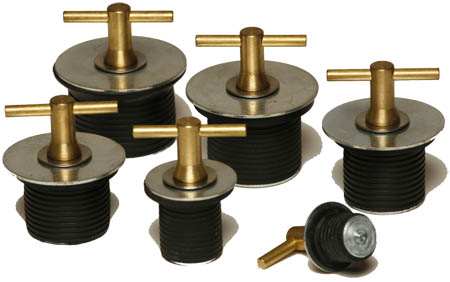
 
How about a selection of these

lowpressuretplug.jpg


https://www.newmantools.com/cob/pipeplugs.htm
 
Problem is that any failure may not result in a nice clean hole. If a bronze/brass fitting failed one might be faced with a fractured elbow with part of the bend still in place or a very rough jagged edge.
provided one can geta hammer in then one has a chance of driving a wooden plug home. Plugs would preferably be from a timber that absorbs water easily and expands soon after insertion
however, if access is restricted it can require an alternative solution
 
Last edited:
We always carry some of the 'squeeze together and knead' 2-part epoxy resin putty to cope with odd-shaped holes.

If you shop around you can often pick up a few packs relatively cheaply and, if it can't be pushed into the hole from the inside, we also carry some swimming goggles to apply it from the outside, although this may be ambitious on a bumpy day.

I got the idea years ago from Mr Seajet. It sounds great in principle and of course since we now carry the epoxy putty on board, we haven't needed it. I guess it's like carrying an umbrella :)
 
Once in the dim and distant past, I was completely stripping out an old wooden 60ft fishing boat, prior to converting her to a motor yacht. At this stage, she was afloat in a dock, and basically just a bare shell with nothing in her. There was some dubiety about her 3.5" bronze propeller shaft, so it had to be drawn. The propeller was off. I duly made up a slow taper wooden plug to suit, and rigged a tackle to draw the shaft.

There I am, standing in the bottom of the boat. Tackle rigged - check. Timber arranged to support the shaft - check. Packing extracted - check. Wooden plug - check. Big mash hammer - check.

Right here goes - shaft comes in, followed by a considerable woosh of water. In goes the plug, except that at first it wouldn't go in. Found that the problem was a bit of packing. Cleared it, and hammered in the plug. Soaked. Turned my back, and the b***** plug flew into the boat, followed by even more water. So there I was, sitting in the bilge with my foot up against the plug. Eventually shored the plug in with timbers, OK. Don't try this. :D
 
The are also cone shaped soft plastic bungs call Stay Plug which are claimed to hold in better because of their graduated ridges.

Although we ritually tie a bung onto each through hull the chances of needing them if you have bronze or DZR through hulls is just about zero. Just like double clipping all based on myth and the fact that such things are a requirement to meet racing rules, which themselves should be no different from non-racing as thew risks (that is virtually none) are the same irrespective of whether the boat is racing.

Bungs may have value though in other situations where the hull skin is pierced, although that is also very rare.
 
Like most of us I have softwood plugs of the right size tied handy to each seacock.

I have often wondered what is the right size for a given through hull.
Consider for instance a 1 1/2" skin fitting. If the flange should fall off there will be a hole in the hull close to 50mm diameter to fill.
On the other hand, if the hose tail breaks off, the plug must be able to enter a hole that is only perhaps 32mm.
A plug that can cover both these possibilities must be quite long, if the taper shall be reasonable.

Perhaps there should be two different size plugs for each seacock?
 
I have often wondered what is the right size for a given through hull.
Consider for instance a 1 1/2" skin fitting. If the flange should fall off there will be a hole in the hull close to 50mm diameter to fill.
On the other hand, if the hose tail breaks off, the plug must be able to enter a hole that is only perhaps 32mm.
A plug that can cover both these possibilities must be quite long, if the taper shall be reasonable.

Perhaps there should be two different size plugs for each seacock?

Just trying to imagine what would cause the hose tail to fall off never mind the flange is they are made or bronze or DZR (or glass reinforced plastic). it is true that plain brass fittings might fail if they are dezincified, but the solution is to replace them with material that does not.
 
Good point. Make that “of plausible size”!

The other thing that struck me as we undid the deep bilge drain plug was that I had never really thought properly about it.
One will be soaked, freezing and being struck on the chest if not the face by a very powerful jet of cold sea water. Speaking for myself, the chances that I would do a good job seem rather remote.
 
I have often wondered what is the right size for a given through hull.
Consider for instance a 1 1/2" skin fitting. If the flange should fall off there will be a hole in the hull close to 50mm diameter to fill.
On the other hand, if the hose tail breaks off, the plug must be able to enter a hole that is only perhaps 32mm.
A plug that can cover both these possibilities must be quite long, if the taper shall be reasonable.

Perhaps there should be two different size plugs for each seacock?

For that very reason, on my own boats I always carry around a bag of various sized bungsrin a handy place rather than have to grope around next to a flood trying to find the one thats tied up nearby. Probably as a result of a hull valve failure on a yacht in the Bay of Cadiz some years ago. Makes sense for me, anyway.

Regarding hose clips, they do corrode so double clipping for me also makes sense.
 
Velocity of discharge v =√hg for water times coefficient of discharge say 0.95. multiply by area of pipe a=πrxr gives you flow rate.
It's surprisingly high but at 1m head the pressure won't stop you inserting a plug.
 
Regarding hose clips, they do corrode so double clipping for me also makes sense.

Not if they are all stainless steel. I expect you can tell tales of how difficult it is to remove a hose from a spigoted or barbed tail so even if the hose clip fails there is no reason why the hose would just pop off.

All the many hoses on my cars are just clipped with one clip. Never had one come off.

Don't know where the idea of double clipping came from but I doubt it is based on any empirical evidence other than anecdotal.
 
Knowing that a skin fitting is placed in such an inaccessible location would make me quite uncomfortable. I don't think that I could live with it.

Emoticon-GQ-hp-18Jun14_istock_b.jpg

It’s a drain plug, located just above the encapsulated permanent ballast. It gets screwed up with plenty of mastic and left until the boat is next ashore. Standard Camper & Nicholson fitting afaik.
 
HRs have the same. Considered important there so the boat can be completely dry so nothing freezes in the winter if stored outside.

Also great for leaky boats with deep bilges!
 
It’s a drain plug, located just above the encapsulated permanent ballast. It gets screwed up with plenty of mastic and left until the boat is next ashore. Standard Camper & Nicholson fitting afaik.

HRs have the same. Considered important there so the boat can be completely dry so nothing freezes in the winter if stored outside.

Also great for leaky boats with deep bilges!

I am not familiar with that problem because it is unknown for water to freeze in my country... unless it is in the ice-maker of the freezer. ;)

Perhaps - probably - I would think differently if I lived elsewhere.
 
Good point. Make that “of plausible size”!

The other thing that struck me as we undid the deep bilge drain plug was that I had never really thought properly about it.
One will be soaked, freezing and being struck on the chest if not the face by a very powerful jet of cold sea water. Speaking for myself, the chances that I would do a good job seem rather remote.

This is worth a look:

 
Top