Shroud U-Bolts, a Cautionary Tale

Major_Clanger

Well-Known Member
Joined
15 Oct 2016
Messages
1,709
Location
Home is Suffolk, boat either Suffolk or Cornwall
Visit site
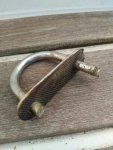
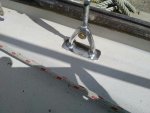
IMG_20170523_1651239.jpgIMG_20170524_1724070.jpg I took Vim, a 1969 Co26, out for her shake-down sail a fortnight ago in a short sea with a steady 5 occ.6 blowing. She was a delight and well-balanced, all was going well until there was an almighty BANG that shook the boat. One of the lower shroud deck plates had snapped. We crash-tacked, and jury-rigged it to get us home. The fitting was original and encapsulated in to the GRP. I had to grind out a fair bit of resin and once removed it was clear the fitting had been waiting to break for a long time. There was a witness mark across the break that had oxidised. Clearly the fitting had been work hardened (unless the fault had been there since manufacture?).

I've replaced all the U-bolts and have moved up to M10 diameter A-bolts. Grinding out the main shroud terminals was a real pain as they were located right where the internal bulkhead sits. All done now but suggest any of you with stainless fittings of a similar age with discolouration around the fittings, as in the picture, go-ahead and change the terminals before they give up the ghost. Hope this helps.
 
I had no discolouring of the deck or even inside, as everything there was covered in gelcoat.

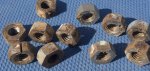
But when I dug the nuts out they were all pitted or cracked. Some crumbled to dust when I squeezed them gently in a vice.

U-bolt chainplates should be completely removed and check every five years. They are a cheap, but quite nasty way of providing a chain plate.

Nuts-1.jpg
 
" All done now but suggest any of you with stainless fittings of a similar age with discolouration around the fittings, as in the picture, go-ahead and change the terminals before they give up the ghost. Hope this helps. "


A good reminder, mine are coming up 25 years old now.

I had a similar event once with the backstay of a Sadler 25, the only thing that saved the mast was that the owner had made off the topping lift to the pushpit.
 
View attachment 64644View attachment 64645 I took Vim, a 1969 Co26, out for her shake-down sail a fortnight ago in a short sea with a steady 5 occ.6 blowing. She was a delight and well-balanced, all was going well until there was an almighty BANG that shook the boat. One of the lower shroud deck plates had snapped. We crash-tacked, and jury-rigged it to get us home. The fitting was original and encapsulated in to the GRP. I had to grind out a fair bit of resin and once removed it was clear the fitting had been waiting to break for a long time. There was a witness mark across the break that had oxidised. Clearly the fitting had been work hardened (unless the fault had been there since manufacture?).

I've replaced all the U-bolts and have moved up to M10 diameter A-bolts. Grinding out the main shroud terminals was a real pain as they were located right where the internal bulkhead sits. All done now but suggest any of you with stainless fittings of a similar age with discolouration around the fittings, as in the picture, go-ahead and change the terminals before they give up the ghost. Hope this helps.

Vyv will pass comment on the mode of failure if he passes this way ......... fatigue would be my guess, but just a guess without close inspection.

BUT

Crevice corrosion of stainless fittings and fastenings where they pass through the deck is a real possibility

We had one fail on a Westerly ........... I found a broken off piece of "stud" with two nuts on it on the cabin floor and started looking around!

Very important that when stainless fittings are fitted they or their fastenings are well sealed in the hole so that there is no "crevice" into which salt water can penetrate.

We should have found this one earlier as it was leaking slightly, but into the galley sink so did not worry about it.
 
Last edited:
I wrote up this or a very similar failure for YM in the past couple of months. Yet another example of crevice corrosion of fittings that never dry out fully. A serious problem in wood, which stays wet for longer or indefinitely. Several examples of this from forum contributors on my website. However will also occur in GRP where deck sealing is inadequate.
 
Very important that when stainless fittings are fitted they or their fastenings are well sealed in the hole so that there is no "crevice" into which salt water can penetrate.

We should have found this one earlier as it was leaking slightly, but into the galley sink so did not worry about it.

The surveyor who checked my boat when I bought her asked for a U-Bolt (starboard cap) to be withdrawn and checked because of some discolouration around its backing pad. It was OK, luckily, but as in your case the slight leak had gone unheeded because it dripped into a sink ... the heads one in my case.

The boat is being surveyed by Ian Nicolson at this very moment and I shall be interested to see what he thinks about the U-bolts.
 
View attachment 64644View attachment 64645 I took Vim, a 1969 Co26, out for her shake-down sail a fortnight ago in a short sea with a steady 5 occ.6 blowing. She was a delight and well-balanced, all was going well until there was an almighty BANG that shook the boat. One of the lower shroud deck plates had snapped. We crash-tacked, and jury-rigged it to get us home. The fitting was original and encapsulated in to the GRP. I had to grind out a fair bit of resin and once removed it was clear the fitting had been waiting to break for a long time. There was a witness mark across the break that had oxidised. Clearly the fitting had been work hardened (unless the fault had been there since manufacture?).

I've replaced all the U-bolts and have moved up to M10 diameter A-bolts. Grinding out the main shroud terminals was a real pain as they were located right where the internal bulkhead sits. All done now but suggest any of you with stainless fittings of a similar age with discolouration around the fittings, as in the picture, go-ahead and change the terminals before they give up the ghost. Hope this helps.

Given that the U-bold was fitted nearly 50 years ago I'd say it's been on borrowed time for some years.

I'm about to replace the U Bolts on a 1984 built yacht and that feel's a little "overdue".
 
Given that the U-bold was fitted nearly 50 years ago I'd say it's been on borrowed time for some years.

I'm about to replace the U Bolts on a 1984 built yacht and that feel's a little "overdue".

The Blakes seacocks, P-bracket, keel, rudder skeg and almost every fitting on my 1984 boat are attached by stainless steel fastenings. They are without exception in pristine condition. Provided stainless steel does not remain wet in enclosed situations such as embedded in wood, plastic or other metals it will last indefinitely. A long time ago I collected some stainless steel bits and pieces from a Beaufighter that crashed in the Aran mountains in 1944. They are still in perfect condition, admittedly not in a marine environment.
 
I agree that the fittings were past their sell by date, but the boat's unusual insofar as she's 48 years old, but has only spent 4 previous seasons afloat. My shake-down was exactly that as I only bought her last October.

All the other U-bolts appeared fine and I wonder whether the one that failed had a manufacturing fault that was just waiting to fail? Certainly the crack had been there for a long time. I know it's quite common, but I can't see why deck fittings are often encapsulated; it makes servicing them impossible. The new A-bolts are M10, bedded nicely and torqued to the maker's figures.
 
I agree that the fittings were past their sell by date, but the boat's unusual insofar as she's 48 years old, but has only spent 4 previous seasons afloat. My shake-down was exactly that as I only bought her last October.

All the other U-bolts appeared fine and I wonder whether the one that failed had a manufacturing fault that was just waiting to fail? Certainly the crack had been there for a long time. I know it's quite common, but I can't see why deck fittings are often encapsulated; it makes servicing them impossible. The new A-bolts are M10, bedded nicely and torqued to the maker's figures.

Ignorance mainly. Remember these boats were built when the materials and technology were both new and there was little or no service history to inform designers and builders.
 
. . . I wonder whether the one that failed had a manufacturing fault that was just waiting to fail? . . .

I don't think it has a manufacturing fault, but it is installed incorrectly. Unless it is a cap shroud, (which it doesn't look like), then when the rig is tensioned it will apply a bending moment to the U-bolt, and the point of maximum flexion will be at deck level where this one has failed. U-bolts used for chainplates should be 'cranked' to the angle the shrouds make to the deck. Otherwise every wave, and every gust is wanging (engineering term) that poor fixture back and forth. Alternatively if you don't fit a cranked U-bolt, the axis of the bolt should be pointed at the mast centreline so the articlulation is taken on the radius of the 'U'.

However, with a little boat like a Contessa 26, the size of the U-bolt that 'looks' strong enough is probably 'stiff' enough to hold up in service as the life of yours proves. But that has almost certainly been the mechanism of failure and crack initiation which may then have been exacerbated by crevice corrosion. People with bigger boats should be even more alert to poor orientation in rigging components inducing unhelpful bending on those parts.
 
I don't think it has a manufacturing fault, but it is installed incorrectly. Unless it is a cap shroud, (which it doesn't look like), then when the rig is tensioned it will apply a bending moment to the U-bolt, and the point of maximum flexion will be at deck level where this one has failed. U-bolts used for chainplates should be 'cranked' to the angle the shrouds make to the deck. Otherwise every wave, and every gust is wanging (engineering term) that poor fixture back and forth. Alternatively if you don't fit a cranked U-bolt, the axis of the bolt should be pointed at the mast centreline so the articlulation is taken on the radius of the 'U'.

However, with a little boat like a Contessa 26, the size of the U-bolt that 'looks' strong enough is probably 'stiff' enough to hold up in service as the life of yours proves. But that has almost certainly been the mechanism of failure and crack initiation which may then have been exacerbated by crevice corrosion. People with bigger boats should be even more alert to poor orientation in rigging components inducing unhelpful bending on those parts.

Good job I put 18 deg. cranked A-bolts on the lowers then!
 
I don't think it has a manufacturing fault, but it is installed incorrectly. Unless it is a cap shroud, (which it doesn't look like), then when the rig is tensioned it will apply a bending moment to the U-bolt, and the point of maximum flexion will be at deck level where this one has failed. U-bolts used for chainplates should be 'cranked' to the angle the shrouds make to the deck. Otherwise every wave, and every gust is wanging (engineering term) that poor fixture back and forth. Alternatively if you don't fit a cranked U-bolt, the axis of the bolt should be pointed at the mast centreline so the articlulation is taken on the radius of the 'U'.

This is the comment I was going to make.
The angle the shroud intersects the deck is putting an unfair load on the U-bolt.
 
I don't think it has a manufacturing fault, but it is installed incorrectly. Unless it is a cap shroud, (which it doesn't look like), then when the rig is tensioned it will apply a bending moment to the U-bolt, and the point of maximum flexion will be at deck level where this one has failed. U-bolts used for chainplates should be 'cranked' to the angle the shrouds make to the deck. Otherwise every wave, and every gust is wanging (engineering term) that poor fixture back and forth. Alternatively if you don't fit a cranked U-bolt, the axis of the bolt should be pointed at the mast centreline so the articlulation is taken on the radius of the 'U'.

However, with a little boat like a Contessa 26, the size of the U-bolt that 'looks' strong enough is probably 'stiff' enough to hold up in service as the life of yours proves. But that has almost certainly been the mechanism of failure and crack initiation which may then have been exacerbated by crevice corrosion. People with bigger boats should be even more alert to poor orientation in rigging components inducing unhelpful bending on those parts.

If the unfair loading was the problem I would have expected it to fail at deck level, where stress would be maximised by the restraint of the drilled hole. In fact it has failed much lower down, pointing to corrosion as the mechanism. This is a very common failure mode on all sorts of fittings, not restricted to U-bolts.
 
. . . I would have expected it to fail at deck level . . .

Yes I agree that's a reasonable expectation, especially with the welded deck 'plate'.

But my research over the years of stainless steel fastener failure, often shows the failure point to be just below the surface, when the mechanism is flexion and the holding medium to be a soft matrix such as grp or even limestone. The lip of the hole becomes easily radiused unlike steel or other materials of similar hardness to the bolt where the failure is level with the surface.

Often these fittings are mounted on 'plenty' of sealant and often in oversized holes, especially when re-bedded over the years. The weld bead will provide additional stiffness above the plate, but the sealant and pretty soft nature of the gel coat moulded non slip, will allow sufficient movement for the flexion to initiate failure. Or alternative some corrosion was exacerbated by the bending.
 
Last edited:
Yes I agree that's a reasonable expectation, especially with the welded deck 'plate'.

But my research over the years of stainless steel fastener failure, often shows the failure point to be just below the surface, when the mechanism is flexion and the holding medium to be a soft matrix such as grp or even limestone. The lip of the hole becomes easily radiused unlike steel or other materials of similar hardness to the bolt where the failure is level with the surface.

Often these fittings are mounted on 'plenty' of sealant and often in oversized holes, especially when re-bedded over the years. The weld bead will provide additional stiffness above the plate, but the sealant and pretty soft nature of the gel coat moulded non slip, will allow sufficient movement for the flexion to initiate failure. Or alternative some corrosion was exacerbated by the bending.

Can the OP please provide a good photo of the fracture face? This would help with a diagnosis.
 
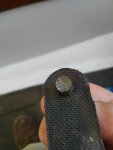
See below.... The witness mark is clearly visible and you'll see to one side of it the metal is heavily discoloured (almost oxidised). If not a manufacturing fault, then it looks as if it'd been there for a long time. The boat hasn't been in the water since 2004-ish so it certainly pre-dates that.

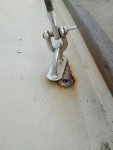
The other pic is what I've replaced them all with; straight on the mains and cranked on the lowers. The decks have backing plates encapsulated in the resin but I've added larger ones that I can get to and monitor. Nuts torqued to maker's spec.
IMG_20170610_1132188.jpgIMG_20170610_1327230.jpg
 
See below.... The witness mark is clearly visible and you'll see to one side of it the metal is heavily discoloured (almost oxidised). If not a manufacturing fault, then it looks as if it'd been there for a long time. The boat hasn't been in the water since 2004-ish so it certainly pre-dates that.

View attachment 64664

Unfortunately the fracture face is not in perfect focus but it doesn't look like fatigue to me. I do agree that there is evidence of progressive growth but the face, so far as I can make out, looks like an inter-granular path, which is characteristic of stress-corrosion. The stress in this case would be constant from a combination of rigging load and bolt tension and the corrosion of course from constant wetness by both rain and seawater. Higher temperatures are usually required for this mechanism but it is surprising how hot metal parts can become on deck in summer.

Are there other cracks in each leg or are the fractures the only ones?
 
Top