Sheet bend or 2 bowlines ?

The actual "knot" that forms a bowline is identical to a sheet bend so from that point of view not a lot to choose.

Chafe maye be a possibility with two bowlines ????/


For a bit more security than a simple sheet bend consider a double sheet bend.

Not really answered your question, sorry.
 
Last edited:
Another vote for the Zeppelin Bend. Easy to tie, doesn't jam and very nearly a perfect lead.

Thank you for these. I'm aware of tendency of bowlines to come undone, so you need to leave a long tail. I came across a Yosemite bowline recently, which is stated to be more secure (and is definitely prettier than standard bowline). Zeppelin looks interesting but requires learning another knot (actually learning is easy – remembering is hard!).
If the sheet bend is, as stated, the same knot as a bowline would it not suffer same tendency to come undone?
Again thanks.
 
* Two bowlines are good if you want to untie quickly.
* Sheet bends probably better if you want to untie under a bit of load.
* If chafe is an issue you can double-loop the bowlines.
* Two bowlines good if reach is an issue. For example I used to tie a really big loop bowline when setting a barber hauler on my main, so I could untie it comfortably on deck.
* Two bowlines better for ropes of different size.
* Bowlines can easily be made secure by taking the rabbit round the tree twice.
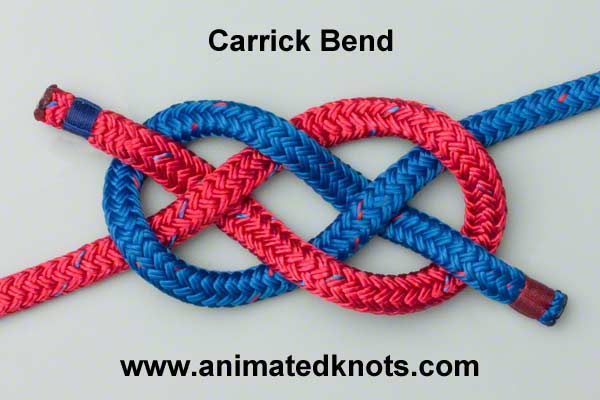
* Carrick bend is a knot worth learning and good for slippy lines and shock cord.
 
* Two bowlines are good if you want to untie quickly.
* Sheet bends probably better if you want to untie under a bit of load.
* If chafe is an issue you can double-loop the bowlines.
* Two bowlines good if reach is an issue. For example I used to tie a really big loop bowline when setting a barber hauler on my main, so I could untie it comfortably on deck.
* Two bowlines better for ropes of different size.
* Bowlines can easily be made secure by taking the rabbit round the tree twice.
* Carrick bend is a knot worth learning and good for slippy lines and shock cord.
The sheet bend is generally thought to be the better knot for ropes of different sizes - the thicker rope being used for the bight. You also only have one knot and not two that can risk coming undone with less loops and knots to catch on other things.
 
Last edited:
My reply is if in doubt both! Tie the tails of the sheep bend into bowlines...

If not in doubt I would say sheet bend or double sheep bend.....
 
For joining climbing ropes for an abseil I always use a reef knot secured with a double fisherman. The ideas is that the reef knot comes undone easily even after loading. And the fisherman stops it coming undone too early!

Never failed for me. May have failed for other people though ;)
 
If not in doubt I would say sheet bend or double sheep bend.....

Don't tell me there actually is a knot called a sheep bend? :)

I can't think of many situations where I would use interlinked bowlines to join two lines together. In fact, about the only one is, as Jeremy suggests, where a big loop means you can reach the knot to undo where you otherwise wouldn't be able to.

Otherwise, sheet bend if the ropes are similar in size, double sheet bend if there's a big difference, and occasionally a carrick bend just to be different :) (The actual reason for a carrick bend is if the knot might be difficult to undo afterwards, eg a tow-rope being wetted under heavy strain for a long period. The carrick bend has two good places where you can "break the back" of the knot to start undoing it.)

Pete
 
Greetings
When joining two ropes together, what considerations decide whether you use a sheet bend or 2 bowlines?
Many thanks

It takes two hands to tie a bowline normally, so you have to have both hands on one rope.
However with a double sheet bend, you have one rope in each hand, so it is quicker and less cumbersome, and you don't have to let go of either rope.
 
Two bowlines will give you two nips bearing against each other, a sure recipe for chafe, and two knots with potential for working loose if not continuously loaded. Still sometimes a good option for a temporary measure. A double sheet bend will not work loose (especially if wet) and is purpose designed for dissimilar sized ropes. For years we used a double sheet bend to fasten the dinghy painter to the buoy rope of the mooring and it never failed us.

Rob.
 
Carrick bend would be my choice. Easy to learn and easy to remember once you understand the logic of the simple pattern.


carrick_bend.jpg
 
Thank you all very much – some very helpful thoughts and a few knots to add to my collection. The carrick bend and the zeppelin bend seem somewhat similar in approach. The sheet bend or double sheet bend has a great simplicity to it and it is very obvious straight away if it's not done correctly.
 
'The tendency for bow lines to come undone'

Just tie a proper one and hang off of it To be certain.

I have had to tie bow lines every 2 weeks in summer to two sails call genoa load 200 HP and the StaySail 80HP. I tie the bowline leave a good tail then crunch it up and apply 82kg (beginning of season) then 88kg (end of season) to the knot. Works well for me
 
Top