Setting up rod rigging ?

dunedin

Well-Known Member
Joined
3 Feb 2004
Messages
15,840
Location
Boat (over winters in) the Clyde
Visit site
Can anybody explain how one goes about checking the setting up of ROD rigging ?

I am familiar with setting up wire rigging, and the use of a tension gauge on wire (which measures wire deflection) - but don't see how that can work with solid rod. Also, if lee shrouds too slack that will be visible with wire, but much less so with rod

Its on a 38 footer with twin spreaders - fast cruiser rather than racer.

Thanks in advance
 
You can buy tension gauges for rod rigging, it's not absolutely necessary to have one. Otherwise very little difference from wire rope rigging, do take care that when you tension it you don't put any torsional force onto the rod and its head. Our rigging has a sleeve which the rod head sits in, it's important that you hold it still as you tension the bottle screw.
 
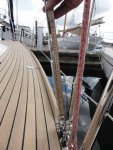
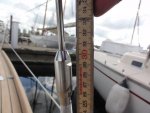
image.jpgimage.jpgYou can ask previous owner/boatyard about the specific measures from the toggle to the upper bottle screw. I have rod rigging and the boatyard send me picture instructions about such measures both for upper and lower shrouds. See attached pictures.
 
You can ask previous owner/boatyard about the specific measures from the toggle to the upper bottle screw. I have rod rigging and the boatyard send me picture instructions about such measures both for upper and lower shrouds. See attached pictures.

Thanks. Not sure that previous calibration by measuremt would be precise enough as the reason for needing to check tuning is a replacement rod (one was rusty due to manufacturing defect and hence has been replaced).
Rigging screws are marked so can recalibrate if remove in future
 
Bottom of this page for a picture of a rod tension gauge:

http://www.saltyjohn.co.uk/riggingtensiongauge.htm

Very helpful thanks. Just can't get my head round how the gauge tests tension through deflection of a solid rod perhaps 8mm or so thick, but I guess you can or Loos wouldn't sell them. Already had access to a wire Loos gauge - will perhaps see if the new one was calibrated in this way before buying just for one use. But could be a good investment (once I check rod size precisely)

Thanks
 
The Loos gauge for rigging tensionmeasurement seems a very pricy way of doing things to me, perhaps justifiable if you're using it frequently. I always use the Selden "folding rule method" described on page 32 of their "Hints and Advice" document:

http://www.seldenmast.com/files/1416926327/595-540-E.pdf

As an improvement imho, I substitute a 2m length of 12mm hardwood dowelling for the folding rule and, if you don't already have a vernier gauge, last time I looked you could get a good quality one from Amazon for around 20 GB pounds.

For rod rigging, don't forget to use a total extension of 2.1mm over the 2m gauge length rather than the 3mm extension for 1x19 wire used in the text.

One of the beauties of this approach is that the same extension gives the correct tension for all sizes of stainless rigging, changing only with type (1x19, dyeform or rod).

Hope this helps.
 
The Loos gauge for rigging tensionmeasurement seems a very pricy way of doing things to me, perhaps justifiable if you're using it frequently. I always use the Selden "folding rule method" described on page 32 of their "Hints and Advice" document:

http://www.seldenmast.com/files/1416926327/595-540-E.pdf

As an improvement imho, I substitute a 2m length of 12mm hardwood dowelling for the folding rule and, if you don't already have a vernier gauge, last time I looked you could get a good quality one from Amazon for around 20 GB pounds.

For rod rigging, don't forget to use a total extension of 2.1mm over the 2m gauge length rather than the 3mm extension for 1x19 wire used in the text.

One of the beauties of this approach is that the same extension gives the correct tension for all sizes of stainless rigging, changing only with type (1x19, dyeform or rod).

Hope this helps.

Very interesting thanks. Hadn't come across this approach before
 
bit messy to apply in practise because you ideally require the rod / wire to be completely slack when you measure out the 2m. Not always easy with a mast attached.
 
Hi Howard,

I don't find it messy at all.

Simply follow Selden's instructions. Tighten both shrouds equally to hand tight then fix the top end of the rule (or dowel) to one shroud with tape so that the bottom end is 20mm or so above the top of the lower swage. Measure from the dowel end to the top of the swage accurately with your vernier, hen crank that screw up with a panner until the measurement has increased by 1.5 mm, counting the number of turns. Crank up the opposite shroud by the same no. of turns and, to check you got it right, take the measurement again at the first shroud - it should be 3mm and, in my experience, always is within 10% which is good enough for me, but you can add or take off turns equally each side to get it bang on if you want.

What's messy about that? Once you've cut the dowel in your workshop at home, you don't actually have to measure out the 2m again, just tape it to to a shroud. The pair of stays you ae setting need to be hand tight when you take the initial measurement with the vernier. Unless you're trying to set up on a gale, a yacht's mast will be quite safe with all the stays only hand tight on the rigging screws.

Peter
 
Last edited:
Top