
Seized sheave - Impossible

Mikedefieslife

Well-Known Member
Joined
8 Aug 2016
Messages
579
Location
On a boat
Visit site
I have a set of sheaves and spaces aft of the base of the mast. In Prout's infinate wisdom, these are aluminium, and are held in place with a stainless rod. What could possibly go wrong huh?

Well the one for my main halyard (white red specked) is completely and utterly seized. Due to it's location, hot water, penetrating oil, etc... doesn't have any affect on it whatsoever. The soft spacers around it, mean I can't use heat. I have of course tried a big hammer and a strong arm on the pin. All to no avail.

Short of angle grinding the whole thing out and rebuilding, are there any other methods worth trying?
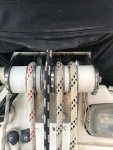
IMG_3909.jpg

p.s obviously, I've removed the halyards and tension when trying to remove it.
 
I have a set of sheaves and spaces aft of the base of the mast. In Prout's infinate wisdom, these are aluminium, and are held in place with a stainless rod. What could possibly go wrong huh?

Well the one for my main halyard (white red specked) is completely and utterly seized. Due to it's location, hot water, penetrating oil, etc... doesn't have any affect on it whatsoever. The soft spacers around it, mean I can't use heat. I have of course tried a big hammer and a strong arm on the pin. All to no avail.

Short of angle grinding the whole thing out and rebuilding, are there any other methods worth trying?

View attachment 76708

p.s obviously, I've removed the halyards and tension when trying to remove it.

I had similar issues with aluminium sheaves with stainless shaft.

I took the housing home and used brute force to get then apart.

I then bored out the pulley and fitted a pair of stainless sealed ball bearings and a new solid stainless shaft.
 
I don't know the unit but it appears from your photograph that the whole thing comes off and can be taken away? In which case boiling it in sodium carbonate (washing soda) solution should free it. Alternatively, if the cause of the problem is only the typical carbonate salts that develop with seawater splashing, you might find that a quick immersion in dilute hydrochloric acid, brick cleaner. will fix it. HCl attacks aluminium but relatively slowly, so wash off after trying it.

Here is a stainless antenna fitting in an aluminium bracket, completely seized solid. A few drops of HCl freed it in minutes.
IMG_0740_zps4d5a2e38.jpg
 
I've used ACF-50 for seized ally/stainless and had some success.

Might be worth a try. Spray it on liberally and leave it on for a day or so. Re-apply as necessary (or until you get fed up!).

ACF-50 slowly dissolves the ally crud (if it can leach through to it).
 
If in situ methods fail, can you unbolt the whole fitting and take it to a workshop where some real force can be used to drive out the shaft? After that I suggest putting the sheaves in a lathe, boring them out and pressing in some bronze bushes. Buy sintered bronze bushes like these ones for a 10mm shaft, https://www.ebay.co.uk/itm/AM101620...852189&hash=item41f5a6f4ea:g:SJ0AAOSwdgxcCqBR similar ones are available in just about any combination of bore and length that you are likely to need. Alternatively any competent machinist can turn suitable bushes from bronze bar. Oil or grease the bushes on assembly and occasionally threreafter. Do not heed the armchair engineers who talk about galvanic corrosion between bronze and aluminium. You are not in the habit of immering your mast foot in the sea, are you? I have used bronze bushes pressed into aluminium on the boat for years with no problems.
 
Hmm. That's a big job then. To remove it means removing the mast. If going to those lengths, it's probably easier just to angle grind it off and find a new pin, sheaves, and spacers.
 
Hmm. That's a big job then. To remove it means removing the mast. If going to those lengths, it's probably easier just to angle grind it off and find a new pin, sheaves, and spacers.

O.K. If you cannot easily remove the fitting you need to make up a forcing tool to remove the shaft. Its not difficult to make one but you will need a access to a drilling machine and to find someone who can tap a hole into a piece of steel. You need to get two pieces of fairly thick steel, at least 8mm and preferably 10mm about 40 or 50mm wide. Each piece needs 3 holes drilled through it in a straight line. The outer two take lengths of 10mm or 13mm studding (threaded rod) with a nut each side and the inner hole on one piece must be big enough for the shaft to pass through. On the other piece the inner hole must be threaded for a big bolt, and by big I mean about 16mm, assuming the shaft is 10mm. Get the bolt drilled from the theaded end, about 20mm deep, 10 mm diameter. To use it a piece of plain 10mm steel set into the hole in the bolt is forced against one end of the shaft be means of the big bolt. You may only need to move it a short distance to break the grip of the corrosion, after which it should be able to be punched out, but in need you can force it all the way if you have a few assorted lengths of the plain 10mm rod to hand. All the above dimensions are assuming a 10mm shaft and can be scaled. If you cannot get anyone to tap a the hole 16mm have a plain 16mm hole and put a nut inside the end plate and use two spanners.
 
Last edited:
Top