Securing the contacts of a winch solenoid using varistors

GerardV

New Member
Joined
14 Sep 2020
Messages
22
Visit site
This week I found out that the anchor winch solenoid (winch relay 200Ampere) have broke down. More specific the issue being the “anchor lift” contacts. I assume that the cause of this problem is that the contacts have ‘burned in’ due to transient power surges when switching off the relay.
Power surges are common with inductive loads such as the DC electro motor of the winch.
Soon I will install a new solenoid (a 500 Ampere type). Naturally I want to prevent this from happening again.

Does anybody has experience with installing varistors parallel over the contacts of a anchor winch solenoid? Or other devices such as transient suppressor diodes?

For ‘fun’ I contacted the well known manufacturer of the anchor winch. The answer was that they tested 500 of these solenoids and never had an issue. I was the first one:rolleyes:.......
 
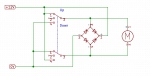
It's a DC system, so you can divert any transients back into the battery supply itself; no need to add energy absorbing parts such as varistors. A bridge rectifier configuration with the two ~ ports to the motor, the - port to 0V and the + port to the battery supply will do this job.
 
It's a DC system, so you can divert any transients back into the battery supply itself; no need to add energy absorbing parts such as varistors. A bridge rectifier configuration with the two ~ ports to the motor, the - port to 0V and the + port to the battery supply will do this job.
Thanks that is clever. Didn't think about that
 
Cheers JDC. I worked for a well known German electric forklift company in the 90's and don't think I ever remember seeing such a technique . Many thanks!
 
It's a DC system, so you can divert any transients back into the battery supply itself; no need to add energy absorbing parts such as varistors. A bridge rectifier configuration with the two ~ ports to the motor, the - port to 0V and the + port to the battery supply will do this job.
I like that. It always seemed to me to be a crude solution just to dump the current through a diode. Not nice for the diode either.
 
The ridge rectifier is indeed just a bunch of diodes - albeit purchasable in a form which is convenient for 'Lucas' crimp connectors.

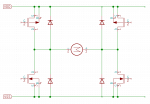
And I bet everyone has seen this exact configuration before - it's just a sleight of hand to draw it differently. In my world of solid-state electronics it is more familiarly drawn as an 'H' drive like this:
Screenshot 2021-05-09 at 12.27.32.png
Note the 4 diodes are in fact a bridge around the motor.
 
The ridge rectifier is indeed just a bunch of diodes - albeit purchasable in a form which is convenient for 'Lucas' crimp connectors.

And I bet everyone has seen this exact configuration before - it's just a sleight of hand to draw it differently. In my world of solid-state electronics it is more familiarly drawn as an 'H' drive like this:
View attachment 115078
Note the 4 diodes are in fact a bridge around the motor.
So does it stop back emf? Is that the purpose?
 
So does it stop back emf? Is that the purpose?
It stops the emf from the motor appearing as a voltage across the switch.
You open a switch and the inductance of the motor tends to either keep the current flowing or create a big voltage.
It's easier to see in the H-bridge configuration. Say the motor is running via the upper left and lower right FETs. Turn off the FETs suddenly, the current continues flowing through the motor, through the lower left and upper right diodes, back into the power supply.

Which is a problem, the power supply must have a low impedance at high frequency and absorb that current. In solid state, that's done by capacitors. In your windlass installation, the battery won't have a very low impedance at HFand will be connected via long inductive wires. So people sometimes use varistors and other transient absorbers, and mostly use fairly butch switches/relays which can take the abuse.
Using diodes to put the current pulse back on to the battery line can also subject other equipment to voltage spikes.
It's a long time since I did design work on anything as powerful as a windlass, so I don't know the 'state of the art' for components of this size.
 
Top