Sanding advice. Should I go against the grain?

Homer J

Well-Known Member
Joined
19 Jun 2017
Messages
545
Visit site
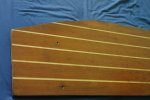
When sanding holly and ivy flooring (I think it’s called that) to remove varnish and some of the scratched damaged wood prior to refinishing should I sand with or against the grain and does it make any difference with a vibrating electric sander?
 
When removing varnish from Teak and Holly ply cabin sole, it is best to take up the panels if possible. then remove the varnish using a heat gun and scraper taking care not to scorch the wood. The top veneer could be very thin possibly 0.6mm. Don't try to sand out the scratches as you could go right through the veneer instead use filler of the same color and lightly sand the repair and the hole panel with 120-180 grit using a vibrating palm sander. For a hard wearing cabin sole my preference for varnish would be 5 coats of single pack polyurethane, coat 1&2 thinned after coat 3 leave for a few days to harden, then sand half of coat 3 off with 120-180 grit, then coat 4&5.

Plank
 
Use 2 coats of Sadolins PV 67 for the clear finish. Do 2 coats over 2 days. I have used it in my joinery shop on things such as laboratory worktops. Bar tops, reception desks, staircases ( My own Oak spiral stairs lasted 19 years with 2 coats & no further attention). It is designed for floors & is exceptionally hard wearing.

If there is any indication of silicones on the surfaces (any sort of polish etc can cause it) then a good coat of shellac to prevent fisheye (tiny bubbles in the surface) is necessary. If you do not want to invest in shellac use sanding sealer & do 3 coats & sand with fine sandpaper between each coat. You can do 3 coats with 3-4 hours between each coat & use tack cloths to wipe prior to each further coat.
Apply the PV 67 with a roller (easiest) or brush. Dries in 1 hour so user friendly.
over the last 3 years I have re polished 14 tables in our club & they take a fair hammering. There are no scratch marks at all, even in areas where the kids play (& bang & drag things on the tables when parents not looking)
 
When removing varnish from Teak and Holly ply cabin sole, it is best to take up the panels if possible. then remove the varnish using a heat gun and scraper taking care not to scorch the wood. The top veneer could be very thin possibly 0.6mm. Don't try to sand out the scratches as you could go right through the veneer instead use filler of the same color and lightly sand the repair and the hole panel with 120-180 grit using a vibrating palm sander. For a hard wearing cabin sole my preference for varnish would be 5 coats of single pack polyurethane, coat 1&2 thinned after coat 3 leave for a few days to harden, then sand half of coat 3 off with 120-180 grit, then coat 4&5.

Sound and comprehensive advice.
Even with non veneered timber I sand with the grain. Going cross grain every scratch shows and you need to 'sand them out' with finer grades scratches along the grain are less visible so non experts like me can get away with a few remaining!

Plank
 
I removed varnish from a lot of veneer cupboard doors using Nitromorse. It took a few coats, about 4 do get the job done but it preserved the wood without mechanical damage. Stipple on with an old brush, use a triangular steel scraper, not a carbide blade. On some areas, small areas and in corners, edges, I used a stanly blade by itself. Folks will state that Nitromorse is not as strong as it used to be but you just need to use more of it.

After the Nitromorse I washed in fresh water, dabbed dry and left to air dry, then sanded in the direction of the grain with a sanding block. With the doors on a table it was not really that difficult to hand sand. Wear a dust mask. Used a vacuum brush attachment suck up the dust and then wiped with a tack cloth. Worked well, I thought.
 
Having recently done my own floor boards I would I would caution against using a hot air gun to strip off the old varnish - it is all to easy to get burn marks which are near impossible to sand out.

Most paint removers are now useless but I have found this stuff to be quite good, not as good as the original Nitromors, but better than most:

www.stripperspaintremovers.com/product/resin-buster-410/. It's quite nasty stuff, so use gloves and so on.

Apply liberally (it is a thick jelly), cover with cling film and leave for a couple of hours. Scrape of what you can, then repeat. I find scrubbing with stainless steel wire pads (from Poundland) gets a good finish, ready for sanding with an palm sander with 180 grade.

Varnish - Blackfriars 1 pack polyurethane satin finish floor varnish, 6-7 coats.

floorboard_s.JPG
 
Last edited:
Having recently done my own floor boards I would I would caution against using a hot air gun to strip off the old varnish - it is all to easy to get burn marks which are near impossible to sand out.

Most paint removers are now useless but I have found this stuff to be quite good, not as good as the original Nitromors, but better than most:

www.stripperspaintremovers.com/product/resin-buster-410/. It's quite nasty stuff, so use gloves and so on.

Apply liberally (it is a thick jelly), cover with cling film and leave for a couple of hours. Scrape of what you can, then repeat. I find scrubbing with stainless steel wire pads (from Poundland) gets a good finish, ready for sanding with an palm sander with 180 grade.

Varnish - Blackfriars 1 pack polyurethane satin finish floor varnish, 6-7 coats.

View attachment 77155

I greatly appreciate all the advice given so far. I had actually already sanded 2/7 boards and they look pretty good now but I was worried that sanding with the grain would remove the softer strands and leave ridges (it has a little if I'm honest) but overall it looks really good.
I notice in the picture above that there are still small dark marks and I was anxious to get rid of these, which the sanding seems to have done
I have also been really careful not to try to take off too much wood as I realise the vaneer is v thin. I really don't trust myself with the heat gun - I am almost certain to burn the wood - at least I stopped myself before I applied the belt sander I initially had in my hand - I think i would have been in trouble.

I think I will have a go with the paint stripper as suggested.

Many thanks for all who contributed
 
Top