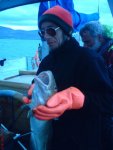
Sailing to France this w/e - how to stay warm?

Good boots and gloves are essential.
I've always gone with good thermals, normal trousers and a Musto Snug jacket underneath good offshore or ocean oilskins.
I believe you can get big fleecy onesies as mid layers these days. Not sure if they're any more effective though.
+1.
Keep feet, hands and head well dressed, most heat escape is through them.
Two things should be remebered:
Wool is the only stuff keeping warm when wet;
Wind must not penetrate the clothing - and this holds for pants and boots too.

"Real", not treated wool will not soak much water and can be worn wet, still keeping one warm - no other fiber can be used wet. Wet cotton will actually cause frostbite (congelatio, or whatever the term), it's downwright dangerous, some other 'wicking' synthetics pose same danger.

I used any kind of hi-tech modern ideas there were, for skiing or clmbing as those are lighter and better when sweating, but those are much inferior to normal wool clothing outside of active sports. Certainly while sitting still in cockpit.

Tips from colder climate :) : I use woolen sweaters, thick, knitted from untreated wool - flannel shirt (soft, or a sweatshirt etc) + such sweater + warmed jacket is enough in -30 or so in the mountain winds :cool: Avoid stiff collar and such. But more important are woolen soft pants (or any sport pants, warm) put below oilies (or jeans etc when ashore); woolen thick socks (knitted are best); woolen gloves; woolen cap, thick.

On boat I use wellies made of foam (EVA) entirely, sole included (soft sole, best nonskid I know) - light, warm, windproof. Cannot soak, should get wet inside - can be wiped dry. Warm feet are essential.

Outer layer must be windproof - so oilies - and not breathable. As said wool under it may get a bit moist, no problem. Breathables are for evaporating sweat from under, this evaporation has cooling effect, sometime this aspect gets forgotten...
For winter condition sailing: shirt, sweater, and thick fleece jacket under the not-insulated oilskin. But fleece is only good when dry - not so easy to keep it dry and it holds tons of water.

Better to have insulated storm wear, and best IMHO are flotation suits, with foam built in, those are so warm that sometime wearing pants of this kind is impossible... Jacket can be unzipped to cool down, so more comfortable. ;) Also a great safety measure; not only provide flotation and keep warm in water but save from bruises aboard.

No reason to spend much on "modern sports gear" - best stuff is available from industry clothing. Fishermans floating oilies can be found cheaper and better than made for yachties. I like those http://www.mullion-pfd.com/products/floatation-garments/jacket-and-trousers but there are cheaper kinds in UK. Very thick fleeces I buy (handfull) at industry clothing are exactly the same as most expensive sports stuff, only no brand name sewn on; 7 pounds. My foam wellies, now many years old and good as new were meant for foresters, 10 pounds. Good woolen garments may be not sold in UK industry stores, though.
 
Last edited:
But freezing, then warming up, then freezing again and so on is even more exhausting. Better to dress well and get acclimatized, adjust the body to conditions. Moreover there might come a time when ability to stay at helm longer gets essential :cool: I remember once having "watch" at helm in some F11 or more for 20 hours with not much breaks - skipper was the only one left still standing but had other duties... About 0 C, water around 4-5 C. It was steel boat and even wheel was steel. How cold steel is can be realized only on cold waters, lucky you to have Gulfstream in UK.
Interestingly to keep hands from freezing, though I had gloves (woolen, knitted) I took opportunity to dip hands in waves when came on deck - to warm them up... We had no waterproof gloves aboard, thing I never will forget to carry ;)

So this is another tip: get rubber gloves, big size so the thin woolen ones can be worn underneath. Something this kind: greenland 1826.jpg (note wooden rim added onto original stainless wheel ;) )
 
Last edited:
Chemical handwarmers - the type where you flex a metal plate to start an exothermic reaction - are great, and reusable. Either slip them in your gloves, or tuck one in your collar at the back of your neck. Lovely!

Neil
 
But freezing, then warming up, then freezing again and so on is even more exhausting. Better to dress well and get acclimatized, adjust the body to conditions. Moreover there might come a time when ability to stay at helm longer gets essential :cool: I remember once having "watch" at helm in some F11 or more for 20 hours with not much breaks - skipper was the only one left still standing but had other duties... About 0 C, water around 4-5 C. It was steel boat and even wheel was steel. How cold steel is can be realized only on cold waters, lucky you to have Gulfstream in UK.
Interestingly to keep hands from freezing, though I had gloves (woolen, knitted) I took opportunity to dip hands in waves when came on deck - to warm them up... We had no waterproof gloves aboard, thing I never will forget to carry ;)

So this is another tip: get rubber gloves, big size so the thin woolen ones can be worn underneath. Something this kind: View attachment 30424 (note wooden rim added onto original stainless wheel ;) )

ah, Marigolds- you mean the Skipper didn't have a single pair on board!:eek:
Just asking for trouble-What did he do when the heads got blocked:D
 
ah, Marigolds- you mean the Skipper didn't have a single pair on board!:eek:
Just asking for trouble-What did he do when the heads got blocked:D
Funny You mentioned...
It was a boat from sailing school facility (kind of chartered) taken for last sail before winter. Bit abused over the season already. There were more things lacking from usual equipment aboard, including spares for heads... Don't ask what we did, OK? ;)
Alternator belt failed right away, tools set to repair this missing, dead batteries, no nav lights etc - we entered the nearest harbour in F9 (strictly forbidden to try in F6) with onshore wind... and towed her into Burlak's way - 50', 15 tons.
He was one hell of a good skipper.

BTW - another thing I carry (only used in real emergency though) Zippo ;) Ignite and put into chest pocket.
http://2.bp.blogspot.com/_i5BMSIH9k...W0zcqY-RbU/s1600/hand-warmer-steps-sketch.png
 
Last edited:
Funny You mentioned...
It was a boat from sailing school facility (kind of chartered) taken for last sail before winter. Bit abused over the season already. There were more things lacking from usual equipment aboard, including spares for heads... Don't ask what we did, OK? ;)
Alternator belt failed right away, tools set to repair this missing, dead batteries, no nav lights etc - we entered the nearest harbour in F9 (strictly forbidden to try in F6) with onshore wind... and towed her into Burlak's way - 50', 15 tons.
He was one hell of a good skipper.

BTW - another thing I carry (only used in real emergency though) Zippo ;) http://2.bp.blogspot.com/_i5BMSIH9k...W0zcqY-RbU/s1600/hand-warmer-steps-sketch.png

Bit of Fred Drift but Obviously he was a very good boat handler in that lot but he'd have been an even better Skipper if he'd run through the kit list before sailing!
But I speak as having been Mate/Pilot and then Skipper of chartered Porte Solente Sunscum job regatta fleet 37's, and they were breaking up on the pontoons as you looked at them!
We crawled all over them before leaving the pontoon, took pics of everything, but that still didn't stop us finding the spinny pole car on one had only two 'dummy' rivet heads only superglued in on one side by previous "charterers"??, and both the bodies missing to hold the spinny pole mast end to the track until the first practice hoist off Gilkicker:o:eek:

Never saw our foredeck hand duck so fast in his life as the mast end broke free and scythed about the fore deck, took several very hairy minutes before three of us got it under control, fortunately without damage to us or the boat.
Definitely a change of trizers moment:o:o
Of 8 crew, 5 froze, 3 reacted- so not bad, if stressful way of finding out who you could rely on in an allocated scratch crew.

Get in the Thread relevance and reverse Fred Drift; Breton keps and very thick woolly bobble hats very good-ish at taking impact of pole but i'm still a bit :confused::confused:
 
Last edited:
Oh yesss, this kinda thing. At my instance this was first time I went to sea and never had any so good learning opportunity - for one never again had I sailed in hurricane :D
Skipper had no time for anything - we were to take another boat but engine was inoperative and just undergoind some repairs, so another was given instead. And we came from afar to go sailing; in Poland certificates (similar to RYA) are mandatory and issued only when you have enough 'sailing experience', counted in hours of actual sailing. This was such a 'gaining official documented experience' trip - I needed it to be eligible for exams, most others were in similar situation. So there was no point in wasting time.

Boat was sound, sails were good. This is all that matters, everything perfectly seaworthy. Yes, we checked what matters really, all the rest was taken as was. Considering over a week of hurricane winds with no problems the approach was right...

Who needs the engine :confused: There was a name for it in those old times: auxiliary :p

It's today's "yachtsmen" who need electronics, engines, heads, hod water running and such... :o

Those boats were meant for hardship, many are still sailing and never heard of any breaking the mast. We were never worried about breaking something.
 
Last edited:
Take your point, and anyway, if you survive it, it's 'valuable experience gained', and if you don't, the Coastguard says you were 'a Captain Calamity';)

Take it from me, even an manky old outboard, let alone a proper engine, can be useful in the Solent when the Brittany Ferry decides to cut the corner inside of you off the east side of the Isle of Wight at 20+kts and it's half tide running-another of Life's brown trizer moments:o:o:D

Oh, and hot water, heaters, clean, working heads and such are great ways of keeping SWMBO sailing with you as the years catch up with us:D
 
At that time no rescue service there was, able to help. Not in this sort of weather. And we did repair engine and electrics to have it working, once the problem was discovered.
OK, don't ask why I decided to buy a motor-sailer now, in fact. Good old Perkins - 50 hp in 30' is an overkill, but being old-fashioned mechanic found it appealing :o But must say that it's first boat I have that is equipped with engine. Getting old may have something to do with this...
 
Last edited:
Getting old may have something to do with this...[/QUOTE]

'Fraid so:D, you cruise a Wayfarer extensively, then one day, there is no sleeping mat thick enough to rest aching bones, then 3 weeks rainy cruise in your beloved 6m results in a stooped and aching back like Quasimodo, so you go for 10.82m of standing headroom, hot water, heater, en-suite heads,a 35hp engine, and in mast furling, spending the kids inheritance in the process:D
but you keep sailing, even if the bills increase:)
 
Last edited:
We're off from London to France - or at least that's the plan. Thought that by now this "blocking high" would have dissipated and let in some south westerlies and a bit of a rise in temperature. Somehow I don't think it 's going to happen.
Anyway what's YOUR approach to keeping the cold out when doing winter passages? Mine has been lots of layers from head to foot with a balaclava, but it sure does restrict movement. Anybody use some of the new miracle clothing which is supposed to dispense with the layers - or any other approach?

Best way to stay warm
Roll over & pull the duvet over my head
Try to persuade the wife to get up & make some coffee
Leave the boat where it is
 
then one day, there is no sleeping mat thick enough to rest aching bones, then 3 weeks rainy cruise in your beloved 6m results in a stooped and aching back like Quasimodo, so you go for 10.82m of standing headroom, hot water, heater, en-suite heads,a 35hp engine, and in mast furling, spending the kids inheritance in the process:D
but you keep sailing, even if the bills increase:)
My broken back left me horizontal for two years (no boat to blame); headroom was the first thing. Next thing required - my wife suffers from mal de mer (was taken there to accept the boat finally) - proper sea-berths: not too wide, not at angle and right in the center of gravity :D
No mast furling for me, had enough of complicated "systems".
BTW - I'm the one who cooks. And eats, any weather. Yes, would I not like the galley, i.e. not handy in rough going, it would be another boat.

We have a goose down filled sleeping bags. Polish geese. ;)
 
Last edited:
Funny that, SWMBO gets M-de-M for first few days, but Scopaderm patches help.
The thing about our current boat, she is not flung about in a cavernous modern 'caravan', plenty of hand holds, etc.
I tend to sail it upright, not on it's ear, just so long as we average a good 4kts, we are happy:cool:

We two Old Farts are Definite Fred Hijacking here!:o
So to return briefly to Thread;), I & SWMBO wear Trax/Buffalo tops and salopettes, since our Wayfarer cruising days, copes with most conditions, with layers above and beneath when needed, and good boots-our Dubarry's- have lasted long, keep feet warm, and the professional horsey folk round here live in their cleat sole Dubarrys or Muckboots-farmers neoprene wellies like your forester's boots.

Going over the village pub for a bit now,
TTFN
 
It's been quite cold lately but in dry weather you shouldn't need a lot of clothes that restrict movement. We were out over the few days and never felt the need for oilies etc. Apart from my grundies, all I wore were

* merino wool long johns and vest (most outdoor shops)
* cheap fleece-type polo neck shirt/pullover (ditto)
* cheap woollen or Thinsulate-typer fleece long socks (ditto)
* cheap fleece lined windproof jacket (ditto)
* cheap Thinsulate bunnet or other windproof head cover (ditto)
* fleece-lined windproof salopettes (I wear old end-of-line Dougals Gill salopettes that were going cheap years ago - looks a bit like a baby-gro on me...)
* pair of soft leather riggers' gloves (B&Q)


Not bulky at all. Also, none of the basics need to be expensive; only one of the above items came from a chandlery, and that was off the sale rail. My sole luxury item of clothing is an old pair of Dubarry leather boots, well over ten years and resoled at least once - very comfy and keeps the toes warm on days and nights like this:

20130402_0519_edited-1small_zpsdcd5e078.jpg
 
Last edited:
I did st kats to calais dec 2011 in v.cold weather

A few things id recommend that made all the diffence for me
Thick socks with tog rating
Gill helmans gloves (musto offshore were terrible an shared my gil with crewmate)
Glove liners, made from the same material as helly Hanson base layer stuff. Made a real difference
I was also given artic thermal top an bottoms that divers wear under drysuit

I also wore a thermal balaclava and HH fleece an base layers with this sweat evaporating wicking business

The rest has already been mentioned, ultimately the cold will eventually work through all your layers in time.

Enjoy :) it'll be awesome
 
Have a look in a motorcycle shop , the thermal layers are just as good but a lot cheaper than a chandlery .

Motorcycle waterproofs will give expensive marine gear a run for it's money.
The helmet is optional :cool:
 

I had something vaguely similar for skiing, except it covered the whole face where that one looks like it's chin and nose only (mine didn't extend down the neck though, you'd wear a scarf instead). I took it, together with the ski goggles, on the February Baltic delivery I've mentioned before. Didn't need to wear it, but perhaps I might have done in strong winds and hailstorms.

Pete
 
Top