Sail Trim Question - Headsail Leech Tensioner

Babylon

Well-Known Member
Joined
7 Jan 2008
Messages
4,398
Location
Solent
Visit site
Our new (this season) furling Yankee has a tensioning-rope in the leech, which is too high to reach from the foredeck without the faff of dropping the sail, so its not something I've yet spent any time experimenting with adjusting.

My question is what does it actually do? Is it to do with adjusting the sail's draught or does it have some other function?

Thanks

Babs
 
It's used to stop the leech of the sail flapping (drumming / motoring) when sailing to windward. To adjust: ease it off until the leech starts to flap and then retension until the flapping just stops.......then forget about it.
 
It's used to stop the leech of the sail flapping (drumming / motoring) when sailing to windward. To adjust: ease it off until the leech starts to flap and then retension until the flapping just stops.......then forget about it.

when tensioned the leech should form a ? (question mark ) & not "Hook" inwards as this upsets the air flow, if it Hooks the sail isnt cut correctly or has gone out of shape
 
It's used to stop the leech of the sail flapping (drumming / motoring) when sailing to windward. To adjust: ease it off until the leech starts to flap and then retension until the flapping just stops.......then forget about it.

I wondered if this was its primary function, as I do recall seeing a small but knackered genoa leech tensioned on another yacht to stop the flapping.

Right now its tensioned and I don't get flapping when going to windward, but I don't know if its overdone? Will just have to experiment with it on the next suitable occassion. (Would have been slightly easier to drop, adjust and re-hoist the old hanked-on yankee.)

Thanks

Babs
 
I wondered if this was its primary function, as I do recall seeing a small but knackered genoa leech tensioned on another yacht to stop the flapping.

Right now its tensioned and I don't get flapping when going to windward, but I don't know if its overdone? Will just have to experiment with it on the next suitable occassion. (Would have been slightly easier to drop, adjust and re-hoist the old hanked-on yankee.)

Thanks

Babs

the leech should be as i stated. and looke one of these ?????????????????????????
 
I wondered if this was its primary function, as I do recall seeing a small but knackered genoa leech tensioned on another yacht to stop the flapping.

Right now its tensioned and I don't get flapping when going to windward, but I don't know if its overdone? Will just have to experiment with it on the next suitable occassion. (Would have been slightly easier to drop, adjust and re-hoist the old hanked-on yankee.)

Thanks

Babs

Presumably there is a jammer at the clew? Is there enough on the leech line to form a loop or bowline when not under way? You could then use a boat hook to sort it when sailing and then leave it.
 
Presumably there is a jammer at the clew? Is there enough on the leech line to form a loop or bowline when not under way? You could then use a boat hook to sort it when sailing and then leave it.

You are wise, intelligent, kind, creative, really useful, and a genius.

There is a jammer above the clew and sufficient tail in the leech-line to form a bowline. Will have a go with this setup.

Thank you
 
Thanks

when tensioned the leech should form a ? (question mark ) & not "Hook" inwards as this upsets the air flow, if it Hooks the sail isnt cut correctly or has gone out of shape

Thanks Sailorman, I've made a mental note of your description and will check the shape of the leech when we're next out sailing - which should be the weekend after this.
 
? Eeek! That's what I'd call a badly hooked leach, just like my current genoa. The new one should look like !
 
If the leach looks like ? i would suggest that it is hooked too much. A very flat ? = ok. A new sail should not really need any application of the leach line tension as any significant use is likely to hook the sail and stall the leach. The leach line is useful to quieten a knackered genoa leach on a cruising sail, however it is inefficient.
 
I found the leech line tensioned on my boat when i first sailed her. It had been obviously tensioned and un touched for ages as the leech line was well mossy and un movable so i left it. Found out in a big blow it was over tightened as it ripped out of the leech!!! Our local sail wizard made it all better for a few well spent quid and since I have only tensioned it a little. Any flapping I try and cure through sheet tension and car position.
 
If the leach looks like ? i would suggest that it is hooked too much. A very flat ? = ok. A new sail should not really need any application of the leach line tension as any significant use is likely to hook the sail and stall the leach. The leach line is useful to quieten a knackered genoa leach on a cruising sail, however it is inefficient.

Mmm. This additional information makes sense. I think I'll slacken the leech-line off altogether, and only lightly tension it if-and-when flapping starts to arise. Thanks.
 
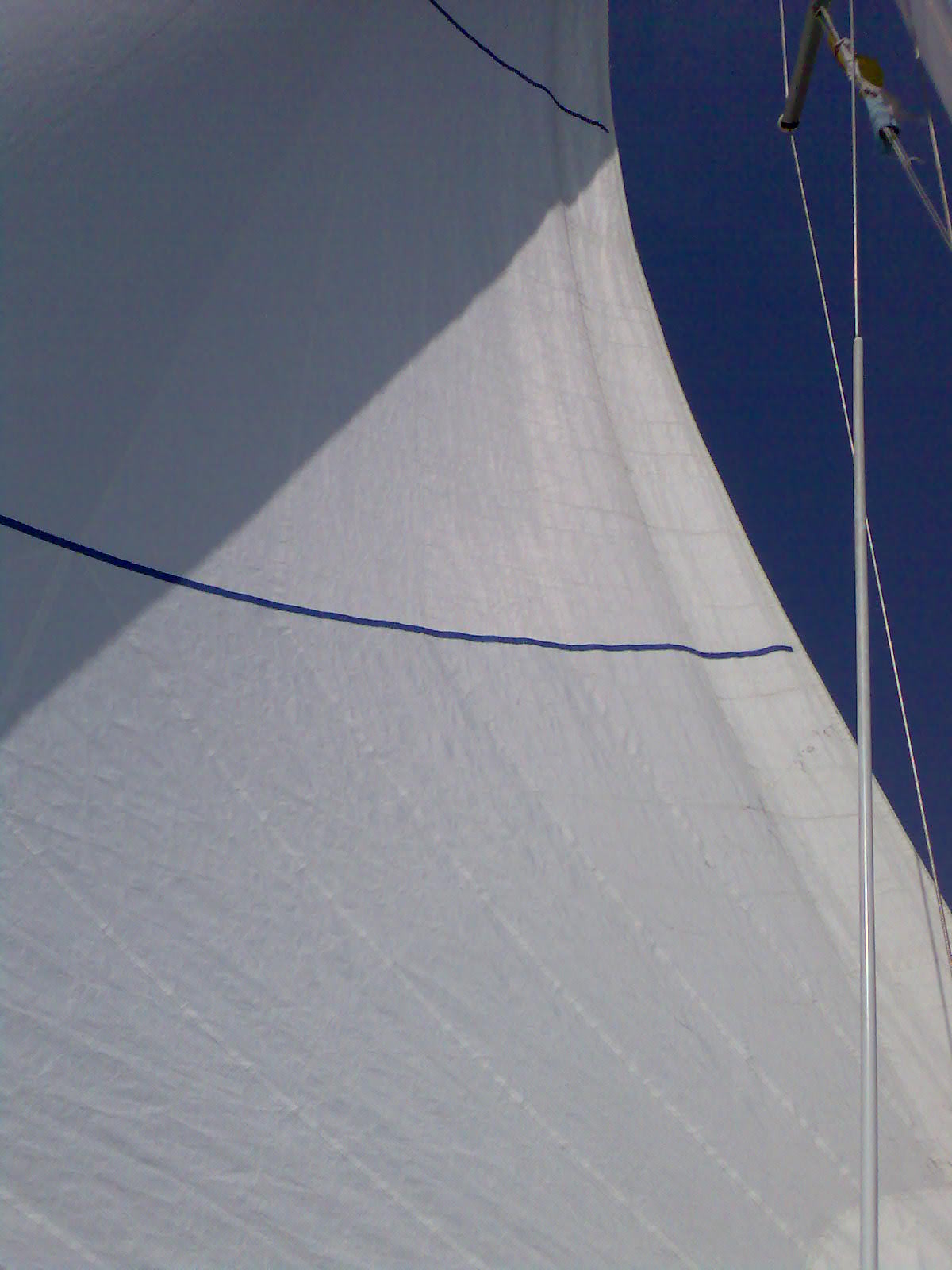
If you've got a draught-stripe on your jib- a contrasting stripe fore/aft- it should look like an aeroplane-wing.
Have a look at this pic to see a fairly good example. In the pic, up near the spreader, the leech looks a little tired- see the way the draught-stripe curls to leeward? It could start flapping there first, so a smidgen of leech-line would be in order, but just an inch, maybe- no more!
 
Last edited:
when tensioned the leech should form a ? (question mark ) & not "Hook" inwards as this upsets the air flow, if it Hooks the sail isnt cut correctly or has gone out of shape
Got a lovely question mark in mine and always thought it was because the leech was too loose and/or the UV strip is spoiling things:-

Leech1.jpg
 
Top