
Sabre 27 bilge keel vs Seal 28 lifting keel - performance?

:rolleyes: For "I have no real experience of Sabres apart from sailing past them," yet another unconvincing claim for your speed machine!
PS
When did I mention "drying out"?

Alant,

quite the opposite I'm afraid; I was trying to say gently that the Sabre is a bit of a plodder.

As for comparison with an A22, it wouldn't have a hope, have a look at the PY's.

Drying out; maybe just maybe, this was in answer to someone other than yourself...
 
The only time a twin keeler is better for drying out than a lift keeler is when the seabed is a little rocky; for this reason I dislike boats with completely retracting keels which settle right on the hull rather than a ballast stub, even if the seabed is mud there will be the odd stone.

I understand your point but I think that a bilge keelers ability to take the ground anywhere (?) is also a distinct advantage.
A lifting/stub keeler will need legs if it isn't against a wall. Admittedly some lifters have twin rudders and can take the ground
 
Be gone with all this talk of bilge keeled evilness! Bilge keels are the devils work, I tell you!

The fin keeled Sabre is actually a surprisingly "proper" shape below the water. The keel has a slight bulb to the bottom of it, and the skeg and rudder are much higher aspect ratio than the bilge keeled version.

Remember, a PY is only as good as the people sailing the boat. I've gone past bilge keeled Sabres scratching my head in amazement...we've had full sail and the cruising chute up, they've had a reef in and a partially rolled headsail...so its not just about what's going on under the water! Compromise wise, the Sabre certainly leans towards accommodation and sea keeping, but it's surprising what the old girl will do if you push her a bit...

3981370400_dec1e46e2b.jpg
 
Last edited:
Wasnt the Seal the boat that became the Parker, or am I getting confused? Maybe it was the Super Seal? If it did become the Parker they have the rep of being light weight flyers - big dinghies but not really good seaboats. The sabre 27 is real slow.

If you ignore the Anderson 22 bit ( yawn), Seajet has a point. Drop keels arent the best for taking to the ground, firstly because a lot of the ground round the UK has industrial heritage from old abandoned anchors / boats / engines / shopping trollies / general rubbish not to mention some areas of hard sand. Also because in muddy areas you get the problem of mud in the case jamming the keel in the up position.
 
Do give it a rest. Seajet said his only experience of the boat was sailing past them. He didn't mention overtaking them, sailing faster than them or anything else. There's no "claim" here, dubious or otherwise and the "banter" has long since ceased to be funny; it's now moving beyond tedious into a form of on-line bullying (and I know Seajet is quite capable of defending himself but it's spoiling my enjoyment of too many threads).FWIW I would expect something like an Anderson 22 to be noticeably faster than a Sabre 27 in light airs, especially a well-laden Sabre (as most are, being family boats). There also no comparison in the accommodation obviously and the Sabre would be a far nicer place to be in any kind of sea except perhaps if you were surfing big waves downwind. In a chop I would expect the weight and extra waterline length of the Sabre to tell and you would be very uncomfortable in an Anderson if you tried to keep up.

So there you are - an unbiased comparison of an Anderson 22 and a Sabre 27 just for you Alant - not that I can imagine somebody ever considering both. Mind you I'm not sure I've even sailed past an Anderson 22 and probably wouldn't recognise one if I did. Spent an awful lot of time sailing Mr Lee's other designs though, especially the Squib, admittedly about 30 years before I sailed a Sabre 27.

ps why do you have to mention drying out before anyone else can mention it?

It was Seajet, who made a point of talking about drying out, not me, that was before "why do you have to mention drying out before anyone else can mention it"

"it's spoiling my enjoyment of too many threads"
What a pity, I'm sure the forum is really concerned about your feelings!
 
Alant,

quite the opposite I'm afraid; I was trying to say gently that the Sabre is a bit of a plodder.

As for comparison with an A22, it wouldn't have a hope, have a look at the PY's.

Drying out; maybe just maybe, this was in answer to someone other than yourself...

No "maybe just maybe" about it!
 
The Seal 22 and 28 are both Primrose designs. There was also a later play on the 28 - the 850 which removed the rear cabin.

The Super Seal 26 became to Parker 27 / 275 / 285, the later boats having ballasted keels, the seal's daggerboard weights about 40kgs, the ballast is in iron in the bliges of the boat.
 
I understand your point but I think that a bilge keelers ability to take the ground anywhere (?) is also a distinct advantage.
A lifting/stub keeler will need legs if it isn't against a wall. Admittedly some lifters have twin rudders and can take the ground

Getting into somewhere like Keyhaven, when the tide is ebbing, can certainly use "a bilge keelers ability to take the ground anywhere". When you are 'on', it doesn't have a lifting keel's (or fin keel) advantage of easily getting 'off'. I'm not suggesting that this is the ultimate good feature, but has saved many an embarrassing moment.
 
Wasnt the Seal the boat that became the Parker, or am I getting confused? Maybe it was the Super Seal? If it did become the Parker they have the rep of being light weight flyers - big dinghies but not really good seaboats. The sabre 27 is real slow.

If you ignore the Anderson 22 bit ( yawn), Seajet has a point. Drop keels arent the best for taking to the ground, firstly because a lot of the ground round the UK has industrial heritage from old abandoned anchors / boats / engines / shopping trollies / general rubbish not to mention some areas of hard sand. Also because in muddy areas you get the problem of mud in the case jamming the keel in the up position.

Stones can get into the casing causing that problem, but "mud", particularly with a heavy cast iron swing keel?
 
Wasnt the Seal the boat that became the Parker, or am I getting confused? Maybe it was the Super Seal? If it did become the Parker they have the rep of being light weight flyers - big dinghies but not really good seaboats. The sabre 27 is real slow.

When Bill Parker took on the Super Seal moulds from John Baker when he retired, Bill made Super Seals, Then the Parker 27 and finally 275 and 285 in much the same vein but updated. Bill has now retired himself.

A Super Seal once won it's class in the AZAB race and another made to the Caribbean and back so they're not that bad as sea boats and the Parker derivatives would be even better.

My Parker 21 (same bottom arrangements as the Super Seal) spent 10 years on a mud mooring here in Stanpit Creek without any problems with mud or cockleshells interfering with the lifting arrangememnts.
 
Do give it a rest. Seajet said his only experience of the boat was sailing past them. He didn't mention overtaking them, sailing faster than them or anything else. There's no "claim" here, dubious or otherwise and the "banter" has long since ceased to be funny; it's now moving beyond tedious into a form of on-line bullying (and I know Seajet is quite capable of defending himself but it's spoiling my enjoyment of too many threads).

FWIW I would expect something like an Anderson 22 to be noticeably faster than a Sabre 27 in light airs, especially a well-laden Sabre (as most are, being family boats). There also no comparison in the accommodation obviously and the Sabre would be a far nicer place to be in any kind of sea except perhaps if you were surfing big waves downwind. In a chop I would expect the weight and extra waterline length of the Sabre to tell and you would be very uncomfortable in an Anderson if you tried to keep up.

So there you are - an unbiased comparison of an Anderson 22 and a Sabre 27 just for you Alant - not that I can imagine somebody ever considering both. Mind you I'm not sure I've even sailed past an Anderson 22 and probably wouldn't recognise one if I did. Spent an awful lot of time sailing Mr Lee's other designs though, especially the Squib, admittedly about 30 years before I sailed a Sabre 27.

ps why do you have to mention drying out before anyone else can mention it?

Just to put the record straight, the Anderson 22 comes into its' own in strong weather, not so good in light airs.

I agree the Sabre would be more comfortable, but probably especially slower in the rough stuff.

As for mud and stones in keel casings, the Seal 22's which used to be at my club definitely suffered this, but I don't remember the Seal 28 having the same problem, and I have known the owners well since 1978.

You'll be pleased to hear the A22 doesn't suffer mud or stones in the casing, simply because the ballast bulb is veed on top and fairs in with the hull when raised; I have never understood why more lift keel designs don't do this, it seems to give an 'end plate' hydrodynamic effect too.
 
Last edited:
I understand your point but I think that a bilge keelers ability to take the ground anywhere (?) is also a distinct advantage.
A lifting/stub keeler will need legs if it isn't against a wall. Admittedly some lifters have twin rudders and can take the ground

Not too sure about ' take the ground anywhere ', the idea of one keel gong into a very soft bit or off the edge of a bank would give me the willies !

Some A22's do have legs for settling on firm ground but personally I avoid this like the plague.

As for the jobs which dry on twin rudders, spiffing if drying out on a billiard table in a flat calm, otherwise a creation of the devil, imagine the splaying loads on those rudders and the small footprint of keel and rudder tips...
 
Isn't there enough to go wrong on a boat without adding in the complication of a lifting keel? My bilge keel Sabre draws about three feet. How much closer inshore does one need to go? And when I dry out on hard sand to scub off the barnacles I can crawl about underneath.
 
Richard,

it's a common misconception that lift keels are for ditch crawling, well not in my book !

My boat draws 2' with the keel up but I'd be getting twitchy at over twice that in depth, especially in any waves, though it is handy for scraping over the mud on the first or last of the tide at the mooring.

The great advantage is being able to go on drying moorings, which are not only cheaper they're also close inshore to row out to, usually sheltered, and far more pleasant than deep water moorings; I tried those for 3-4 years and it was awful, one required a young lifeboat just to get to the mooring it was so exposed and rough.

As for lift versus twin keels, we all know the pro's & cons.
 
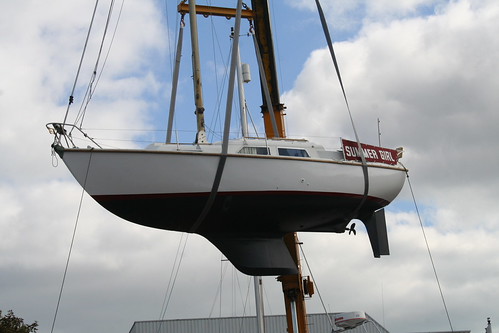
That's my boat in the cradle in post 14 :) Most Seal 28s were lifting keel. As you see in the photos mine has a fixed keel, she is fitted with legs to dry out.

The fixed keel Seal 28 sails and points well, although she is not the fastest in light airs.
 
Last edited:
Top