Sabre 27 bilge keel vs Seal 28 lifting keel - performance?

Can't speak for the Seal really but the Sabre is steady and reasonable. Not particularly fast or close-winded for her size but very pleasant on the helm and more than acceptable given the accommodation on offer. The fin keel Sabre does seem to be better to windward than the twin keel (or I'm a better helmsman than I thought) - the keels on the twin Sabre are quite long and shallow I believe.
 
Some friends at my club had a seal 28 for many years and cruised her far & wide inc S Brittany and twice through the French Canals.

I have no real experience of Sabres apart from sailing past them, I get the idea they're a good boat which will look after one but the keels are low tech and draggy - the Seal would be faster on all points of sail, particularly to windward.

A good sailor I know reckoned the Seal 28 is a bit hard mouthed to steer, due to the long ballast stub, but I'd still expect handling to be better than a twin keeler.

The Seal is also very much roomier, and the aft cabin not only keeps following seas off, it's a handy place to stow children / visitors or have a workshop.

If looking at any lift keel boat an inspection with boat hoisted and keel lowered is essential, as is a cradle or pit to allow maintaining the keel plate.
 
Some friends at my club had a seal 28 for many years and cruised her far & wide inc S Brittany and twice through the French Canals.

I have no real experience of Sabres apart from sailing past them, I get the idea they're a good boat which will look after one but the keels are low tech and draggy - the Seal would be faster on all points of sail, particularly to windward.

A good sailor I know reckoned the Seal 28 is a bit hard mouthed to steer, due to the long ballast stub, but I'd still expect handling to be better than a twin keeler.

The Seal is also very much roomier, and the aft cabin not only keeps following seas off, it's a handy place to stow children / visitors or have a workshop.

If looking at any lift keel boat an inspection with boat hoisted and keel lowered is essential, as is a cradle or pit to allow maintaining the keel plate.

:rolleyes:
 
There is a lovely looking seal 28 for sale on the association's website, looks like a very well maintained boat

http://parkerseal.org.uk/forsale/saphenaminor.aspx
sephenaminor0006.jpg


No connection!

The 28 was a Primrose design.
 
Where are you going to be sailing?

A lifting keel, is much handier than bilge, should you touch bottom, & getting onto a mooring, when little water underneath, can be a godsend.

Alant,

it would be interesting to hear why you put a raised eyebrows emoticon in reply to my perfectly reasonable post, other than the fact you lately reply with nonsense to anything I say.

Th only time a twin keeler is better for drying out than a lift keeler is when the seabed is a little rocky; for this reason I dislike boats with completely retracting keels which settle right on the hull rather than a ballast stub, even if the seabed is mud there will be the odd stone.

Deliberately drying out on a known rough / pointy seabed is not on for any keel type though.
 
Sitting upright?

Where are you going to be sailing?

A lifting keel, is much handier than bilge, should you touch bottom, & getting onto a mooring, when little water underneath, can be a godsend.

Does the Seal 28 (or any or the Seal / Parker range) - sit upright on a hard / sand bottom?

I have had a Sabre 27 and loved the ability to sit upright in drying harbours.

Mike
 
I have a mooring on the Exe and love sailing in Brittany - so I'm keep to have the ability to dry out - but not sure if the Seal 28 sits upright.

Mike
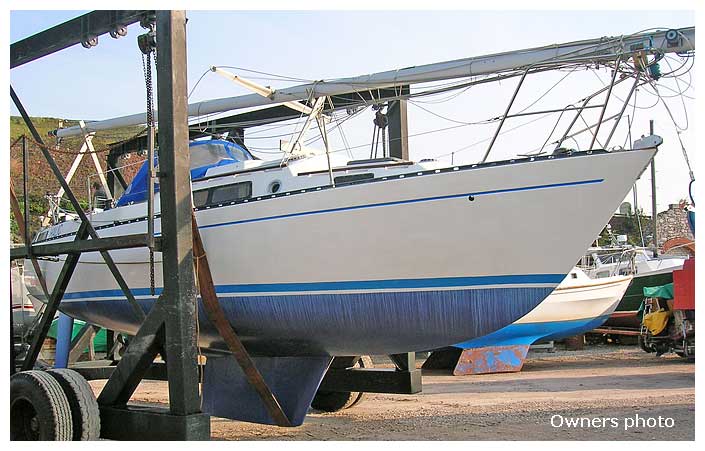
 
The Sabre 27 has a very good reputation, either the twin or fin keel, as a go anywhere yacht. The Seal 28 may be more convenient because it is bigger and roomier; whether it dries upright, I do not know, however, the twin keel Sabre 27 is a very robust design and will certainly dry upright.

Which one is faster? obviously the Seal28 due to its underwater hull design, however, are you that concerned making one knot extra?. Also, sail trimming and good sailing abilities will make a slow boat go much much faster than faster boats.
 
Thanks - I do want to dry upright as I adore Brittany. So its seems the Seal 28 is off the list. I have had a Sabre 27 in the past and on past Channel crossing I would have gladly had an extra knot.

Cheers

Mike
 
Drying any boat on a hard bottom, sand or other is horribly cruel and should only be attempted in light conditions.

The Seal 28 dries upright in soft mud, the lift keelers with ballast stubs on my clubs' soft mud moorings are usually a lot more upright than the twin keelers due to inconsistencies in the mud, t k's pecking their bows down etc.

As for passing Sabres well that's to be expected, but you can imagine any scenario you like if it makes you feel better !

The Sabre is a good solid boat, not bad looking either, but the question was the performance relative to the Seal 28, the only answer has to be ' quite a lot slower '.
 
Alant,

it would be interesting to hear why you put a raised eyebrows emoticon in reply to my perfectly reasonable post, other than the fact you lately reply with nonsense to anything I say.

Th only time a twin keeler is better for drying out than a lift keeler is when the seabed is a little rocky; for this reason I dislike boats with completely retracting keels which settle right on the hull rather than a ballast stub, even if the seabed is mud there will be the odd stone.

Deliberately drying out on a known rough / pointy seabed is not on for any keel type though.

:rolleyes: For "I have no real experience of Sabres apart from sailing past them," yet another unconvincing claim for your speed machine!

PS
When did I mention "drying out"?
 
Last edited:
I do like my swing keel for getting into the shallows and drying mooring but sometimes it would be good to be able to keep the sails up AND have a shallower draft. So I guess twin keelers do have that advantage (although not as shallow as a lifting keel). There have been occasions when we've started putting the sails up and remembered the keel isn't down too. Think I remember hearing about a capsize in the Solent due to a similar error (yikes!)
 
:rolleyes: For "I have no real experience of Sabres apart from sailing past them," yet another unconvincing claim for your speed machine!

PS
When did I mention "drying out"?

Do give it a rest. Seajet said his only experience of the boat was sailing past them. He didn't mention overtaking them, sailing faster than them or anything else. There's no "claim" here, dubious or otherwise and the "banter" has long since ceased to be funny; it's now moving beyond tedious into a form of on-line bullying (and I know Seajet is quite capable of defending himself but it's spoiling my enjoyment of too many threads).

FWIW I would expect something like an Anderson 22 to be noticeably faster than a Sabre 27 in light airs, especially a well-laden Sabre (as most are, being family boats). There also no comparison in the accommodation obviously and the Sabre would be a far nicer place to be in any kind of sea except perhaps if you were surfing big waves downwind. In a chop I would expect the weight and extra waterline length of the Sabre to tell and you would be very uncomfortable in an Anderson if you tried to keep up.

So there you are - an unbiased comparison of an Anderson 22 and a Sabre 27 just for you Alant - not that I can imagine somebody ever considering both. Mind you I'm not sure I've even sailed past an Anderson 22 and probably wouldn't recognise one if I did. Spent an awful lot of time sailing Mr Lee's other designs though, especially the Squib, admittedly about 30 years before I sailed a Sabre 27.

ps why do you have to mention drying out before anyone else can mention it?
 
Top
