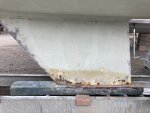
Rusty keels

rumtoddy1

Member
Joined
29 Jun 2009
Messages
40
Location
essex
Visit site
I am grinding back the keels on my westerly konsort (twin keel) and plan to treat with fertan rust convertor prior to filling and fairing.

I think about 1 litre will do the job but anybody done this before and have any advice?
thanks in advance
 
Just treat the rust spots at each lift out, paint and forget it.

Very difficult to sucvesfully treat cast iron rust on keels. It has been discussed many times on this forum, and likely worth a search of previous threada on the topic
 
Cast iron is used for your keels, like my Fulmar. It is a porus and rusts easily. I stripped my keel 9 years ago and treated the keel with Fertan followed by 5 coats of International Primocon. After a couple of years in the water, the amount of rust was substantially less. The rusty areas were treated again and after another 2 years in the water, there was even less rust. The last time I came out of the water there was almost no rust at all. I will find out in a couple of months the current situation. A litre of Fertan will last for years. I should mention I always treated the rusty areas twice as extra protection against rust.

If you look at this PowerPoint presentaion on Concerto you will see the treatment of the keel.
https://wiki.westerly-owners.co.uk/images/3/3f/Concerto.pdf Renovation of Concerto 2013-2020
 
Cast iron is used for your keels, like my Fulmar. It is a porus and rusts easily. I stripped my keel 9 years ago and treated the keel with Fertan followed by 5 coats of International Primocon. After a couple of years in the water, the amount of rust was substantially less. The rusty areas were treated again and after another 2 years in the water, there was even less rust. The last time I came out of the water there was almost no rust at all. I will find out in a couple of months the current situation. A litre of Fertan will last for years. I should mention I always treated the rusty areas twice as extra protection against rust.

If you follow the above, you can't go wrong 👍
 
Over the years I found that I had an annual task of grinding out rust patches, treating them with rust convertor and Primocon. Two years ago I hired a Needle Blaster from HSS, which was much more effective at removing the rust. I followed up with my customary treatment and no rust was visible on liftout. I now await, with fingers crossed, to see how it looks when lifted this year.
 
Over the years I found that I had an annual task of grinding out rust patches, treating them with rust convertor and Primocon. Two years ago I hired a Needle Blaster from HSS, which was much more effective at removing the rust. I followed up with my customary treatment and no rust was visible on liftout. I now await, with fingers crossed, to see how it looks when lifted this year.
That's interesting, will be looking out for your results. Needle guns are normally not as effective on cast iron as they are on steel as the rust tends to be driven into the graphite and the inevitable porosity.
 
Remember your old school chemi lesson where the teacher put a nail into a beaker of boiled water and it didnt rust, the reason being that to rust iron or steel needs water and air. So if you manage to put an air tight epoxy or whatever coat over your iron keels they wont / cant rust further. Problem is getting a totally air tight seal. I once tried epoxy on one keel and chlorinated rubber on the other - the stuff I believe they use on ships. Despite real care applying it the epoxy failed but the rubber worked.

Mind you as soon as you take to the ground which is what a bilgie is for, you risk damaging the coating.
 
Remember your old school chemi lesson where the teacher put a nail into a beaker of boiled water and it didnt rust, the reason being that to rust iron or steel needs water and air. So if you manage to put an air tight epoxy or whatever coat over your iron keels they wont / cant rust further. Problem is getting a totally air tight seal. I once tried epoxy on one keel and chlorinated rubber on the other - the stuff I believe they use on ships. Despite real care applying it the epoxy failed but the rubber worked.

Mind you as soon as you take to the ground which is what a bilgie is for, you risk damaging the coating.
Chlorinated rubber is a remarkable paint. We used to coat panel edges with it for Weatherometer testing, a seriously severe test. It very rarely failed.
After a winter afloat in Corsica our Coppercoated keel had failed badly with rust beneath the coating after about 10 years. With only a day to do something I painted chlorinated rubber that held for the following season.
 
The trouble with painting any keel is it is almost impossible to completely seal an iron keel as the boat would need to be left hanging for about a week to paint the bottom of the keel. I have found Fertan and Primocon do certainly work well and I expect a small amount of rust along the edge of the base of the keel.

IMG_2834 1000pix.jpg

This is my keel when lifted in August 2021. Just a little rust on the botton section, some due to running aground on shingle, but the Primocon has done a good job on most of the keel.
 
I'm have a cast iron keel for the first time this year and it's looking a bit sad.
The boat will only be in the water for 3 months this year so can I just antifoul over it a few times or will it fall off within days?
 
There were extensive rust patches on the sheet steel bilge plates which I cleaned and primed before antifouling last year> in the water for 10 weeks and most of the paint was still there. Problem solved permanently (hopefully!) by blasting and immediately epoxy coating.
 
This might be the place to ask a question that's been on my mind. When rust spots on steel are left and painted over, what's the chemistry that allows the rust to keep going and in due course bleed through / lift off the paint? Is it just that the rust contains a little bit of air and water? Or something more exotic - I read recently (without much understanding) that residual hydroxides pull water through the paint coating by osmosis.
 
This might be the place to ask a question that's been on my mind. When rust spots on steel are left and painted over, what's the chemistry that allows the rust to keep going and in due course bleed through / lift off the paint? Is it just that the rust contains a little bit of air and water? Or something more exotic - I read recently (without much understanding) that residual hydroxides pull water through the paint coating by osmosis.
If you just paint over rust spots you are not stopping any rust. Treaments like Fertan work to create an inert form to stop rusting. I first came across Fertan after a visit to see HMS Holland 1, the submarine built in 1901 but sank in 1913, but recovered in 1982. The complete submarine was treated with Fertan and she is still exhibited today. HMS Holland 1 | National Museum of the Royal Navy

However reading wikipedia the Fertan coating was beginning to fail after 10 years and she had to be immersed in a sodium chloride solution for 4 years to remove the corrosive chloride ions. HMS Holland 1 - Wikipedia

Remember HMS Holland 1 was initially displayed outside when I first viewed her and had no sealing paint covering. Now she has been in a climate controlled building since 2001.

I cannot answer your questions in a scientific way as I am not technically qualified. For me Fertan certainly does work pretty well as per my photo in post #10. I always feel an epoxy coating of a cast iron keel will have more problems with rust that a Fertan and Primocon surface.
 
Thanks Concerto, yes, I've used Fertan myself and been pleased with the results - even when grinding back to bare steel there are often still tiny pits which could have rust in, so a coat of Fertan to neutralise them a bit seems sensible.
What I'm not clear on is what goes on within the tiny pits that allows rust to keep forming even though a subsequent paint coating is keeping out air and water.
 
There’s this thread, goes into a lot of detail.

I didn’t use Fertan, but used Hold Tight 102 to prevent flash rusting, as in my post in above thread. After a couple of seasons there’s only one small flaky/rusty patch, that I’m putting down to poor application/pin holes in the over paint.

I’m with Birdseye on this. We talk about ‘neutralising’ the rust as if it’s a living organism, rather than a simple reaction to specific conditions.

Interesting quotes from Fertan's website: “The purpose of Fertan is to provide you with all the benefits of shot blasting with no surface damage and no material loss.“, and “Fertan converts loose rust to powder that can be rinsed away leaving a converted stable and inert surface.” Wondering if that’s how people are actually using it.
 
There’s this thread, goes into a lot of detail.

I didn’t use Fertan, but used Hold Tight 102 to prevent flash rusting, as in my post in above thread. After a couple of seasons there’s only one small flaky/rusty patch, that I’m putting down to poor application/pin holes in the over paint.

I’m with Birdseye on this. We talk about ‘neutralising’ the rust as if it’s a living organism, rather than a simple reaction to specific conditions.

Interesting quotes from Fertan's website: “The purpose of Fertan is to provide you with all the benefits of shot blasting with no surface damage and no material loss.“, and “Fertan converts loose rust to powder that can be rinsed away leaving a converted stable and inert surface.” Wondering if that’s how people are actually using it.
On the multi-day handover of my previous boat, the vendor, an engineer, demonstrated sanding/grinding off rust, then leaving it overnight, to flash-rust, the rust converter was then applied, allowed to cure/dry, was rinsed with water, then , once dry,covered with Primocon. I have followed that prescription, but always with mixed results, but it seems to me that, if it is called "rust converter", it must have some rust present with which to work.
 
For the woefully ignorant (that's me), can anyone explain whether (or how) Fertran is different from something like Hammerite?

I'm thinking of this:
No.1 Rust Beater

In anticipation of having to do some remedial work on an iron keel.
 
For the woefully ignorant (that's me), can anyone explain whether (or how) Fertran is different from something like Hammerite?

I'm thinking of this:
No.1 Rust Beater

In anticipation of having to do some remedial work on an iron keel.
None of the examples of substrates mentioned in the description are under salt water i.e. it appears that the paint is not intended for underwater use and is likely to saponify if immersed in salt water for more than a short period.
 
Top