Rudder re-design or rebuild Macwester 30'

bowderygiles

New Member
Joined
31 Aug 2005
Messages
10
Visit site
Hello et-all
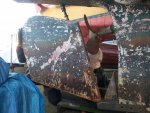
So end last season i noticed some slop in the rudder and once the boat was lifted noticed the rudder was showing vertical cracks along the leading edge on splitting the rudder apart I was able to confirm my assumptions that the tangs have sheared from the shaft.
Now from general reading and my limited experience Macwester's suffer from "heavy helm" (also weather helm but that is another issue)
As i have to rebuild the rudder should i try and redesign it to improve or just leave well alone?

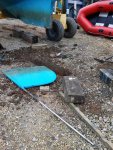
The 3 things i could address seen in the photo are
1, rudder/shaft angle is steep, (self centers due to gravity)
2, There is also no balance area to the rudder
3, The shape of the rudder (improve aspect ratio)

Would simply making the rudder shaft more vertical by extending the shoe be enough? or should i look at a spade design. (the boat lives on a mud berth)

Your thoughts experience very welcome
 

Attachments

  • Macwester_Rudder-1.jpg
    Macwester_Rudder-1.jpg
    120.4 KB · Views: 6
You do have a tiny amount of balance area, at the top of the rudder, there is area forward of the shaft axis.
You could possibly add more below the prop?
To change the rudder shaft angle seems like drastic surgery for probably not much gain. It will also possibly mean making the tiller shorter?
It might be worth making the rudder taller, so that it only just clears the hull on full lock. So the hull reduces flow over the top.
Maybe lose a little area off the back and make the bottom more horizontal? Obviously taking this to excess makes it more vulnerable to grounding.

I would think seriously about sorting the weather helm. Some longkeel boats are best steered by the sails.
Radical suggestions would include:
Get rid of that prop, it's causing carnage to the flow over most of the rudder. Only alternative would seem to be a feathering prop though? Maybe a two blade prop would be a bit better?
Make the whole boat a bit deeper! I've seen this done on a wooden boat. Keel lower and a 4" wooden spacer inserted! You could have a deeper rudder then.
A transom-hung rudder would have more leverage to turn the boats as it's further from the centre of the keel.

Another thing, some boats with this kind of issue, as the boat heels, the rudder is getting too near the surface, which makes it ineffective. Moving weight aft might help?
 
The picture shows the rudder dropped some what as I had already removed the shoe bolts. then the rudder is correctly located there is very little room in to increase the height when it is turned. making the bottom edge more horizontal is a possibility.

As to extending the keel and bilge plates to me that is a massive undertaking compared to re glassing the rudder tube slightly more vertical. A transom hung rudder is a possibility but would require some fairly involved fabrication (inverse rake to transom) and the tiller would have to be about 6-7" long :-(
 
652c43c54cf5551023ff380562ab9f15.jpg

a55c599a6f8ccf870cbce9c88f0b4d24.jpg

This is my Macwester 30 Sloop. The bottom of the rudder has an angle to ensure it moves freely when on the hard and therefore it should not be changed. There is no balance on the rudder at all; it could do with a small counter balance (or a spoiler) to make the rudder lighter. The rudder will be more effective if it was bigger on the vertical axis; there is a huge gap between rudder and hull and I suggest that you enlarge the rudder to bridge the gap and allow only a small clearance (approx 30mm when the slack is taken in water). I am considering doing the same when I get time.

The weather helm can be avoided/ corrected easily by reducing the main sail well before the genoa (unlike modern yachts). Good luck
 

Attachments

  • f559d6bd99b6a8deab32561180607b11.png
    f559d6bd99b6a8deab32561180607b11.png
    99 bytes · Views: 4
Last edited:
I did what you are considering on a Macwester 26, which has a similar badly proportion rudder that is too close to the prop, has little balance area and at an ineffective angle that has strong self centering tendency.
For proportions I copied the Vetus Stock Spade rudders and made my rudder from 10mm steel plate with a new stock (I could have used the old one but wanted a completely new rudder and the stock was a little wasted) and had it all galvanised. I altered the angle at the top fitting, moved the shaft tube astern several inches and glassed up the old tube hole. I made a new heel fitting several inches longer with new bushes in Delrin. The shaft ended up near vertical which freed up vertical space to achieve optimum aspect ratio and the balance section was around the optimum, forget exactly what that was thought to be at the time.
It was a job but not enormous and my old rudder, bushes and heel fitting were ready for replacing anyway.
The boat was transformed from being unpleasantly heavy on the helm quite apart from any weather helm, not going astern with any certainty and with a constant tug to self centre to being a delight to helm, light and good going astern. It was an unqualified success.
I did some soul searching about using a flat plate for the rudder rather than a proper foil shape but reasoned that a Mac is not a performance boat and that if ever I thought a foil section would be better I could simply fit shaped wooded foil panels to each side of the rudder at a later date. I did about 10,000 miles over 12 years with the boat and never felt the necessity to modify it further.
 
I often found myself sailing with the main fully reefed or sometimes just the genoa. to help with the weather helm.

If i move the rudder tube then decreasing the amount it pokes through the hull is an option and would also mean i could easily gain some extra on the height vertical rudder section.

If we go down the re-design route are there some basic rule of thumb for design? from my readings balance plane should be between 15-18% aspect ratio 5:1 (would make the chord length very short? maybe a 0008 0012 foil shape. but what about surface area?

The Macewsters are not exactly a performance boat happy to sacrifice lift etc for a just a reduction in required force on the tiller.
 
I did what you are considering on a Macwester 26, which has a similar badly proportion rudder that is too close to the prop, has little balance area and at an ineffective angle that has strong self centering tendency.
For proportions I copied the Vetus Stock Spade rudders and made my rudder from 10mm steel plate with a new stock (I could have used the old one but wanted a completely new rudder and the stock was a little wasted) and had it all galvanised. I altered the angle at the top fitting, moved the shaft tube astern several inches and glassed up the old tube hole. I made a new heel fitting several inches longer with new bushes in Delrin. The shaft ended up near vertical which freed up vertical space to achieve optimum aspect ratio and the balance section was around the optimum, forget exactly what that was thought to be at the time.
It was a job but not enormous and my old rudder, bushes and heel fitting were ready for replacing anyway.
The boat was transformed from being unpleasantly heavy on the helm quite apart from any weather helm, not going astern with any certainty and with a constant tug to self centre to being a delight to helm, light and good going astern. It was an unqualified success.
I did some soul searching about using a flat plate for the rudder rather than a proper foil shape but reasoned that a Mac is not a performance boat and that if ever I thought a foil section would be better I could simply fit shaped wooded foil panels to each side of the rudder at a later date. I did about 10,000 miles over 12 years with the boat and never felt the necessity to modify it further.

That's good news; do you have any pictures?
 
The picture shows the rudder dropped some what as I had already removed the shoe bolts. then the rudder is correctly located there is very little room in to increase the height when it is turned. making the bottom edge more horizontal is a possibility.

As to extending the keel and bilge plates to me that is a massive undertaking compared to re glassing the rudder tube slightly more vertical. A transom hung rudder is a possibility but would require some fairly involved fabrication (inverse rake to transom) and the tiller would have to be about 6-7" long :-(

Sounds familiar. The rudder is how it is for reasons associated with the choices made in designing the boat.
But lots of people have coped with non-ideal rudders. If you have a boat with the advantages of a long keel and shallow draught, you have to work around the downsides of that.
Dinghy sailors who are much better than me will tell you that using the rudder to fight the sails is slow.
Having said that, I used to have an Impala, they were much improved by a better rudder design.
Has the shouty CAPTIN got a smaller 4 blade prop which might upset the flow over the rudder less?

I suppose if you did make the rudder less raked, there might be space for a folding prop.
But if the extension of the keel is going to take much load, it will have to be well engineered, and if it isn't taking much load, the rudder shaft/stock will have to be plenty stiff.
I've always been comfortable with spade rudders, but some people are averse to them, particularly on a drying mooring.
 
I had similar problems with my Eventide. It was relatively easy to deepen the keel because it is wood with a bolt on ballast keel. It is now 9" lower of which 8" is in the form of laminated wood glued to the original keel and the other 1" a steel plate to add extra ballast to compensate for a new lighter engine.

The original rudder was flat plate and elliptical with only a small balance area. The new rudder is higher aspect ratio with more balance, although constrained by closeness to the prop. Construction is stock and tangs then wooden frame and ply faces, sheathed in glass epoxy. If I were doing it again I would just use ply and shape it.

These two changes stransformed the boat's handling.

You have enough height on your rudder to increase the aspect ratio by removing area from the aft end and increasing the area at the top and bottom. That on its own would make a big difference. Agree making the stock more vertical would help, not only in allowing an increase in balance area up to the ballpark 15% of total area but reduce the tendency for the rudder to stall.
 
That's good news; do you have any pictures?

Unfortunately I threw away the very large paper template for the welder to work to and the drawings of the heel fitting only very recently. However the rudder plate was just welded to the stock and with 3 off 6mm x40mm straps folded around the stock and welded to the rudder.
I am amazed looking back that I did not think to take any photos as it was quite a big job for a non-boat builder amateur and I was very pleased with the final result both as a construction and functionally.
Anyway good luck with whatever you decide to do about your rudder situation. I always lusted after a Malin or a Wight when I had my Macwester 26 but I got the opportunity of a cat at a super price ( the pound strong against the Euro & a bereavement sale) from Houth and dashed over and bought that so I never progressed onto a bigger Macwester. My Macwester was in Wales and was called Marcus ( not to be confused with Marcus11 or Marcus111), I hope she is still afloat and knocking around the Welsh Coasts!
 
Unfortunately I threw away the very large paper template for the welder to work to and the drawings of the heel fitting only very recently. However the rudder plate was just welded to the stock and with 3 off 6mm x40mm straps folded around the stock and welded to the rudder.
I am amazed looking back that I did not think to take any photos as it was quite a big job for a non-boat builder amateur and I was very pleased with the final result both as a construction and functionally.
Anyway good luck with whatever you decide to do about your rudder situation. I always lusted after a Malin or a Wight when I had my Macwester 26 but I got the opportunity of a cat at a super price ( the pound strong against the Euro & a bereavement sale) from Houth and dashed over and bought that so I never progressed onto a bigger Macwester. My Macwester was in Wales and was called Marcus ( not to be confused with Marcus11 or Marcus111), I hope she is still afloat and knocking around the Welsh Coasts!

Thanks for the reply; I will change the rudder's configuration when I get time, primarily, to make it lighter by forming a balance in a form of a spoiler on the leading edge. My Macwester which i had for 11 years, is the 31ft sloop wight, only 12 were made and i understand that is the only one left in the UK!!.
 
Well while on nightwatch at my local club I took the time to measure all the skeg hung rudders in the club. out of the 25 boats NONE have a cord to length ratio of less than 1.4 (max was 3.2) but my Macwester 30 rudder comes out at 0.65!. while the surface area at 0.5m2 is similar to other yachts of it size most have a much bigger sail plan.
(read that rudder area is a % of sail area also a % of underwater profile but that is a lot harder to calculate)

I may struggle to change the aspect ratio much as we are limited by draft (lives on a drying berth) but I can increase the distance between the prop and the rudder and add some balance plane in at least.
 
My old Mac 26 was a pig to handle and the weather helm nearly pulled my arm out of the socket.
We had a new main sail made shorter on the foot this did not make much difference. I had planned to redesign the rudder as discussed above however before I could get round to this the old Stuart Turner blew up and I had to fit a new engine. The new engine was less than a third of the weight and when in the water the stern was about 2inches further out of the water.

I don't know why or how but the excessive windward helm was sorted !!!.

Good luck
 
Top