Rudder Balance

Javelin

Well-Known Member
Joined
3 Sep 2010
Messages
1,413
Location
Southwold
www.southwoldboatyard.co.uk
At the weekend my newish rudder bearings decided to seize to the shaft, so a lift out, investigation and cure will be found, again.

However when the bearings were acting as bearings, with free-ish easy movement at standstill, the tiller has always been heavy once underway.
The rudder is a semi balanced spade type.

I was wondering how I could lighten the load on the tiller given I cant increase the length of the tiller due to the main sheet traveler position.

I guess I could add an inch or two to the leading edge and fair to shape to increase the balance effect but what would be the downside of that?
Would it just want to turn more so I'd end up fighting to keep it straight.

In which case is the only option to reduce rudder area....

Or do I just have to accept that a 34' IOR design is just stuck with having a heavy helm.
 
An IOR design shouldn't have a heavy helm. In general, they needed the efficiency upwind just as much as a modern racer and more activity from the helmsman downwind.

What do you mean by a heavy helm? Stiff to turn when underway, or you need to use too much helm to keep her in a straight line?

If the former, is the stock well aligned? Does the pattern of wear indicate it is getting out of alignment when the boat is moving?

If the latter, sack the main trimmer. Maybe even the genny trimmer too. :)
 
Boat balance is fine - very little weather helm at all - tracks very well.
So I guess more the former.
Alignment is good so bearing design could be some of the answer.

Maybe try for roller bearings instead of plain though I bet that's gonna be pricey.
 
One, amongst many causes of heavy helm on IOR designs (after sail trim, baggy sails etc.),is the fact that the rudder bends the (usually) s/steel shaft into say, a gentle curve.If the bearings are not themselves elliptical roller type, a binding effect will ensue, often resulting in a complete lockup of the helm, until the load is relieved, by a rounding up, or by the perceptive trimmer, releasing the mainsheet,even easing the genoa as well if its a big sail.Which it often is on these rigs.
During this phase the weather helm would usually be quite badly felt.A boat with new close tolerance bearings, say after replacement of the bearings, will be more likely to suffer this problem than a setup that is well worn.The sloppy fit ones give less trouble!
 
Boat balance is fine - very little weather helm at all - tracks very well.
So I guess more the former.
Alignment is good so bearing design could be some of the answer.

Maybe try for roller bearings instead of plain though I bet that's gonna be pricey.

Does sound like bearing design. I get away with nylon bearings on a 43 footer (when I say that, I did have to drop the rudder and gring them out a bit a few years ago because the nylon had absorbed water, but it's ok now). Different symptoms to yours as it was stiff whether the boat was moving or not.

Comment about the rudder stock bending by PaulClan is very interesting. What diameter is it?
 
At the weekend my newish rudder bearings decided to seize to the shaft, so a lift out, investigation and cure will be found, again.

However when the bearings were acting as bearings, with free-ish easy movement at standstill, the tiller has always been heavy once underway.
The rudder is a semi balanced spade type.

I was wondering how I could lighten the load on the tiller given I cant increase the length of the tiller due to the main sheet traveler position.

I guess I could add an inch or two to the leading edge and fair to shape to increase the balance effect but what would be the downside of that?
Would it just want to turn more so I'd end up fighting to keep it straight.

In which case is the only option to reduce rudder area....

Or do I just have to accept that a 34' IOR design is just stuck with having a heavy helm.
when i bought my IOR One Tonner she needed the "Oilite" bearing replacing, this was done ( John Davey- Ipswich ) with a plain bronze sleeve + a grease nipple as the cup greaser was thought to be inadequate.
17 yrs later the bearing is as new, the helm light on a screaming reach it gets heavier & down wind in a blow it self centres when the helm is hands off & light as a feather.
 
An IOR design shouldn't have a heavy helm. In general, they needed the efficiency upwind just as much as a modern racer and more activity from the helmsman downwind.

What do you mean by a heavy helm? Stiff to turn when underway, or you need to use too much helm to keep her in a straight line?

If the former, is the stock well aligned? Does the pattern of wear indicate it is getting out of alignment when the boat is moving?

If the latter, sack the main trimmer. Maybe even the genny trimmer too. :)

Exactly my thoughts. A heavy helm when sailing on the wind means drag which in turn means slow which is not what you was designed into an old racer. But what about the rig? Changing the angle of the main mast to the vertical alters the amount of helm loading on the wind. In a boat of that age the rig will have been changed several times and it could easily be that the mast is at slightly the wrong angle. Its a reasonably sensitive adjustment, and inch or more in forestay length making a significant difference.
If on the other hand it is heavt downwinbd then either lengthen the tiller or add a bit to the front of the blade. Beware this will make the blade heavier when motoring.

If it is wheel steered then check the bearings in the steering system below decks - knackered bearings their could tighten under load though you would tend to feel friction rahter than weight.
 
Does sound like bearing design. I get away with nylon bearings on a 43 footer (when I say that, I did have to drop the rudder and gring them out a bit a few years ago because the nylon had absorbed water, but it's ok now). Different symptoms to yours as it was stiff whether the boat was moving or not.

Comment about the rudder stock bending by PaulClan is very interesting. What diameter is it?

A common cause of binding rudder bearings is replacing Delrin (which doesn't swell in water) with Nylon (which does). Only an expert could tell them apart and as Nylon is cheaper....
 
You need to differentiate 'heavy' into either 'stiff' or 'highly loaded'.
If it's friction you can deal with that.
If you need a lot of force on the tiller because the rudder is not balanced enough, that's a different problem.
Some boats have a lot of load on the rudder when the helm is neutral, as the rudder is a biggish part of the lateral resistance.
The helm is fairly central, but the boat 'leans on the rudder'.
A lot of IOR boats have long tillers for a reason!

If the bearings are not stiff you could look at adding more balance area.

If the stock flexing is causing the binding, you could look at self-aligning bearings?
Or barrelled rollers?
 
Hmm, kind of go with you comment LW where you say
Some boats have a lot of load on the rudder when the helm is neutral, as the rudder is a biggish part of the lateral resistance.
The helm is fairly central, but the boat 'leans on the rudder

The photo below shows her bum but as sods law dictates the rudder was out and I can't find a side shot with it fitted however it does show that with the small but deep keel there would be a fair amount of lean on the rudder.
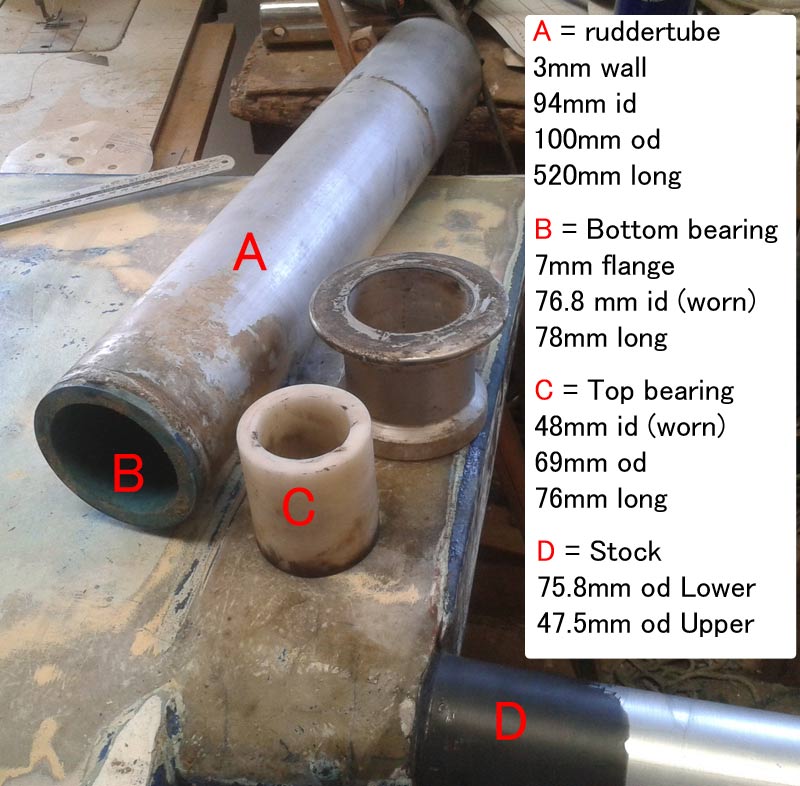
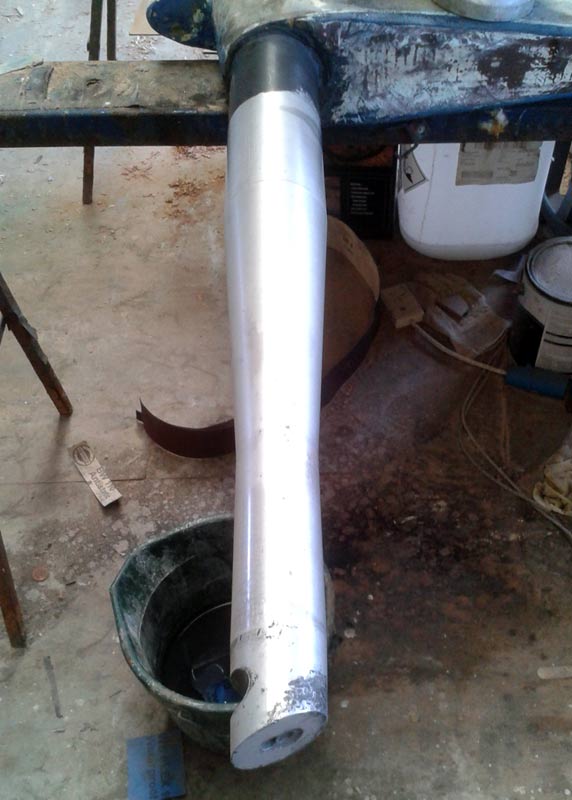
The rudder shaft is a fairly sturdy see lower photo of the offending bits.
11208668_699317940195789_3966439690759355555_n.jpg

rudder08.jpg

rudder07.jpg
 
Last edited:
Hard to believe it is flexing.

If your measurements are very accurate it would imply some play. Does that exist in reality?

Is that mark on the rudder stock above the dark patch wear from the lower bearing?
 
The photos are of the old bearings I replaced last summer as there was fore and aft movement as well as side to side.
The shaft was slightly worn and rebuilt using epoxy and made round again.
The current setup is similar only there is a hard sleeve bonded onto the shaft to avoid future shaft wear.
The new bearings are similar only with a 3mm allowance for the sleeves.

However the new setup is stiffer probably due to me being too tight on the tolerances.
So I'm resigned to haul out and do something about it.
I could just leave as is after freeing off the current system or try self aligning rollers or try a bit more on the leading edge to increase balance,
Hence the thread really, just trying to garner ideas and then formulate a plan.
 
The photos are of the old bearings I replaced last summer as there was fore and aft movement as well as side to side.
The shaft was slightly worn and rebuilt using epoxy and made round again.
The current setup is similar only there is a hard sleeve bonded onto the shaft to avoid future shaft wear.
The new bearings are similar only with a 3mm allowance for the sleeves.

However the new setup is stiffer probably due to me being too tight on the tolerances.
So I'm resigned to haul out and do something about it.
I could just leave as is after freeing off the current system or try self aligning rollers or try a bit more on the leading edge to increase balance,
Hence the thread really, just trying to garner ideas and then formulate a plan.

There is something wrong somewhere if the load on the rudder (mainly from drag if it's not caused by excessive weather helm) is making the steering stiff. Somehow the rudder is moving, if only by a tiny amount.
 
There is something wrong somewhere if the load on the rudder (mainly from drag if it's not caused by excessive weather helm) is making the steering stiff.

Yup.

Weather helm is minimal, a bit of heel induced weather helm in gusts which is to be expected but otherwise almost neutral.
With the kite up on a reach I get a bit of lee helm unless I tweak the kicker or bring the main in a little but again its to be expected as the kite is pretty big.

When I think about it balance maybe not the issue as once I'm turning for a tack for example I need to stop the tiller/rudder turning too much (no rudder stops)
So I'm back to bearings, alignment and design of, I guess.
 
I suspect the epoxy you built up the shaft with may have a lot of friction with the plastic bearings?
There is a lot of side force, I suspect the film strength of the water as a lubricant is not enough and you have two plastic surfaces trying to bind/bond together?
At this point I start wanting a bloke who really knows more about plastics.
I'm assuming the stock/shaft is aluminium?
Can it be sleeved with a tube where worn?
 
Top