RRS Discovery Dundee - how did they withdraw the prop?

bikedaft

Well-Known Member
Joined
16 Dec 2008
Messages
3,917
Location
tayvallich
Visit site
had an enjoyable day there today, though could not see (am i being thick?!) how the prop would have been withdrawn upwards into the corresponding hole in the stern - did they take it off the prop shaft first? thanks...

 
had an enjoyable day there today, though could not see (am i being thick?!) how the prop would have been withdrawn upwards into the corresponding hole in the stern - did they take it off the prop shaft first? thanks...

She probably had a universal joint at the forward end of the shaft, as was done with many warships from the 1840s until the eventual abandonment of sail at the end of the 19th century. Sail lingered on in many navies simply because, with poor fuel economy and few coaling stations in far flung places, areas like the Pacific could only realistically be patrolled under sail. Higher boiler pressures, turbines and oil fuel finally did for the old sailing corvettes and frigates, but the Discovery's propulsion systems had a lot to commend them for Polar exploration.
 
had an enjoyable day there today, though could not see (am i being thick?!) how the prop would have been withdrawn upwards into the corresponding hole in the stern - did they take it off the prop shaft first? thanks...

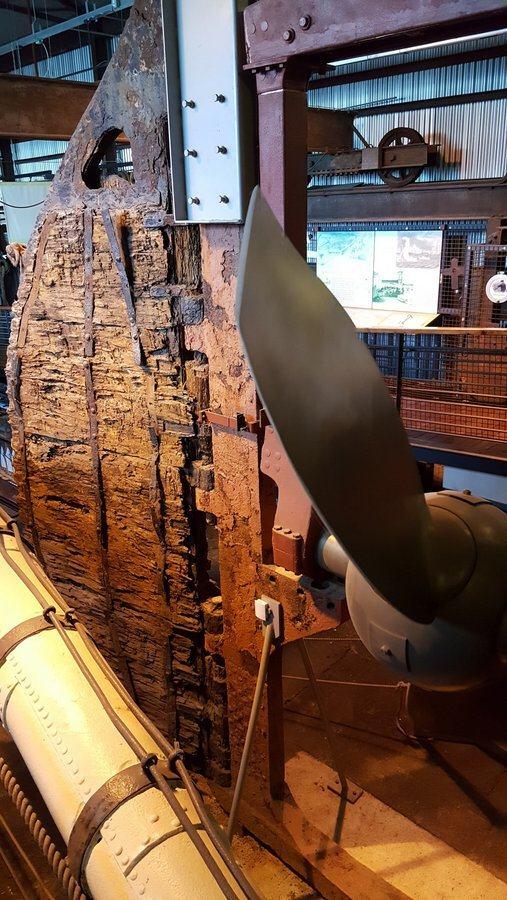
As I recall, the two bladed prop was rotated until it was vertical, then the hook on a block and tackle was attached to a hole in the top blade. The propeller shaft was then retracted from inside the shaft tunnel, after a section was removed, and the propeller was lifted up.

Here's an internal view, showing the flange to which the removable shaft section attached:

1024px-RRS_Discovery_Dundee_Site_in_the_stern_of_the_rudder_and_two_bladed_propeller.JPG


The SS Great Britain had a similar setup for part of her life and you can see a mock up of it, using the original aperture framework, in the shed beside her in Bristol. In her case the propeller was mounted with bearings fore and aft into a vertically sliding framework (standard practice on naval vessel at the time) but I don't know if the Discovery had that system.

O5-Museum.jpg
 
Last edited:
thanks. withdrawing he shaft from inside makes the most sense. wonder how the prop was secured to the shaft?

Splines, I think, but there must have been some way of taking the thrust, in both directions. I think you can see if you look down the trunking. I spend a lot of time 15 miles from Dundee (at the moment, for example) so this might be an excuse for another visit to the Discovery.
 
thanks... no (legit!) access to dry dock

i asked the tour guide guy, he didn't know

and she's shut from Monday for three weeks for mast/spar repairs

thanks for your pic of original SS Great Britain prop/rudder

RSS Discovery seems to have a different design, different holes in the hull for rudder and for prop

splines would be the easiest to re align. tho square section shaft with corresponding markings on inboard end prop shaft also?

cheers for your help
 
RSS Discovery seems to have a different design, different holes in the hull for rudder and for prop

The Great Britain only moved the prop out of the way, to reduce drag when sailing. The Discovery removed the rudder as well, to avoid damage when she was (intentionally) locked into the ice.
 
We were very disappointed in our visit to see the RSS Discovery last year, half the ship internally is missing and the usual posters everywhere and no guides to tell you anything,
you could not even walk all the way around the dock and other displays were again mainly posters.

As an afterthought we then went along to see HMS Unicorn a bit further along and not a pretty picture from the outside, but oh what a great visit, the nice guy at the reception desk was a goldmine of information about the ship, loads of original items to see and you could get to see everything almost right down to her bilges.
 
I have an engineering manual from the 1800 s and it shows these arrangments as tongue and groove. To disconect then turn shaft so tongue vertical allowing prop to lift. The fit was such that the thrust was taken by the prop shaft and thrust block as in steam ships with conventional arrangements.
 
Top