RPM Alternator Pulse count signal conversion - Alternator Pole Count

superheat6k

Well-Known Member
Joined
10 Jan 2012
Messages
6,797
Location
South Coast
Visit site
So today I have attempted to set up the RPM inputs into my engine protection system, and it ain't working !

I am using a Pulse to Analogue convertor rated for 0 - 1 kHz to 0 - 10vdc, and have roughly worked out that at max display revs of 3,000 RPM to expect a pulse frequency ~ 750 hz.

But when I run the engine at idle ~ 750 RPM I am seeing close to max revs voltage ~ 10vdc, and not the voltage I would expect ~ 2.5vdc

Going back to basics I need to know the Pole pair (N + S) quantity and Pulley ratio.

So can anyone tell me the common pole count for a typical ~ 90a marine duty alternator - or specifically as in my case as fitted to Cummins 6BT5.9M engines. Lots of general information available on alternators, but nowhere does it state the specifics of how many poles. I can strip the alternator and count the pole tabs on the rotor, but prefer not to do this.

6 seems to be fairly standard, but possibly 5 or even 8. None of these values explain why I am seeing such a high output.

I can work out the pulley ratio from the OD measurement of each pulley, but even this detail is not listed anywhere. My guestimate is based upon a Pulley ratio of 2.5 and a Pole count of 6.

I have found out the voltage to expect on the signal pulse is ~16 volts ac (RMS) so a peak value ~23vac. I am wondering if the signal is simply too strong or too noisy and is why I am seeing a corrupted output.

Can anyone give me some guidance on the above please ? Perhaps a filter circuit on the pulse input.

Paralleling the pulse tap onto the normal tacho input has not disrupted the normal rev counter display.

The convertor is this device 2x Frequency to Voltage Converter Module 0-1KHZ Frequency to 0-10V Voltage | eBay

Thanks.
 
But when I run the engine at idle ~ 750 RPM I am seeing close to max revs voltage ~ 10vdc, and not the voltage I would expect ~ 2.5vdc


Thanks.

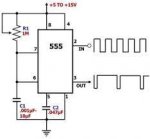
This looks like you are getting 4 times the frequency so just put in a frequency divider either using a 555 timer of a binary divider

1616083885833.jpeg

ic-frequency-divider-counter-electronics-world-january-1969-6.jpg


I have a counter divide by 6 on our garden watering system based on one of there

1616084389056.png
 
Last edited by a moderator:
Not sure how ,any poles your alternator has, buts let’s take 6 as an average, multiply that by idle speed, then multiply that by the pulley ratio, you could be talking a frequency of 10 kHz at idle speed, so your frequency converter is only rated at 1 kHz. The top of the waveform is noisy so you will need to be able to trigger the frequency converter input around 8v above ground if possible. Do you have access to an oscilloscope, if not do any of your dvms have a frequency measuring scale?
 
Not sure how ,any poles your alternator has, buts let’s take 6 as an average, multiply that by idle speed, then multiply that by the pulley ratio, you could be talking a frequency of 10 kHz at idle speed, so your frequency converter is only rated at 1 kHz. The top of the waveform is noisy so you will need to be able to trigger the frequency converter input around 8v above ground if possible. Do you have access to an oscilloscope, if not do any of your dvms have a frequency measuring scale?
I thought that but I have double checked the maths ...

Poles 6 x revs 750 / min / 60 secs x pulley ratio 2.5 = 187.5 pulses / sec or hz

I have just ordered a multi meter with frequency function up to 4 kHz.

What I didn't mention earlier was that varying the revs does not make any sensible change to the reading. I am actually requiring a 0-5VDC input so have a resistor in line on the input of 100 kOhms - this made no difference whatsoever.

Could be that I am using a cheap convertor. I have found several others today, but don't much like the idea of ~ £200 each !

I have bought some rather fancy and not cheap isolated Low volts convertors to read the 75mV Shunts on the alternator outputs, which I intend to hook up on Saturday. If these work as intended I shall have a little more faith in these devices. That said alternator amps are far less important than the engine revs. Not only is the RPM information useful, the background logic for the various engine alarms is dependant upon the RPM reports to set a threshhold (>500) for the 'engine is running' feedback, which in turns arms the loss of SW Flow and Low oil pressure alarms.
 
I am actually requiring a 0-5VDC input so have a resistor in line on the input of 100 kOhms - this made no difference whatsoever.

A single resistor in line will not alter the output voltage what you need is a potential divider of a pot connected across the output and the signal taken from the pot wiper
 
Yes sorry I used revs per minute, should be revs per second, oops! If you cannot get a reliable indication of revs, can you use a logic signal from the charge light to show the engine is running?
 
Yes sorry I used revs per minute, should be revs per second, oops! If you cannot get a reliable indication of revs, can you use a logic signal from the charge light to show the engine is running?
Hadn't thought of that - a 12v signal relay would do that task, coupled to the start switch.

I won't give up on getting the Tacho data just yet though.
 
A single resistor in line will not alter the output voltage what you need is a potential divider of a pot connected across the output and the signal taken from the pot wiper
On the PLC we use this does work because the internal resistance of the sensor circuit is also 100 k Ohms so the inline resistor works, and is the makers recommended practice. I did question this myself when first advised to do this, but now routine where we have to condition a 0-10 input to 0-5vdc.
 
getting such signals right was my biggest nightmare Trevor.
Ended up using an half a euro PC817 optocoupler a diode and a suitable resistor to "read" alternator (straight from the rpm wire that goes to the tacho). Code was interesting to say the least (rather long!)
Still having issues accurately reading anchor chain though (debounching issues on the signal)

You are right, unless you know RPM you cannot set any alarm. Ended up setting multiple alarms (one for idle +200rpm, one for the rest of the running range...)

V.
 
I have looked through all my project books but cannot see an easy circuit to build without a lot of filtering. If all else fails as a last resort, can you use the analogue tacho display unit itself? If you tap into the feed to the meter drive this could be a suitable analogue voltage, again not sure how smooth it will be. Any spare display units available?
Just looked on eBay, you can get stand alone displays for around £40, maybe open one up and do some measurements?
 
Designing suitable signal conditioning depends on information about the alternator's output over all speeds and loads. Such information isn't readily available.

You might find it easier to combine your F2V PCBs with something like this,
https://cpc.farnell.com/multicomp/mcpip-t12l-001/sensor-m12-pnp-shielded-no-2m/dp/SN36994

The datasheet specifies use for RPM counting although there are no frequency limits given.

I suggest that you try to test your PCBs to make sure they haven't been damaged by the alternator. If you disconnect the input signal and short the input to 0V, does the output return to zero?
 
Designing suitable signal conditioning depends on information about the alternator's output over all speeds and loads. Such information isn't readily available.

You might find it easier to combine your F2V PCBs with something like this,
https://cpc.farnell.com/multicomp/mcpip-t12l-001/sensor-m12-pnp-shielded-no-2m/dp/SN36994

The datasheet specifies use for RPM counting although there are no frequency limits given.

I suggest that you try to test your PCBs to make sure they haven't been damaged by the alternator. If you disconnect the input signal and short the input to 0V, does the output return to zero?
 
JohnGC, I've used the exact one to measure RPM on my yanmar generator (sans alternator/pickup)
Not that straight forward, still needed some serious coding to get it working. If I've got that right Trevor cannot "alter" code, just set variables/inputs/etc.

Roger, going to analog and measuring that will be an approximation, wont it? I'd call that as last resort solution
 
I thought Trever was using a frequency to voltage converter in his first post of have I miss read his post.
doh!
apologies, just reread the first post, you're right. For sure I wouldn't like to go digital to analogue on that, but maybe it's only me or Trevor's system cannot "read" digital signals like that.

V.
 
doh!
apologies, just reread the first post, you're right. For sure I wouldn't like to go digital to analogue on that, but maybe it's only me or Trevor's system cannot "read" digital signals like that.

V.


You can do it all digital but as you say you need a digital input and some software to count the incoming pulses to get the RPM.

Don't know if that cn be done with Trever's PLC
 
Designing suitable signal conditioning depends on information about the alternator's output over all speeds and loads. Such information isn't readily available.

You might find it easier to combine your F2V PCBs with something like this,
https://cpc.farnell.com/multicomp/mcpip-t12l-001/sensor-m12-pnp-shielded-no-2m/dp/SN36994

The datasheet specifies use for RPM counting although there are no frequency limits given.

I suggest that you try to test your PCBs to make sure they haven't been damaged by the alternator. If you disconnect the input signal and short the input to 0V, does the output return to zero?
Thanks John - I hadn't thought of this approach. My flywheel housings have threaded holes for these devices, so as they are reasonable prices I have just ordered two. I certainly expect the signals these will produce will be a lot cleaner.

As a rough estimate the flywheel will have ~ 200 teeth so at 750 idle RPM =~ 2,500 and FSD @ 3000 rpm = ~ 10,000

Anyone know the precise teeth count on the flywheel of a Cummins 6BT5.9M ?

Vas - I do know the tacho signals are very dirty - I replaced the flybridge tachos last year and these still do not read properly at low RPM.

The idea of breaking into the tacho's is interesting, but not before I try these pulse sensors.

Indeed if the pulse sensors do work I expect I will run these pulse signals up to the flybridge to run the new tachos there also.

Robertshaw - I have been looking at the convertor shown. Once I have these pulse sensors wired in I will measure the output frequency derived, but if there are more than 200 teeth I will need a convertor with a higher frequency range.

Thanks all for the input.
 
The pulse sensor recommended by JohnCG can be triggered from any point on the flywheel not just the teeth.

You could also drive it from the front pulley or a bolt attached to the front pulley. You can also get optical sensors that can pick up a piece of reflective tape on the pulley of flywheel.

Optical sensors are used in most hand held tachometers

Also if the frequency out put of the sensor on the flywheel teeth are too high you can use a frequency divider as I posted early
 
The pulse sensor recommended by JohnCG can be triggered from any point on the flywheel not just the teeth.

You could also drive it from the front pulley or a bolt attached to the front pulley. You can also get optical sensors that can pick up a piece of reflective tape on the pulley of flywheel.

Optical sensors are used in most hand held tachometers

Also if the frequency out put of the sensor on the flywheel teeth are too high you can use a frequency divider as I posted early
The convertor you have shown should work as I have found from the Starter ring part number followed by an Ebay search this is a 159 teeth starter ring.

This results in a max hz at 3000 RPM of 7,950 hz. The actual engine max speed is 2,700.

I wil need to knock up some simple threaded adaptors for the mount holes which are 3/4 - 18 UNF, with the probe M12. I think I can also get to the tacho probe mount holes on both engines OK. I assume ~ 2mm clearance from the teeth is sufficient.
 
Top