Rotten wood in fibreglass keel

DennisB

New Member
Joined
11 May 2022
Messages
8
Visit site
Hi, my first post. A 19ft fiberglass boat with a 115hp Evinrude outboard was purchased to refurbish as a men's group project. On inspection we found the keel timber inside the fiberglass was completely rotten. This timber has been removed and we are now looking at how to move forward. After reading a few posts we thought about replacing the wood with pvc pipe and covering with fiberglass, however, we then came across another post that talked about Active and Inactive hulls and said that the timber was structural and should be replaced with like timber!
Any advise on this would be very much appreciated.
 
Hi, my first post. A 19ft fiberglass boat with a 115hp Evinrude outboard was purchased to refurbish as a men's group project. On inspection we found the keel timber inside the fiberglass was completely rotten. This timber has been removed and we are now looking at how to move forward. After reading a few posts we thought about replacing the wood with pvc pipe and covering with fiberglass, however, we then came across another post that talked about Active and Inactive hulls and said that the timber was structural and should be replaced with like timber!
Any advise on this would be very much appreciated.
This question can not be answered without further details. Some fibre glass boats have timber used in the construction purely as formers around which the structural fibreglass is formed however once the boat is complete may play no part in the structural strength. One of our members had such a boat where there was timber used to form the floors along the keel which once the boat was launched were exposed to bilge water . This was no problem as the ply involved was there as part of the construction process only. The same company made escape boats for the offshore industry and the same process was used there. for certain components.
I hope your surveyor is aware of this .
 
This question can not be answered without further details. Some fibre glass boats have timber used in the construction purely as formers around which the structural fibreglass is formed however once the boat is complete may play no part in the structural strength. One of our members had such a boat where there was timber used to form the floors along the keel which once the boat was launched were exposed to bilge water . This was no problem as the ply involved was there as part of the construction process only. The same company made escape boats for the offshore industry and the same process was used there. for certain components.
I hope your surveyor is aware of this .
Thank you for the prompt reply 'Bildgediver
 
Without real knowledge of the problem. As said essentially in many cases the wood is just a former for the GRP which has the real strength. Being outside of the wood it tends to have more (geometry) strength. In any case strength can be added or recovered with more GRP or better carbon fibre. Any GRP/wood structure can be wood with a protective layer of GRP or GRP with a wood core where loss of wood means nothing because GRP is so thick.
If the boat is used in rough water at high speed the floor will get a huge pounding so do make it strong.
Just as a extra note do be careful to check for wood in the transom. Heard a story of one boat basically wood but with GRP where the transom just fell away and the boat sank. Nearly killing all on board. In this case failure of the transom exacerbated by towing on the road with outboard hanging on the tramsom. ol'will
 
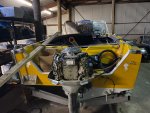
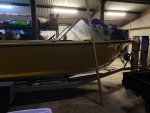
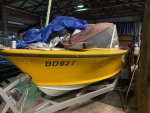
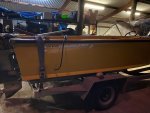
Thanks Bilgediver, as I mentioned this project is for a men's group to work on (in between playing games of pool and drinking coffee), so NO experts (and currently no surveyor!) The timber appears to have been hardwood but was rotten and mostly crumbly when removed. Sorry I don't have a make/model for the fiberglass body, perhaps if I can take few pics and post here, someone may be able to identify.
Is there a way to tell if the timber is structural or just placed as a former for the glass fiber?
Thanks
 
It is difficult to tell without seeing the design of the boat. Assume it is a V shaped planing hull form if it has a 115hp engine so the wood could be providing longitudinal strength. However it does not necessarily have to be hardwood. I was involved in building deep-V planing hulls many years ago and we used Douglas fir to stiffen the bottom if the keel.

Photos would definitely help. You upload jpeg files using the Attach files button at the bottom.
 
It is difficult to tell without seeing the design of the boat. Assume it is a V shaped planing hull form if it has a 115hp engine so the wood could be providing longitudinal strength. However it does not necessarily have to be hardwood. I was involved in building deep-V planing hulls many years ago and we used Douglas fir to stiffen the bottom if the keel.

Photos would definitely help. You upload jpeg files using the Attach files button at the bottom.
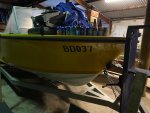
Thanks Tranona, I will take some photos when we next meet, meanwhile I have only the attached front view photo, probably not much good for identification purposes!
 

Attachments

  • IMG-20220201-WA0000.jpg
    IMG-20220201-WA0000.jpg
    122.9 KB · Views: 90
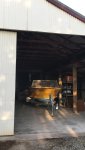
Just been sent these pics of the boat in question, hope they help to identify!
 

Attachments

  • IMG-20220518-WA0002.jpg
    IMG-20220518-WA0002.jpg
    131.2 KB · Views: 66
  • IMG-20220518-WA0006.jpg
    IMG-20220518-WA0006.jpg
    88.9 KB · Views: 67
  • IMG-20220518-WA0003.jpg
    IMG-20220518-WA0003.jpg
    113.8 KB · Views: 65
  • IMG-20220518-WA0004.jpg
    IMG-20220518-WA0004.jpg
    89.8 KB · Views: 67
  • IMG-20220518-WA0005.jpg
    IMG-20220518-WA0005.jpg
    95.2 KB · Views: 62
Is Dennis B in Australia? I only ask becuase of the characteristic registration number on the bow. Typical of thousands of this genre of boat in Oz. (and source of the majority of boating tragedies) As I intimated before you could not go wrong by over engineering the floor strength due to the pounding the hull gets when at speed. ol'will
 
Yes William in Australia. I think we will be replacing with timber. Probably laminate a couple lengths, glue with Sikaflex marine and weigh down until adhesive dries, then fibreglass over. Will use staggered scarf join where board lengths need to be joined. What do you think.
Thanks
 
Is Dennis B in Australia? I only ask becuase of the characteristic registration number on the bow. Typical of thousands of this genre of boat in Oz. (and source of the majority of boating tragedies) As I intimated before you could not go wrong by over engineering the floor strength due to the pounding the hull gets when at speed. ol'will
William, meant to ask the main reason for the tragedies you speak of with this boat type? The boat will be used on lakes, although I know that boat hulls can take a thumping even on lakes.
 
One trick when laying fibre glass cloth over the wood is to lay the cloth on the diagonal. ie the warp and weft cross the wood, and hence the sharp bends, at 45 degrees so more easily enabling the cloth to follow the bends. Use epoxy and paint first with wet epoxy then fill the inside bends with filler to minimise the turn angle of the glass. ol'will (in Perth)
 
I have a similar problem. with my Derben 3.8m runabout built in 1979. I replaced the transom 18 years ago and it is still fine. The floor was getting infirm toward the stern and two weeks ago this happened:
20230302_145345.jpg
Someone told I could bog it up with filler and glass over it once was completely dry. 2 weeks later it's still wet! Should I flip the boat and replace the keel?
 
Rotten transom
Had a near tragedy some years back when a guy bought a I think wooden run about outboard powered. The strain on the transom when towing with motor attached plus general strain in rough water caused total failurwe and boat sank quickly. Crew were in water many hours before being rescued. Check transom strength closely. ol'will
 
Yes William in Australia. I think we will be replacing with timber. Probably laminate a couple lengths, glue with Sikaflex marine and weigh down until adhesive dries, then fibreglass over. Will use staggered scarf join where board lengths need to be joined. What do you think.
Thanks
Did you remove all the keel? Was it difficult to remove? Derben used jarrah in their boats. I 'm concerned that, while the existing keel is rotten near the stern, it might be harder near the bow. How did your boat turnout?
 
Rotten transom
Had a near tragedy some years back when a guy bought a I think wooden run about outboard powered. The strain on the transom when towing with motor attached plus general strain in rough water caused total failurwe and boat sank quickly. Crew were in water many hours before being rescued. Check transom strength closely. ol'will
My transom is awesome, if I say so myself. Has ben solid as a rock for 18 years. The keel presents a different set of challenges like flipping the boat and digging it out.
 
Top