Robotic Sailing

What a fantastic idea. Apologies if this is covered in your video - I'm at 'work' so cannot watch all of it or listen to the audio:

I presume you've coded some kind of 'tactics' engine?
Is it totally GPS based or is it able to 'see' the mark? I imagine GPS is a bit 'course' for a scale model!
 
What a fantastic idea. Apologies if this is covered in your video - I'm at 'work' so cannot watch all of it or listen to the audio:

I presume you've coded some kind of 'tactics' engine?
Is it totally GPS based or is it able to 'see' the mark? I imagine GPS is a bit 'course' for a scale model!

Looks like the processing takes place on shore with an RF link to the boat.
 
What a fantastic idea. Apologies if this is covered in your video - I'm at 'work' so cannot watch all of it or listen to the audio:

I presume you've coded some kind of 'tactics' engine?
Is it totally GPS based or is it able to 'see' the mark? I imagine GPS is a bit 'course' for a scale model!
--------------------
Hi Ruffles,

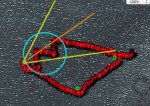
Thanks for your comment. It is totally GPS based. Precision is around 2 meters at the marks.

The tactics for going upwind is the following :
- tack when the boat reaches the lay line
- tack when the boat is too far away from the direct route (this avoids going too far from the course centre)
- tack after a certain amount of time on the same tack (to reposition to the center)

What I found is that going downwind it is better to steer to compass rather than the vane.
This is because the boat is rolling and apparent wind is light so the wind vane is making large swings can you can't fully compensate with filtering. Also going downwind, the sails don’t need to be as precisely tuned as upwind.
So yes, it can jib accidentally in wind shift but in fact it is relatively stable.

Upwind, the boat steers itself to the wind and is very reactive to any wind shift. It tacks when it reaches the lay line or if it spends more than a certain amount of time on one tack or if it is too far from the direct course. This is to avoid having only one long tack or obstacles.

Chris
 
Hi Angus,

No, it is totally autonomous. There is a XBee that sends back all the information on the boat, so that it can be analyzed later. The connection also allows to give the start and enter the buoys coordinates, as well as entering the parameters for the boat (optimum wind angle, filtering of bearing, wind angle, ...).
When it starts, it does does the course alone until the arrival, and then it waits by going about.
The tuning of the boat is quite important, like for real boats, you need to spend a lot of time on the water to have a boat that runs well.
 
Top