Restoring teak veneer

If all goes wrong I will try the 1.5mm if it is available in teak, but by then a new table will becoming a cheaper option !

Once it is on, secure and trimmed I have solid teak fiddles around the edges which do provide effective edge protection.

For the routing I would use a laminate trimmer (with the small roller bearing on) and will cut towards the direction where the cutter blade is turning away from the edge, so it doesn't pull into the veneer.

I asked the supplier about edge trim or top first and they suggest top first, but my concern is that the raw edge lip of the edging strip will stand out when looking down at the table, whereas if I edge trim first the raw edge will be the outward edge of the top horizontally and away from the eyeline. Opinions please.
 
I suspect that trimming the top first gives more protection during everyday use. Having the top overlapping the edge could well lead to its being torn off by people leaving the table. I used a thicker piece of hardwood, about 4 mm, to give good edge protection.
 
If veneering both edges and top of table leaf, I would trim edges first before fitting top surface veneer. Then when you trim the top, the top face masks the edges thereby protecting them from being ripped off if you were to draw something from the middle of the table out over the edges.

However if you are fitting fiddles to the outside edges of the table, I would still do the same because where the fiddles stop short of the corners to allow for crumb removal and cleaning, it will still stop the edges from being ripped off with the cleaning cloth as the exposed edges will be protected by the top veneer.


Only my opinion of course.
 
Veneer arrived during the week, so this weekend's project has been to affix it.

1 I decided to ignore advice to affix the top surfaces first and I am glad I did.

2 Removed by rough sanding the edge trim on the butting hinge edges.

3 Cut the individual sections just oversize for the main top and side flap tops.

4 Used the excess to trim the end and hinge flap edges.

5 Affixed by ironing the side edges to all three parts. After ironing left to cool for 2 hours before trimming the excess with a fresh bladed Stanley knife.

6 Trimmed each edge to approx 0.5mm then used well worn sandpaper on a block to hone each edge flat with the adjacent top surface. I discovered a few glue voids, so re-ironed these as I found them.

7 Affixed the top edge. The main part required two pieces, so I applied the wider first just on one edge then affixed the narrower piece being careful to hold the abutted edge up close. Left to cool for 2 hours, then finished affixing the wider piece.

8 This morning the two butted pieces had moved apart in places up to 1mm. Also some bubble lifts had occurred here and there. I re- ironed the bubbles and tried to re-iron and push back the narrower piece, but this made the gap increase. The bubbles settled fine.

9 To deal with the gap I applied some Brummer wood filler / stopping to the small gap.

10 Trimmed the top edge and rubbed the last 0.5 mm. The excess adhesive forms a small white bead, but as you rub down with very tired 240 grit sandpaper the excess glue disappears leaving a glue line virtually indiscernible from the grain, and on the edge.

11 I am now commencing the varnish phase with Epiphanes Teak varnish. This will be 2 or 3 coats 25%, same 50%, light rub, then 2-3 at 75%, each with a light rub of 600 grit, then 2 coats 90%, again each with a rub. The last two may go on neat as long as the temperature remains above 10c.

The finish looked spectacular whilst the first coat of 25% was still wet.

Can't wait for the finished job but may take a couple of weeks.
 
For those with larger areas to veneer, you can purchase a similar product to Formica which is a plastic sheet ( thinner than formica) but faced with a proper wood veneer( not plastic) . Sheet size ( from memory) 8ft * 4ft
It saves all the problems matching veneers & can be stuck down in one go with PVA if held under pressure & can be slid into place , or contact adhesive if you can place it in the correct place in one go
When I had a joinery business some years ago we regularly used it for site work where on site veneering was difficult.
Obtained from C F Anderson at Marks Tey Essex
 
I will try to load some photos when it's done.

I re-covered the wheel house deck boards on my last boat using a laminate wood effect with holly inlay. I used west system epoxy to mount that, and had the individual pieces all aligned on the holly strips, so it looked like one deck board with cuts in.

I bought that stuff from Hawk House.
 
If fitting more than one piece of veneer to a surface. Carefully stick them all together first using brown paper tape (the kind you lick). This stops the bits moving apart and is not affected by the heat of the iron. Also works for any end cracks in the veneer.
 
If fitting more than one piece of veneer to a surface. Carefully stick them all together first using brown paper tape (the kind you lick). This stops the bits moving apart and is not affected by the heat of the iron. Also works for any end cracks in the veneer.

This is what we used to use 20+ years ago for hand veneering and is still good advice today. Because it is wet when applied, as it dries it shrinks pulling the veneer joints together asuming they were shot with a plane straight beforehand. Now these days joinery firms use what is called a hand veneer stitcher which pulls the veneers together and lays a hot fine sting across the joints. This is why when you sand through veneers these days you see a zig zag type patten where the veneer leaves were jointed.

Another plus for gumed paper is, you can use a sponge and water to remove it once the veneer leaf is glued down. (as long as the glue you have used is waterproof, we used to use hot pot fish glue back in the day)

That seems an age ago.

Now these days I use evostik from a 5ltr can with a fine toothed spatular, trick is to get a fine even coat on quickly then second coat when touch dry, never ever had any problems.
 
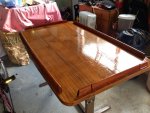
The finished result, after about 10 coats of progressively thicker (less thinned) varnish - Epithanes teak.

Letting it stand at home for a few weeks to harden off.

image.jpg
 
Pity how the brush maks show up in the end of the reflected light

Give it a week or so to harden up then lightly sand with very fine wet and dry on a backing pad. (Use it wet.) Go up grades starting at 400 and finishing at 1000. Then buff up in the same way you would buff up a hull.
This will get rid of the brush marks. How much buffing you do will effect the final finish. Silky sheen to high gloss.
 
Tromploy

I come to this thread late just for reference there are quitalot of different stains depending on the varnish used there is nearly always a stain that will mix with the varnish upto about 20 % . With a couple of colours or so, small areas of sanded through veneer can be touch up with tinted vanish left to dry then overcoated with clear . A light touch and careful matching can effect unnoticeable repairs. It is called tromploy in its most complex form.

http://en.wikipedia.org/wiki/Trompe-l'œil

It can also be done with earth colours mixed in with local application of varnish to the area needing repair

the repair can be invisible in small areas
 
Top